Economy
In Nasarawa, Multiple Levies Threaten Keke Operators’ Livelihoods
Muhammad estimated that the daily payments alone cost him more than ₦300,000 a year, excluding registration, union membership and sticker fees.
 By Hafsat Salihu
19 November 2026 · 8 minute read
Listen to this report
AI narration · about 12 minutes
 Quick brief
- Preparing the summary…
AI-generated from the story.
It is a busy morning in Lafia, automobile horns and engine roars fill the air. Tricycle operators drive through traffic, picking up passengers and dropping them off at every junction. For many of these riders, the day begins with the hope of making enough money to take care of their families. But every community they enter demands payments, making the search for passengers a costly routine.
Yusuf Isyaka has spent 13 years operating a tricycle in Lafia, popularly known as Keke Napep. As a rider who drives Keke owned by someone else, he pays the owner ₦6,000 every day, regardless of the amount he earns. On a good day, Yusuf makes about ₦10,000 to ₦11,000, from which he deducts the owner’s ₦6,000 daily fee and buys fuel to keep the Keke running. Yet, he still pays a daily levy of about ₦1,400 to the Tricycle Owners Association of Nigeria (TOAN), leaving him with just ₦2,600 left to feed himself and take care of his family.
Limiting his operation to one or two communities is not an easy solution either, as he says he would struggle to earn enough to pay the daily ₦6,000 balance for the tricycle. So in a day, he says, he operates within five communities, namely, Agyaragu, Shabu, Adogi, Assankio and Lafia town, and pays ₦200 for each community he enters in search of passengers. This excludes a separate ₦200 he pays to the local government ticket and another ₦200 to the tricycle owners’ union.
Yusuf Isyaka has spent 13 years operating a tricycle in Lafia, popularly known as Keke Napep. As a rider who drives Keke owned by someone else, he pays the owner ₦6,000 every day, regardless of the amount he earns.
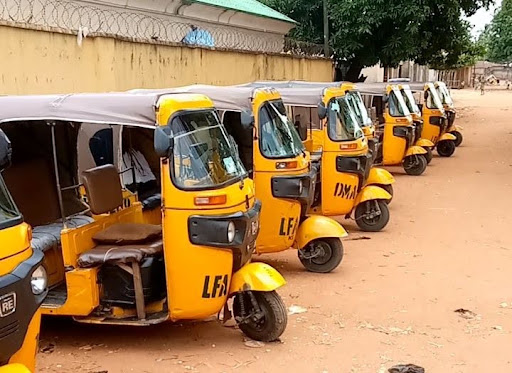
Interviews with several tricycle operators in Lafia revealed that daily levies vary depending on the communities they enter in search of passengers. Some said they pay ₦400 a day, while others pay ₦600, ₦1,000, ₦1,400 or as much as ₦2,000. The differences reflect the additional costs operators face when they travel across multiple communities to find passengers. These daily payments burden many riders, particularly those who say they have little control over how much they earn.
Abubakar Shehu, who has operated in Lafia for 18 years, said his daily levies depend on the number of communities he enters. From experience, he says, a new Keke can cost up to ₦4 million and would last roughly a year before developing faults. During this period, operators spend money on fuel and repairs while trying to earn enough to support themselves and their families.
“If I’m to operate across Lafia, my daily payments can reach ₦2,000, while staying within Lafia costs ₦400 for the local government and union tickets,” Shehu says. “These charges come on top of the cost of keeping the tricycle in good condition. This is the reason many operators cannot afford to buy their own tricycles because of the high cost. They operate Keke belonging to other people and pay an agreed amount to the owners daily.”
Where Is the Money?
Salisu Muhammad, an operator in Lafia, sometimes spends up to ₦1,400 a day on levies. Salisu questioned what Keke riders receive in return for the money they pay. He says when a rider faces a problem, assistance usually comes from other riders who voluntarily contribute to help.
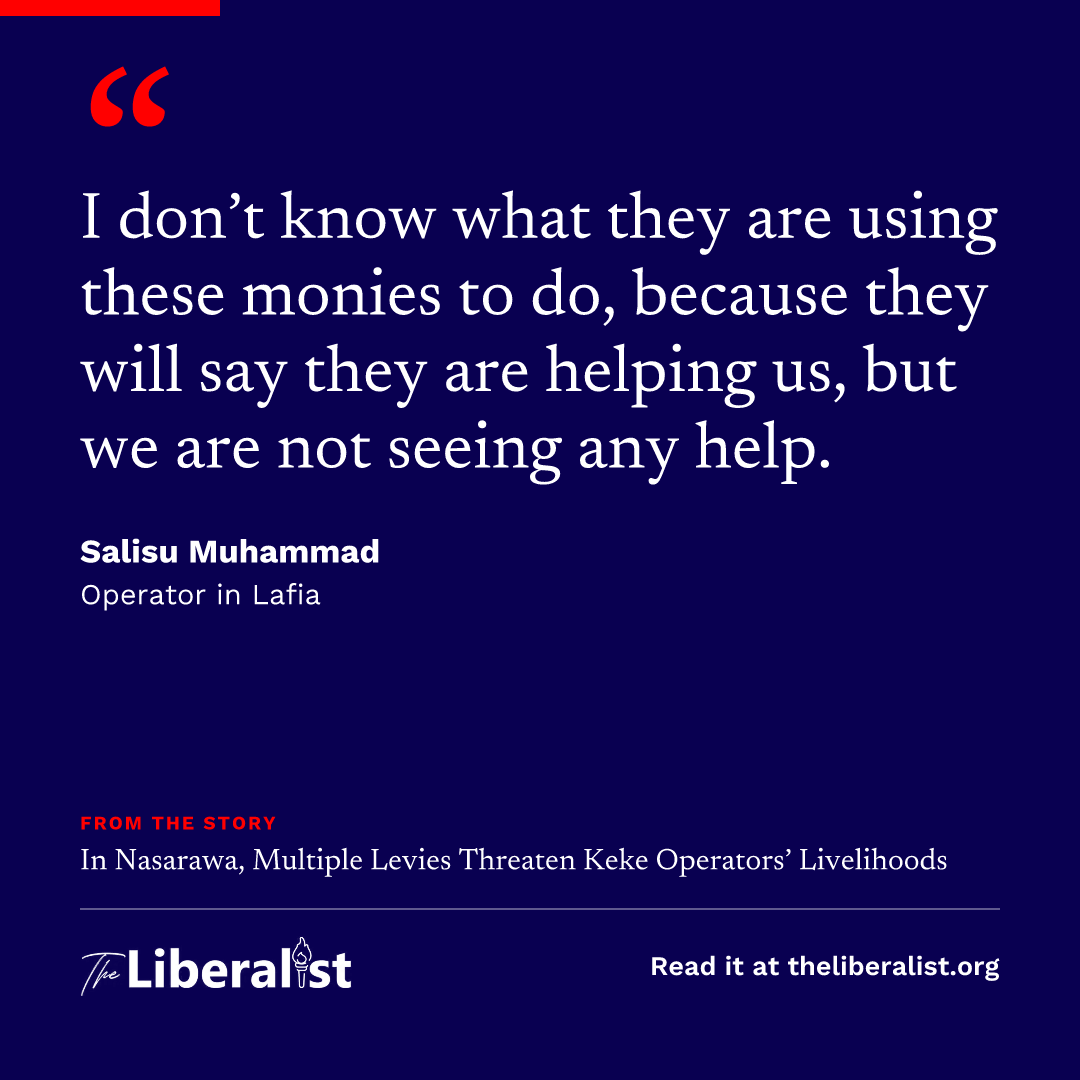
“I don’t know what they are using these monies to do, because they will say they are helping us, but we are not seeing any help,” says Muhammad.
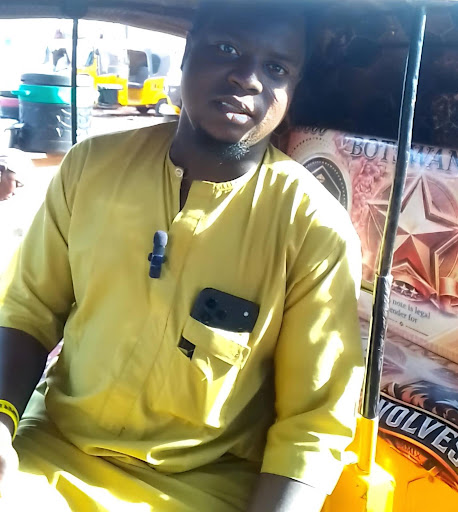
Muhammad recalled entering the Agyaragu community one Friday afternoon to visit someone, without carrying any passengers because he was in a hurry. The task force stopped him and demanded a ₦1,500 fine, even after he explained why he was there. When he refused to pay, they removed his key, and an argument followed. Other riders intervened and pleaded on his behalf, and he eventually paid ₦1,000. But it did not end there.
When he wanted to leave, he said the task force officer thought he wanted to run away and attacked him with a big stick, aiming for his head.
“God saved me that I blocked it with my hand,,” Muhammad says while narrating his experience to The Liberalist. “I suffered a dislocation in the arm and stayed at home for a month and three weeks while recovering from the injury but received no assistance from the union or anyone else.”
I don’t know what they are using these monies to do, because they will say they are helping us, but we are not seeing any help.
Muhammad estimated that the daily payments alone cost him more than ₦300,000 a year, excluding registration, union membership and sticker fees.
While small business owners like Keke riders struggle amid multiple levies in Nasarawa, the state government announced steps to harmonise revenue collection across the state and its local government areas. In February 2025, the Nasarawa Broadcasting Service reported that the Nasarawa State Internal Revenue Service (NIRS) planned to introduce electronic ticketing for transport unions to improve revenue collection. The system was scheduled to begin on 10th February 2025, covering transport daily tolls, park or terminal tolls, and e-manifest payments. Manual and electronic collections were expected to run together during a transition period ending in March 2025. However, the announcement did not establish whether the system had been fully implemented in the state, particularly for Keke operators.
The Liberalist visited the headquarters of the Nasarawa State Internal Revenue Service (NIRS) in October for clarification on the implementation of the policy and subsequent further enquiries. However, officials refused to grant an audience for the interview. The reporter was directed to a particular office after she explained her purpose of visit. But the official she met at the office declined to grant an audience, saying she was unavailable for both physical and even a virtual interview.
Beyond Daily Payments
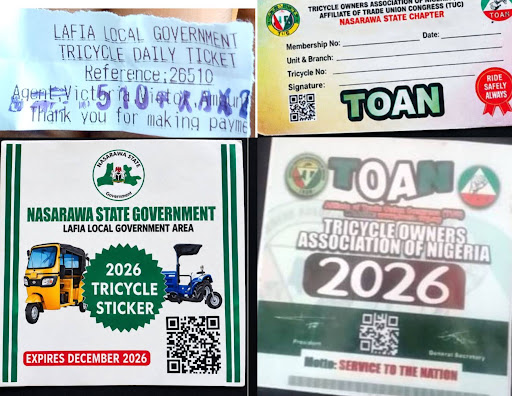
Beyond the daily tickets, Keke riders also pay several fees to continue operating. The Liberalist gathered that operators pay ₦5,000 for local government registration and another ₦5,000 for union membership. They also pay for stickers, including ₦3,000 for the local government sticker, ₦3,000 for the union sticker as well as ₦2,500 for identification cards issued by both bodies. In addition, riders pay for a body number, although the amount varies in their accounts. Some said they paid ₦5,000, while others reported paying ₦5,700.
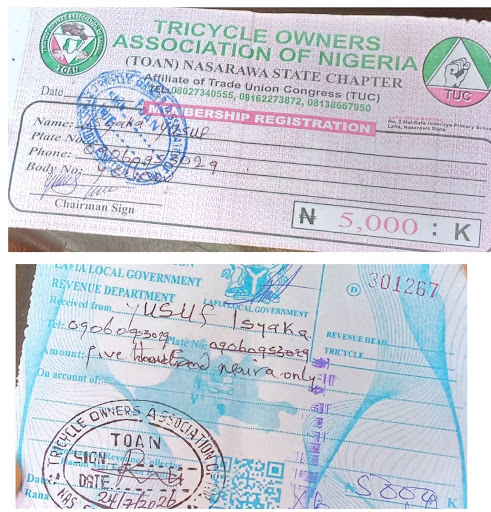
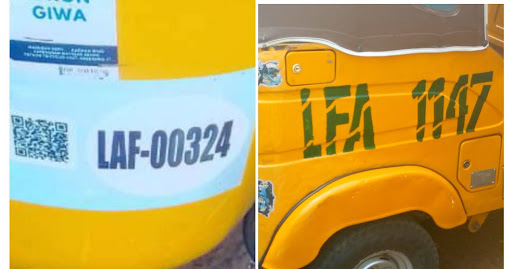
The identification number was previously transferable to another tricycle, meaning operators could move it to a new Keke if they changed vehicle. But this is no longer applicable. More worrisome, authorites have now subjected the identification number to an annual renewal process. Riders said they paid ₦10,000 for the identification number last year and were asked to pay ₦5,700 this year during renewal
Abdullahi Galadima, chairman of the Tricycle Owners Association of Nigeria (TOAN) in Nasarawa, said the payments collected from Keke operators cover different obligations to the union, local government and communities. He explained that although the union collects the money, not all of it belongs to the union, as some payments are handed over to the local government.
He explained that the union collects ₦200 daily from each operator, alongside an annual registration fee of ₦5,000 and a sticker fee of ₦3,000. The local government collects the same amounts for registration and stickers, as well as a ₦200 daily ticket. Operators also pay ₦2,500 for an identification card to both the union and the local government.
“The association works with the government to enforce payment through a task force that operates in different communities, usually from around noon. Operators who fail to produce receipts for the required payments may be fined, depending on the charges they have not paid,” he told The Liberalist.
He added that identification number fees are collected by the local government, not the union. However, he could not provide further clarification on why operators were asked to pay for body number renewals or how the charges were determined. Galadima said the daily tickets collected from operators are among the funds the union uses to assist members who face difficulties, including those involved in accidents or dealing with illness. He explained that operators who need help are expected to write to their unit chairman to request assistance.
Nasarawa state has at least 10,000 registered tricycle operators, according to Galadima. While The Liberalist could not independently verify this figure, research indicates that Mararaba and Karu local government areas alone have an estimated 23,000 tricycle operators working along the corridor.
Operators may pass these additional costs on to passengers through higher transport fares, increasing transportation costs for residents and putting further pressure on household incomes.
TOAN chairman Galadima admitted that the union collects ₦200 daily from each operator, alongside another ₦200 on behalf of the local government. This brings the daily collection to at least ₦400 per operator. Based on the 10,000 registered operators, TOAN and the local government could be collecting a combined ₦4 million daily.
Despite this revenue, some riders interviewed by The Liberalist said they had received no support from the union, and only relied on contributions from fellow operators when they needed help. When confronted with this finding, Galadima responded that the riders in question might not have written a letter to the association.
The Economic Effect
Speaking with The Liberalist, Elijah Iheme Uzoma, an economic expert, stated that multiple levies increase the operating costs of small businesses, reducing their profit margins and threatening their sustainability. He explained that when the cost of running a business becomes too high, some operators may be forced to shut down, reducing economic activity of the area.
“Operators may pass these additional costs on to passengers through higher transport fares, increasing transportation costs for residents and putting further pressure on household incomes,” he added.
The effects of multiple taxation and levies extend beyond the daily earnings of individual operators. A 2026 study involving 384 owners and managers of small and medium-sized businesses across six states in North-Central Nigeria found that multiple taxation had a significant negative effect on business performance. The researchers also found that a higher tax burden was associated with poorer business performance, highlighting the financial pressure that multiple tax demands can place on businesses. The study recommended harmonising overlapping levies and strengthening tax administration in states including Nasarawa and Benue.
If all these changes are not effected, Yusuf, the Keke rider in Lafia, says the impact could mean the loss of his livelihood and the livelihoods of hundreds of keke riders in the state.
“When you are given Keke by someone to deliver ₦6,000 every day,” says Isyaka, “regardless of your earnings or levies you pay, if you don’t pay the owner, the keke will be collected from you and given to another person.”
_________________
This story was produced under the Accountability Reporting Project on Bureaucratic Barriers to Businesses in Nigeria, supported by the Ominira Initiative Freedom Fund.
Follow to get an email when we publish
Get The Liberalist Weekly
Every story we published this week, in your inbox each Friday. Free.
Share this story
About the author
Hafsat Salihu
Contributor
Hafsat Salihu is a Contributor at The Liberalist.
More from HafsatReporting like this takes time on the ground. Help keep it going.
Donate