
Letters of Reasoning
Telecommunication: Reminiscing the Nigeria’s Privatisation Success Story
Even though the prospect of privatisation is saving the villagers from mockery, unavoidably exorbitant travel expenses, vulnerability to phone conversations, and the boost in their standard of living, Adekanbi village is oblivious to the policies that brought about this unprecedented growth in their lives. It is the privatisation.

Listen to this report
AI narration · about 3 minutes
 Quick brief
- Privatisation and deregulation of Nigeria's telecommunications sector since 1992 have improved access, exemplified by MTN extending services to Adekanbi village in Oyo State in 2022, enhancing local connectivity.
- NITEL, formerly government-controlled and monopolistic, served only 30,000 subscribers in 2000, but after privatisation, Nigeria's phone subscribers exceeded 200 million, showing sector growth.
- The government sold 75 percent of NITEL to Transcorp and 25 percent to other Nigerian companies, leading to infrastructure upgrades and improved communication benefiting Nigeria's economy and technology industry.
AI-generated from the story.
Share the summary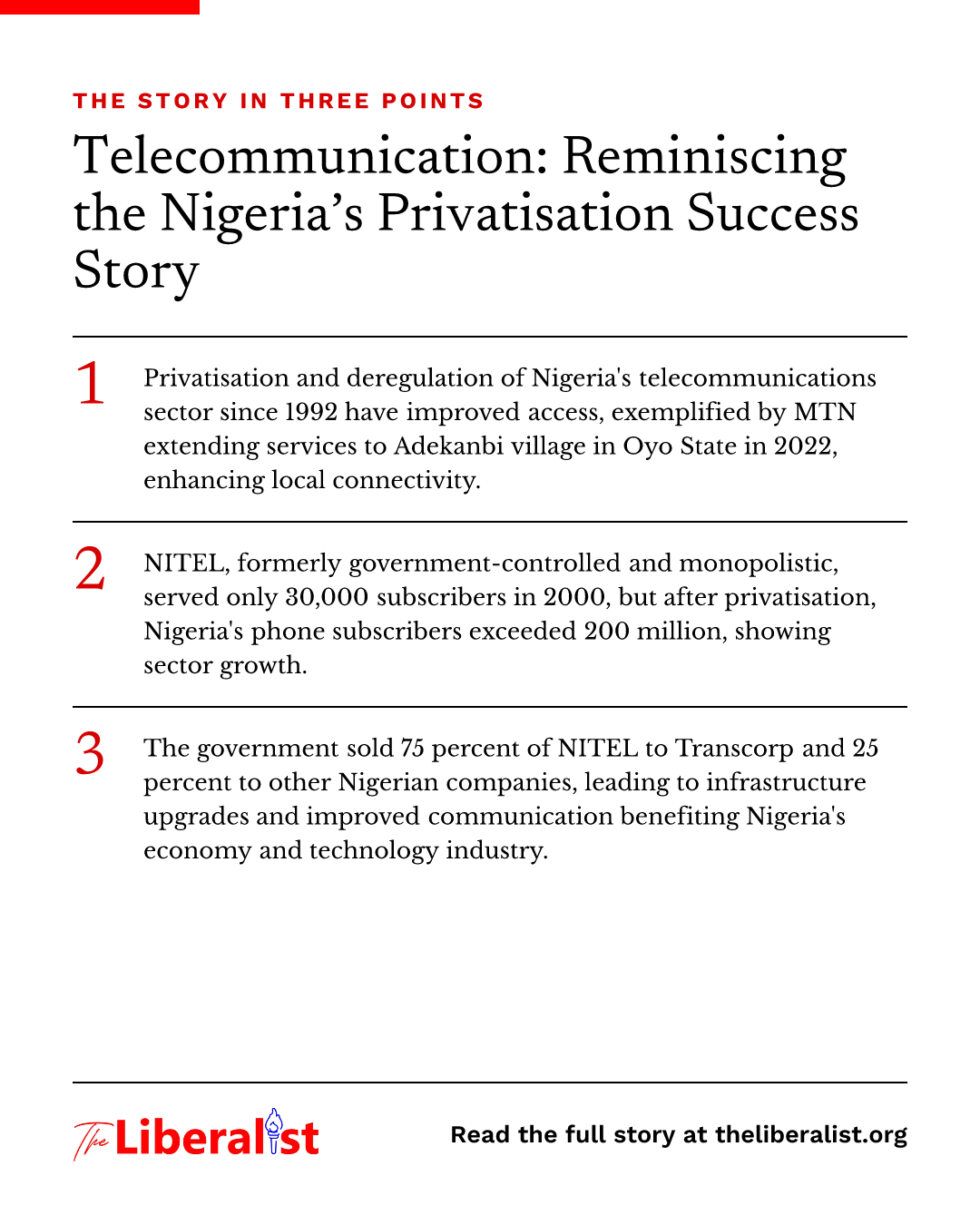
Dear Advocate of Reasoning,
Privatisation serves a major role in the development of a country. And Nigeria’s telecommunications industry is a living testimony. The deregulation of the sector that started as far back as 1992 has caused development in some areas of the country, one of them is the Adekanbi village in Oyo State
The people of Adekanbi village, under the leadership of Baale Akande (the village head), have witnessed rapid growth in telecommunications accessibility after a private telecommunications company, MTN, extended its service to the village in 2022. The extension is part of the impacts of the deregulation of the telecommunications sector and privatisation of NITEL that started in 1992.
Adekanbi, a village whose residents suffered from monotonous service poverty now enjoys unhindered telecommunication access. Although villagers find it hard to reach some neighbouring communities, the service extension has its impact on Adekanbi village. To the villagers, the feeling of talking to people in the cities and other villages from the comfort of their rooms is like being in Adam’s garden, with everything within their reach.
Even though the prospect of privatisation is saving the villagers from mockery, unavoidably exorbitant travel expenses, vulnerability to phone conversations, and the boost in their standard of living, Adekanbi village is oblivious to the policies that brought about this unprecedented growth in their lives.
In the 80s, Nigerian Telecommunications Limited, NITEL, used to be the major telecommunications service provider in Nigeria, solely controlled by the Nigerian government, and giving Nigerians limited opportunities for telecommunications. At the time, the monopolistic nature of the telecommunications sector was culpable for the regression of technology in Nigeria. The slow development in this sector caused the government to adopt the privatisation scheme which has since propelled development.
The government took the bold move and sold off 75 percent to a Nigerian multinational corporation, Transcorp, and 25 percent to different Nigerian companies. In the year 2000, NITEL served only 30,000 phone subscribers but today, Nigeria’s phone subscribers crossed above 200 million, an attestation to the success of privatisation in fostering growth and accessibility in the telecommunication sector. Equitably, growth in the telecommunications sector contributes to the fostering growth in the country’s technology industry.
The immense growth the deregulation contributed to the Nigeria’s economy cannot be quantified. Aside from the upgrade in infrastructure, efficient communication is an added flavour to the business environment of the people.
To delve deeper, read the story: Oyo Villages Enjoying Prosperous Privatization in Telecommunication Sector.
Stay free and keep reasoning.
Follow to get an email when we publish
Get The Liberalist Weekly
Every story we published this week, in your inbox each Friday. Free.
Share this story
About the author
The Liberalist
Reporting and analysis from The Liberalist newsroom, a pro-freedom publication covering human rights, civil liberties and economic freedom across Africa.
More from The LiberalistReporting like this takes time on the ground. Help keep it going.
Donate