
Opinion
When Protecting People Becomes Policing Ideas
Policing thought. And the best way to police thought is to control or restrict free speech.
Listen to this report
AI narration · about 8 minutes
 Quick brief
- Preparing the summary…
AI-generated from the story.
The pursuit of freedom appears to be an obvious concept–almost redundant, much as the concept of murder or slavery being an affront to morality is. And perhaps that’s where one of the problems exists when we consider society’s understanding of rules and regulations in their contemporary form.
Most people make comfortable assumptions, differentiating “slavery” from “taxes” and “murder” from “policing”; the commonality being that the former’s righteousness is determined by an individual while the latter is determined by the government.
A related assumption we make is the distinction between the “government” and “individuals”: the government isn’t some meticulous, static, all-seeing entity that resides in some abstract cloud – the government, in almost all modern forms, is a constantly evolving set of rules and doctrines whose central purpose is to dictate how the resources of individuals are handled. And this determination is made, most often, by very small groups of partisan individuals.
Of course most individuals that seek roles in government do it for money and power. Of course when they propose or vote for or against laws, they do so with a heavy bias towards what benefits their own partisan interests maximally.
The final assumption in this dance is that these small groups of individuals, somehow, unlike everyone we know, are not self-interested despite being highly partisan. Kings are self-interested. Your neighbor is self-interested. You are self-interested. But the elected (or assigned) individuals are not. Otherwise, how could they have attained the positions they have?
Like most things, when we bravely challenge our own comfortable assumptions, we begin to uncover an underside that is much darker than we were originally conscious of. Of course most individuals that seek roles in government do it for money and power. Of course when they propose or vote for or against laws, they do so with a heavy bias towards what benefits their own partisan interests maximally. And, of course, when self-interested individuals create rules that dictate what you can and cannot do with our own resources, they are not likely to lose sleep over doing things that benefit them and hinder you.
How best to accomplish this? If the populace is told a politician is stealing from them, they will oppose it. And this is not advantageous for a self-interested politician. In fact, they would ideally prefer a populace that not only wasn’t opposed, but supported their impositions, and even better, fought for them!
And now we come to the actuation of almost all slippery slopes in nearly every authority in history that claimed to be “for the people”: safety. Scare the populace, offer a remedy, and they will hand over their freedom.
Look at speeding fines. In Australia, speeding fine revenue has gone from $120M/year to $1.2B/year (a nearly 1000 percent increase) in the same time the population has increased by 50 percent. The narrative is, speed kills – we are protecting you by punishing “dangerous” drivers. However, deaths during this period have only reduced by 33 percent, and this is almost completely attributable to the improvements of airbags, electronic stability control, and crumple zones in vehicles – not seatbelts, not speeding, not DWI stops.
Individuals in the government now take in approximately $70/year for each driver in Australia as another “tax” in the form of speeding fines that offers no improvement to safety – however, that’s the narrative, and it’s heavily supported by the majority.
And as soon as we, as citizens, make another comfortable assumption about this money going somewhere useful, we must revert to our previous conclusion: those that work in the government are self-interested individuals. The more money that comes in from the populace, the more these individuals can decide what is done with it – whether that means increasing their wages, distributing the funds to organisations or individuals that they are in bed with, or using those funds to further their partisan agendas.
Money is power–it allows one individual to control another individual, as money is directly related to necessity–food, safety, shelter. Therefore, by these very definitions, the moment a government agency takes money from an individual, they are extracting the currency of survival.
Let us move, now, to the next step – political adaptation. Policing requires individuals to drive and speed. That isn’t dependable. What’s a more effective way of extracting maximal control out of individuals?
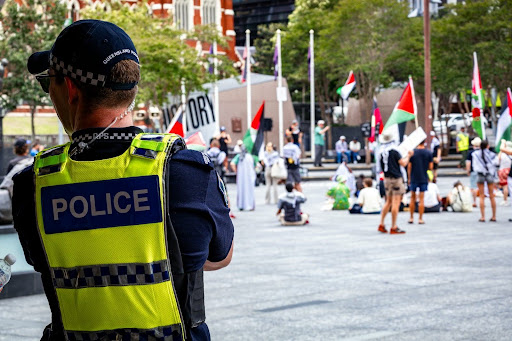
Policing thought. And the best way to police thought is to govern free speech. Now, government employees no longer require drivers to speed. All they need to do is create a narrative of a lack of safety surrounding thoughts – not popular ones, as that could trigger the populace to rebel. They begin with ideas that the populace could believe is dangerous because these ideas are generally unpopular. In doing so, they can fine, jail, arrest, and silence individuals for contemplating these ideas. This allows government individuals to extract control out of fringe groups that have little political clout.
The only rule the government has to follow is to never silence a large majority, as that could create upheaval. It must always target a group the majority is likely to support, and do it over and over again, shaving off larger and larger groups, until there is a relatively docile, compliant central majority that does not think outside the box. Those that comply are no danger, as control can be extracted out of them whenever needed because they have demonstrated a propensity to be fearful for their safety, think in predictable, simplistic manners, and relinquish their and the freedom of others for governmental safety measures.
This is a terrifying reality. It seems almost fictional. But as technology has expanded ever so quickly in even the last five years, are we not seeing parallels everywhere? AI-driven traffic cameras now provide unnamed government individuals access directly into your vehicles – pictures of you, your children, and your families are being taken a hundred times a day and are accessed by individuals you will never meet.
Nearly every new car is now connected to a global relay, tracking your movements, speed, and location. All of this is done in the name of safety. But as we established, physical barriers are only the beginning. Once they are in place as aggressively as possible, then the policing of ideas takes shape, as that is the most effective way of extracting control and resources out of the populace. The technology we are now allowing the government to impose on us in the name of safety is forming a fully enclosed system, whereby should you share something the government deems damaging to the greater whole, through the flick of a button, your vehicle could suddenly shut off; your Internet could cease to operate; your access to your bank accounts could be restricted; you could be jailed, or fined, and your currency to survive moved into their control.
We are now entering an era when allowing the government to dictate even the smallest part of your life is just a digital step away from dictating whether you can feed your family or not. And we must remind ourselves that those who control that button are self-interested individuals – not some altruistic abstraction. It is akin to your unnamed neighbour being able to prevent you from feeding your children because you said a word they do not like.
Follow to get an email when we publish
Get The Liberalist Weekly
Every story we published this week, in your inbox each Friday. Free.
Share this story
About the author
Robin Murarka
Robin is an Australian novelist and essayist whose work explores individual liberty and moral questions. More from him here: https://robinmurarka.com/
More from RobinReporting like this takes time on the ground. Help keep it going.
Donate