
This story was supported by the Pulitzer Center.
_________
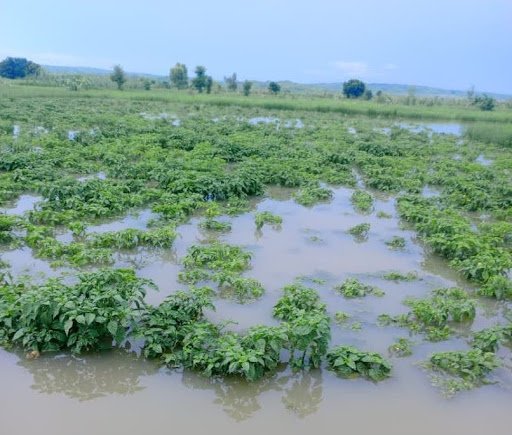
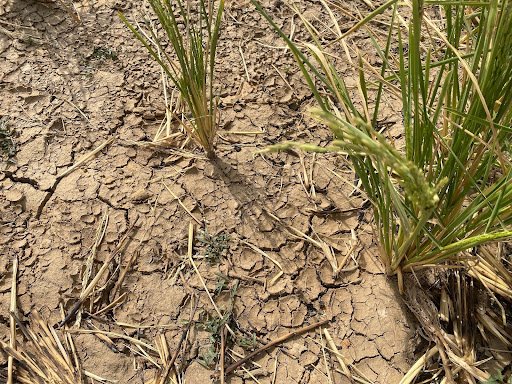
It was December 2025, Ibrahim Jingilma, 70, rested his old, rusted hoe on his shoulder as he walked home from his rice field after an early morning of weeding. He had been clearing dried rice straw, preparing the land for another planting season, even as grief followed him back from the farm. Months earlier, floods had swept through their fields in Shinaka, Goronyo Local Government Area of Sokoto state in northwest Nigeria. During the chaos, his son was killed after drinking from a contaminated stream while taking part in a dredging effort.
Jingilma’s story reflects the fate of at least 249 other farmers in Shinaka whose investments were washed away by flooding, after a year marked by delayed rains and prolonged dry spells that weakened crops before the floods arrived.
Like Jingilma, many large- and small-scale rice producers have been plunged into poverty. For many years, their planting calendars have repeatedly failed, creating a pattern of loss that has steadily eroded their resources from gradual depletion to complete ruin. Rice farmers recount what an ideal seasonal calendar looks like. In the 1990s, rice planted in March matured within four months and should be harvested by July, before heavy rains intensify.
“If you plant your rice in March, by July you harvest. You would not experience the flood,” explained Jingilma. “But once you plant in June or July, you won’t harvest until September or October, and before then the water has come.”
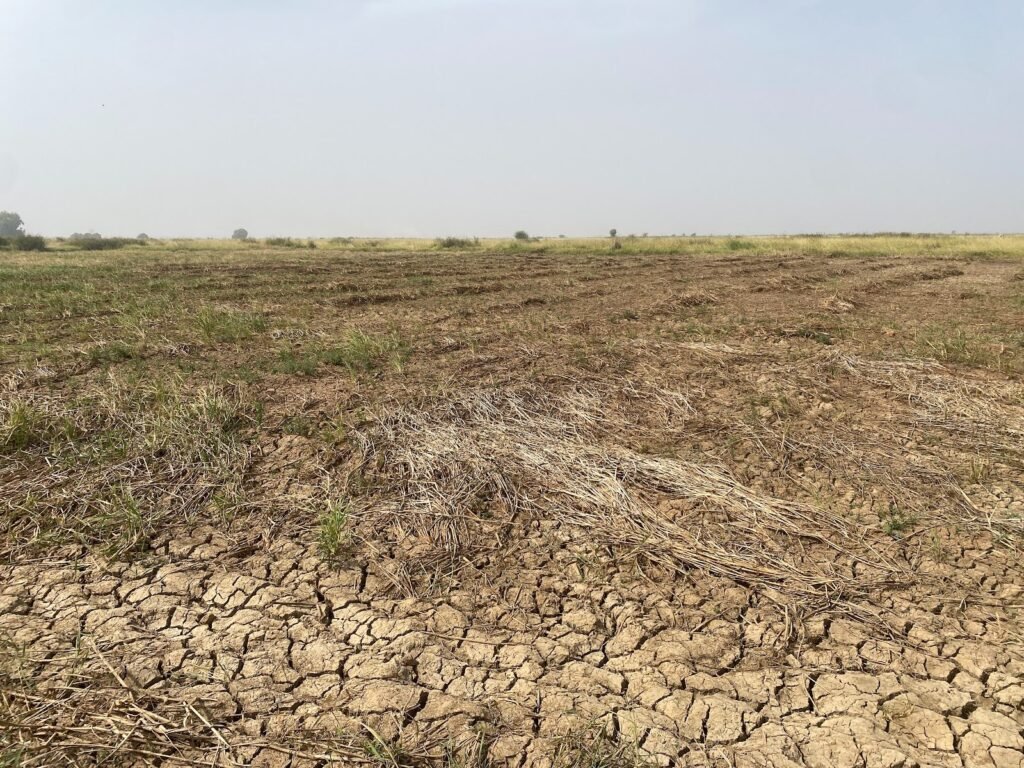
These are traditional planting cycles that many farmers have long relied upon. However, delayed rainfall and prolonged dry spells have rendered them increasingly unreliable, leading to significant yield losses.
Jingilma and many other farmers in his community say they have never heard of any agency called NiMet, nor have they received climate advisories directly or through their leadership, including rice farmers’ associations. The only federal agency they recognise is the National Emergency Management Agency (NEMA), which visited the community after devastating floods to document victims and promise support. Yet the promised assistance has been slow to materialise, leaving many waiting indefinitely for relief.
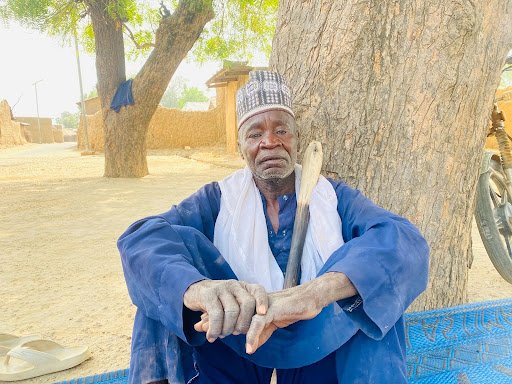
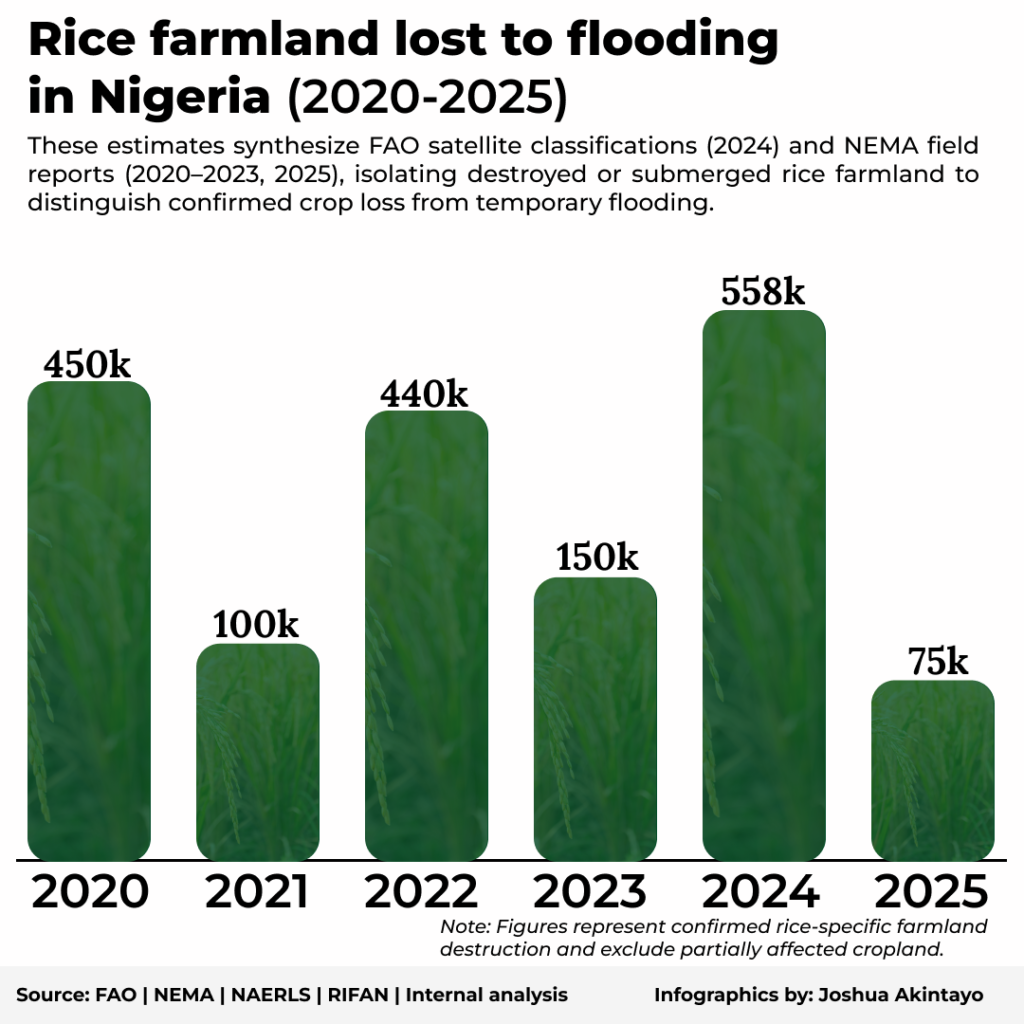
In 2025, Jingilma invested ₦5 million (approximately $3,600) to cultivate six hectares of rice fields: three owned by him and three belonging to his children. A significant portion of this investment was financed through loans. In early September 2025, floodwaters swept through the fields and destroyed everything, repeating the disaster he had suffered the previous year.
He describes the loss as life-threatening, an incident that transformed his status from a farm owner who employed labourers to someone forced to work as a labourer on other people’s farms just to survive and begin repaying his debts.
Labour In Vain
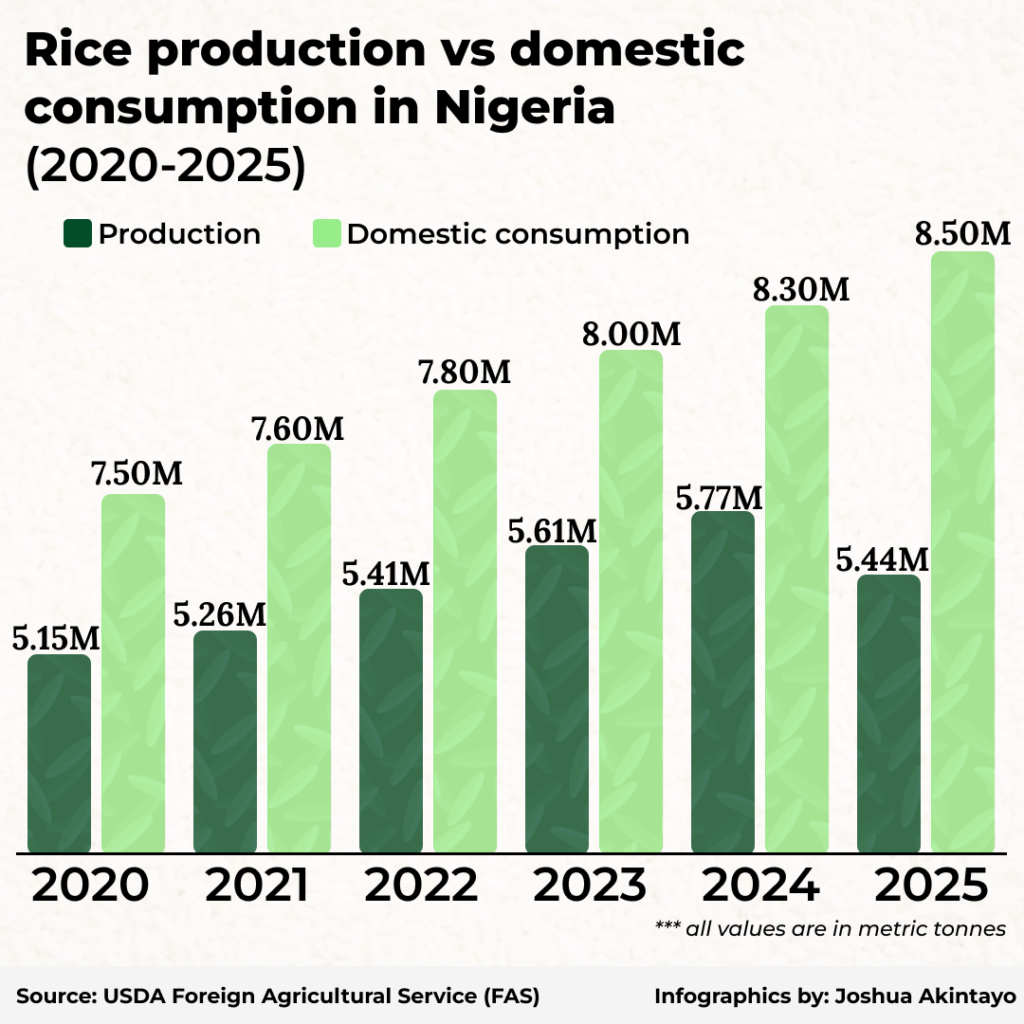
Data shows that Nigeria’s rice output declined to 5.23 million tonnes in the 2024/2025 season, the lowest level recorded in four years. Even in previous years, domestic production has consistently fallen short of national demands, despite the vast scale of farming activities across the country.
A recent report by an independent research institute, PeacePro, estimates that farmers have lost approximately ₦5 trillion (about $4 billion) over the past two farming seasons. The losses were attributed largely to missed or inaccurate meteorological forecasts, a responsibility assigned to the Nigerian Meteorological Agency (NiMet). In 2025, NiMet was allocated about ₦9.82 billion in the federal budget to support its operations, including the dissemination of climate information nationwide. However, in 2026, the agency reportedly struggled to defend its budget before the National Assembly, with members of the budget defence committee recommending its exclusion from portions of the capital budget.
Despite billions of naira allocated for climate services, farmers are unaware of the agency’s existence. This disconnect raises a serious question about accountability within Nigeria’s early warning architecture.
Forecasts Exist, But Don’t Reach Farmers
Ibrahim Abubakar, Chairperson of the Rice Innovation Centre established by AfricaRice and Chairman of the Gada/Goronyo Farmers Management and Delivery Centre, describes the challenges facing farmers in Sokoto as multi-layered. While acknowledging broader systemic problems, he noted that NiMet has never directly engaged with farmers in his network.
Beyond the issue of advisory delivery, Abubakar pointed to structural challenges linked to the Goronyo Dam, managed under the Rima Basin Development Authority. The dam, with a capacity of 947 million cubic metres, is located in eastern Sokoto and supplies irrigation channels across Gada, Goronyo, and Sabon Birni Local Government Areas, extending into parts of Kebbi and Zamfara states. While it serves as a critical irrigation source, with farmers paying fees for regulated water release, it also has a history of emergency discharges that have submerged farmlands. In 2025 alone, more than 600 hectares of rice fields were flooded following water releases in a sector of Goronyo, according to locals.
“Whenever management learns that the water reaches a certain level, they don’t have any other option than to release it,” Abubakar said.
Compounding these structural issues are concerns about inconsistencies in weather forecasting. Abubakar believes NiMet could play a more direct role at the grassroots level to prevent avoidable losses.
“NiMet should try to establish synergy between them and farmers’ leaders so that they can have direct contact,” he suggested. While he acknowledges that farmers can be conservative in adopting new practices, he insists they are cooperative when properly engaged.
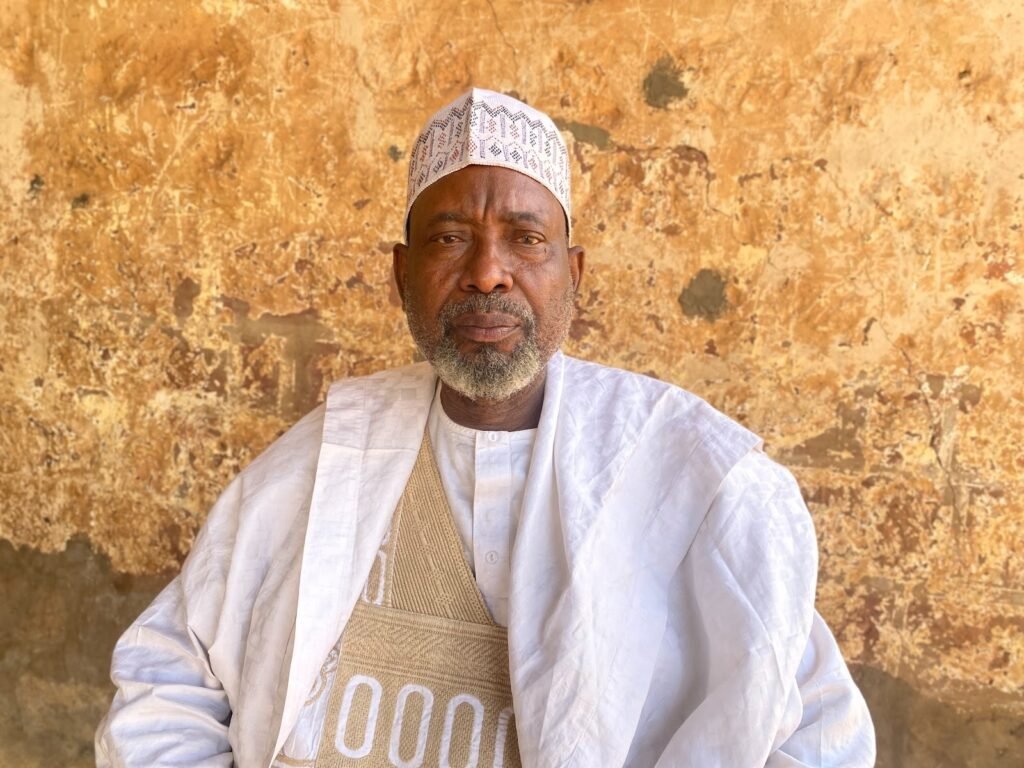
“If they see new faces and you tell them that from now on, if you plant this way, it will be destroyed, out of ten, seven will agree. That is a stepping stone,” he said.
Insecurity has further weakened local coordination mechanisms. Farmer associations that once met almost weekly to discuss irrigation schedules and share knowledge now struggle to convene.
“Some of us can spend months without meeting,” he said.
Shared Fate in Gada
In Gada communities neighbouring Goronyo, farmers face similar hardship. In villages such as Ballagu and Tsitse, residents have been devastated by a combination of climate extremes and insecurity.
In 2025, Shuaibu Muhammad, 52, was not only a victim of flooding but also a survivor of bandit captivity. In 2024 alone, he fell into the hands of armed groups twice. Muhammad was tending his farm along the Tsitse community, where he had planted rice, garlic, onions, and pepper, when armed men attacked the area and abducted him.
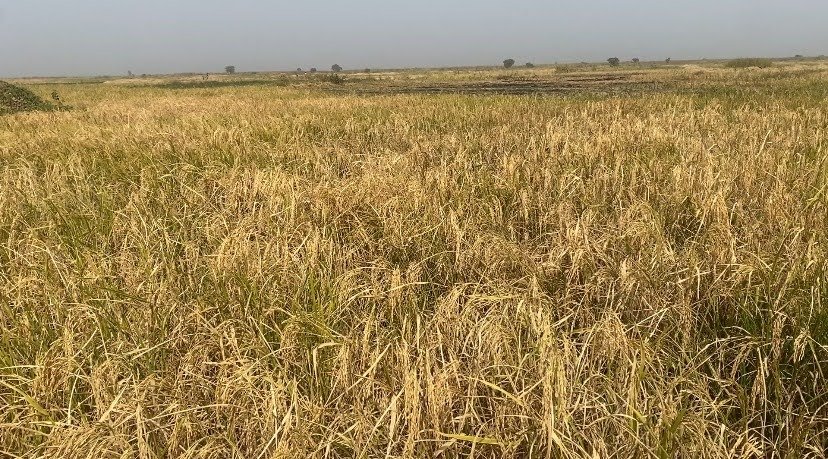
Muhammad spent two months in captivity before his release was secured after his family paid a ₦5 million ransom. His family raised the ransom by selling the family inheritance and contributions from the community. During his captivity, everything he had planted was lost. By the time he returned, the crops had withered for lack of irrigation.
Within a week of his release, his elder sister was also abducted, forcing him to raise yet another ransom payment.
Despite the trauma and financial devastation, Muhammad cannot abandon farming. It remains the only source of livelihood for him and most families in Sokoto.
In 2025, after returning to cultivation to rebuild his life, disaster struck again. Floodwaters swept through his fields, destroying crops cultivated at an estimated cost of ₦500,000. He echoed the concerns raised by other farmers, stating that they had not received any advice from NiMet. Although a lawmaker who visited the community mentioned the likelihood of delayed rains that year, the forecast did not accurately capture the severity or duration of the delay.
While many farmers from Muhammad’s community struggle to rebuild and prepare for another planting season, they remain trapped in uncertainty, unsure how climate change will unfold and whether their next harvest will yield anything.
“We Do Not Take Information Directly to Farmers” — NiMet
Responding to concerns about the climate information gap, the Nigerian Meteorological Agency (NiMet) acknowledged that it does not communicate directly with farmers. Dr James Adamu, Assistant General Manager of Agricultural Meteorology and Technical Assistant to the CEO of NiMet, said the agency operates through established government channels.
“NiMet does not take information directly to farmers,” he stated. “We work with the extension agents in the state. Every year, we give our information to the State Ministry of Agriculture and the State Agricultural Development Project in Sokoto. They are saddled with the responsibility of taking this information to the farmers.”
According to him, dissemination through extension services remains “the best way” to reach rural communities, as Nigeria is too vast for the agency to cover every farming settlement. “NiMet is not designed to go to every nook and cranny,” he said. “That is what we rely on the extension system.”
Specifically in Sokoto, NiMet says it has gone beyond routine advisory releases. Dr James pointed to a series of radio programmes conducted in the state to raise awareness about climate prediction and early warning systems. He also highlighted a partnership project with the United Nations Development Programme (UNDP), which established automatic weather stations and climate peace hubs in selected local government areas, including Ilela and Wamakko.
“We have a climate peace hub where we share information,” he explained. “Last year, we were there like three times. This year we’ll be there again to share information on early warning.” A third location initially selected in the Kebbe local government area of Sokoto state had to be reconsidered due to insecurity. “Because of the insecurity in Kebbe, we couldn’t access that location,” he added.
On the question of monitoring whether farmers actually receive and use the advisories, Dr James maintained that feedback is expected from extension services. “You don’t expect NiMet to start going to every community,” he said. “It is the role of extension. That is what they are paid to do.”
However, acknowledging the limitations of the current structure, NiMet says it is “trying to design a project whereby farmers will be getting SMS in their location,” Dr James said. “But for us to do that, we need the database of farmers in the states. NiMet will not go around looking for farmers. The state has to provide the database.”
He said the SMS initiative is in the design and consultation phase, noting that discussions are ongoing with telecommunications providers. “This is not cheap. It’s not free. We need to work with telecom providers. But who is going to pay for those services? That is what we are trying to resolve,” he said. According to him, pilot implementation may begin in states that are ready to provide verified farmer databases.
While critics argue that the absence of direct outreach has contributed to farmers’ vulnerability, NiMet insists it has fulfilled its mandate within the framework of Nigeria’s early warning system. “We make sure we release forecasts on time and make them public,” Dr James said. “The media also has a role. Extension has a role. It is not just NiMet.”
All efforts to reach the “extension” Sokoto Ministry of Agriculture proved abortive; a WhatsApp text sent to the commissioner was not responded to as of the time of this publication.
Expert Calls for Urgent Climate-Smart Reforms
Dr Sanni Bello Haliru, a Deputy Director at the Centre for Biotechnology and Plant Tissue Culture, describes the situation as a serious structural gap. According to him, while climate change itself may be beyond human control, the scale of farmers’ losses is not inevitable.
“Whatever the farmer is doing, the last target, all the resources spent, is for him to get yield, and most importantly, high yield,” explained Dr Haliru. “If there is total loss, then everything is gone.”

Drawing from international examples, Dr Haliru points to climate-smart agricultural practices as part of the solution. In parts of Asia where flash floods are frequent, he noted, plant breeders have developed submergence-tolerant rice varieties capable of surviving days underwater.
“They develop submergence-tolerant rice varieties for farmers,” he said. “After the flood, these varieties will sprout again and still give farmers yield.”
He argues that Nigeria’s research institutions have the mandate to improve crop varieties but must intensify efforts to make climate-resilient seeds accessible to farmers. In regions like Sokoto, where rainfall is unpredictable, Dr Haliru recommends early-maturing crop varieties to reduce risk.
“Some of these issues are natural,” he said. “Something we do not have control over. The only way is to try as much as possible to mitigate the problem.”
To bridge the information gap, Dr Haliru advocates stronger collaboration between NiMet and state-level Agricultural Development Projects. Climate advisories, he says, must be translated into local languages and delivered directly to farming communities.
“There is no way NiMet can do this alone. They have to collaborate,” he stressed. He also recommends consistent use of radio and community outreach. “Keep on reminding them. Meet the farmers even at the point where they cultivate the crops.”
However, insecurity remains another obstacle to effective outreach. Some climate awareness programs have reportedly been disrupted due to security concerns in parts of the state. Dr Haliru insists that resolving insecurity requires political will at all levels of government.
“There must be political will to end the insecurity issue. Otherwise, we will continue to face this problem,” he said. “But more than anything, the information gap is very, very critical,” he reiterated. “It has to be addressed.”
Between Insecurity and Climate Shock
In Sabon Birni local government area of Sokoto state, the crisis presents a double burden. While much of Sokoto East continues to grapple with insecurity, with some communities reportedly paying levies to bandits before accessing their farmlands or risk being abducted, the region remains one of the hardest hit in recent years. Farmers here must contend not only with the growing threats of climate change but also with the constant fear of kidnapping while working on their fields. In 2022 alone, no fewer than 42 communities reportedly paid ₦70 million to the Bello Turji gang as protection money after many villages were attacked and sacked.
Lukman Umar Tafida still remembers the day he ran for his life.
“There was a time we were on our way to the farm. When we reached the bridge, we were told that bandits were coming,” he recalled. “I insisted I had to go to the farm. As I crossed the bridge, I just heard gunshots and turned back. I had never run like that day in my life.”
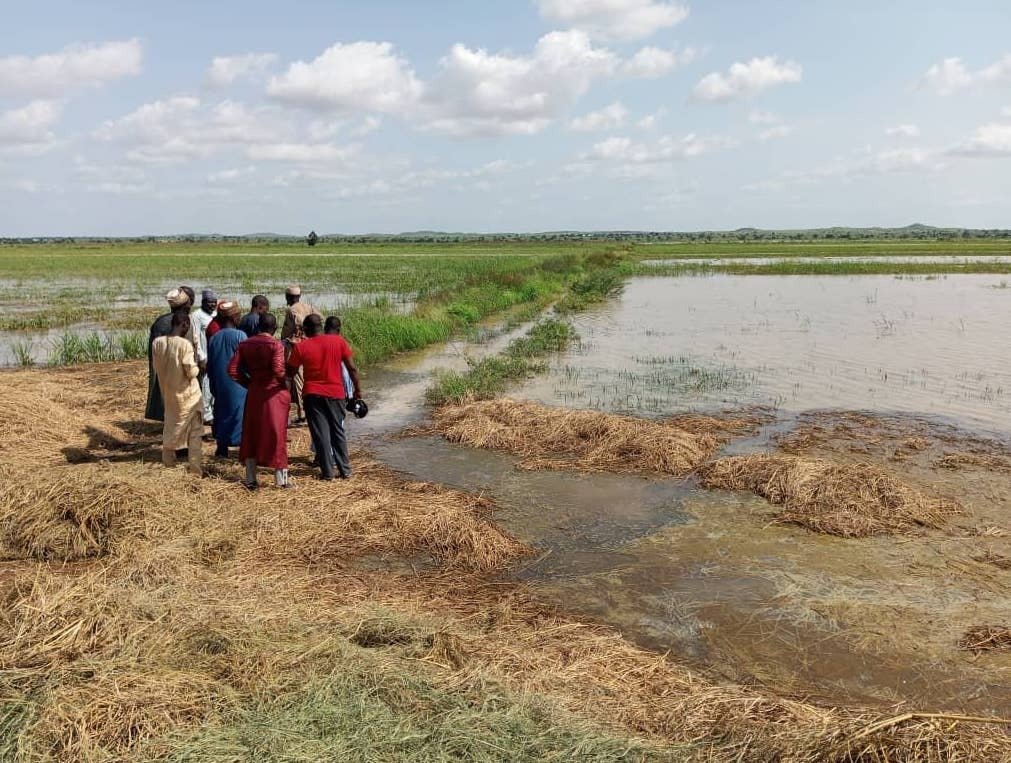
The attack forced Tafida to stay away from his farm for a period while he assessed the security situation before returning. He explained that a group of farmers later travelled back to their fields, accompanied by local vigilantes for protection. By the time they resumed access, an unexpected flood had already washed away the rice farm.
Tafida said he invested ₦300,000 in cultivating the rice, all of which was lost to the flooding. Although the temporary pause in visiting the farm may have contributed to the extent of the damage, he noted that the rainfall occurred earlier than expected based on the forecast he had heard on the radio.
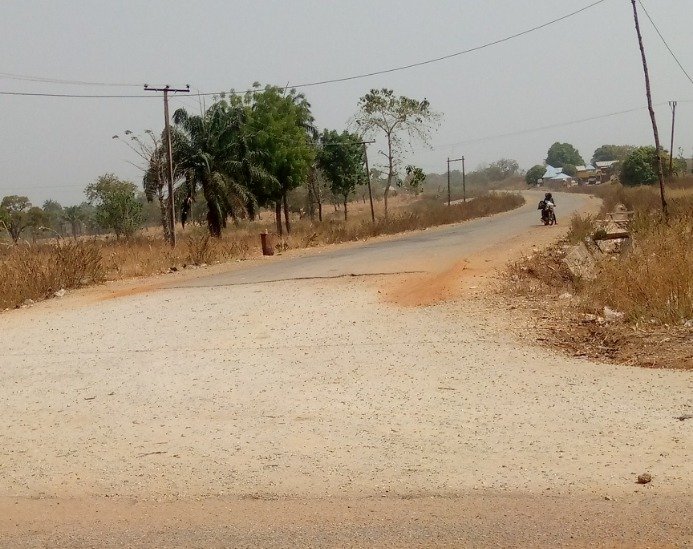
Tafida, a father of three who has spent four years cultivating rice, said last year’s flood was unlike anything he had seen before. “It even destroyed the road that links us to Sokoto,” he said.
In previous seasons, he harvested up to 30 bags of rice alongside guinea corn. This year, he harvested nothing.
Like other farmers, he said he had never received a forecast directly from NiMet. The only weather information he accessed came through a radio programme, and the last time he relied on it, the prediction proved inaccurate.