
This is the first of a two-part series on how solar innovations are addressing Nigeria’s electricity and agricultural challenges through rural microgrids and solar-powered irrigation. You can read the second part here.
_______________
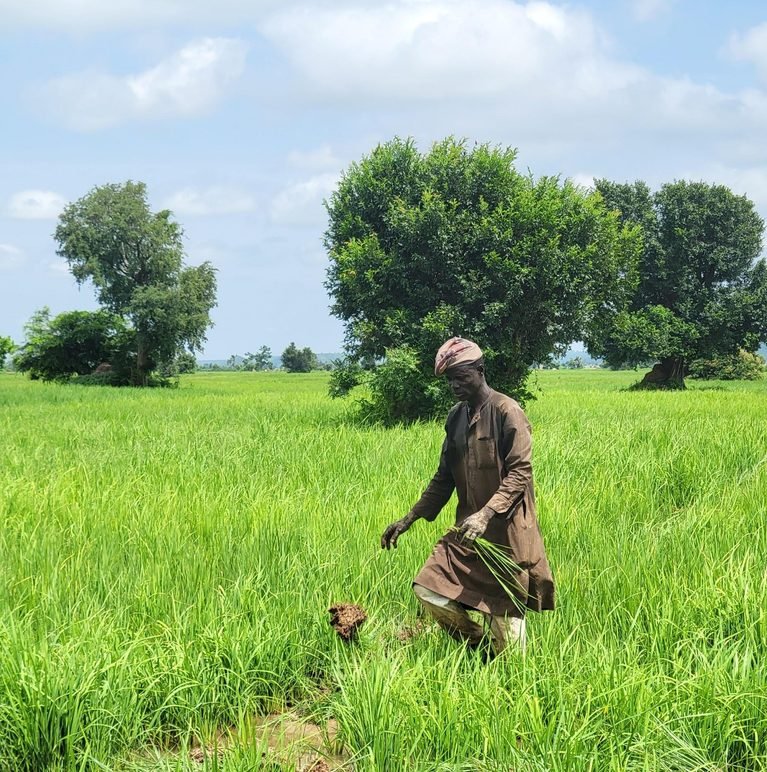
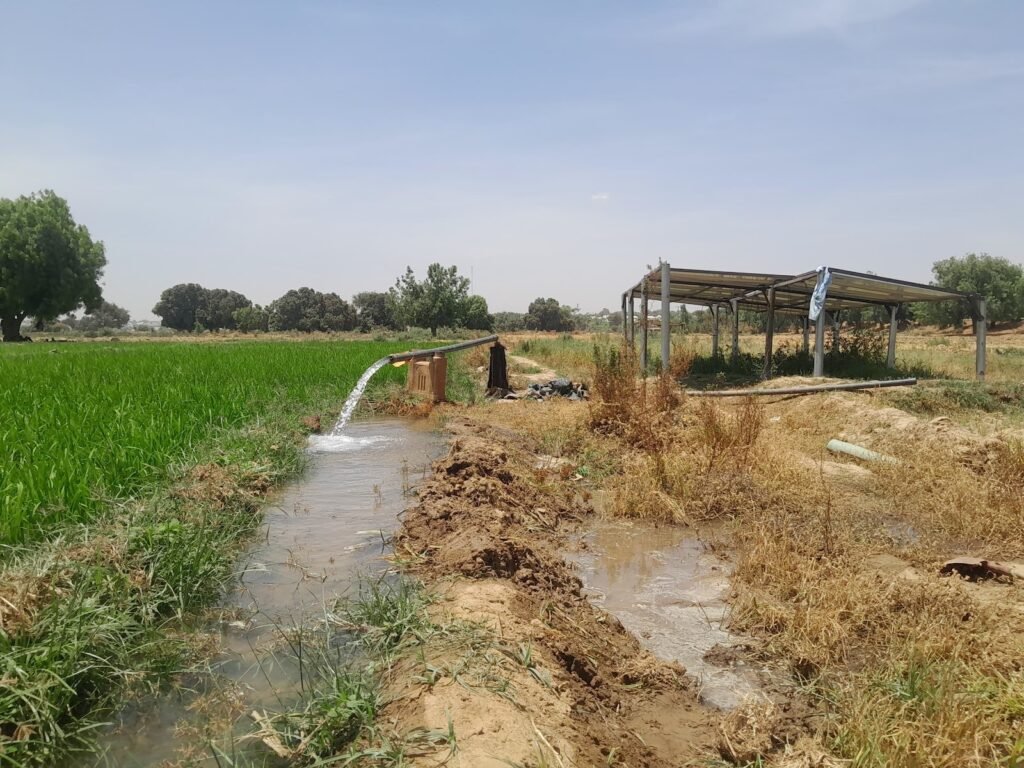
Abdulrasaq Nura wears a smile as he watches his wide stretch of emerald-green rice plants rise from sun-glinting water. The rice’s svelte leaves sway gently in neat and disciplined rows across the field. The farm radiates a sense of promise, with the soil beneath it brown and wet, holding the plants’ lifeblood. Nura attributes every glaring feature of the farm to a simple solar-powered structure standing quietly under the open sky at the edge of the rice field.
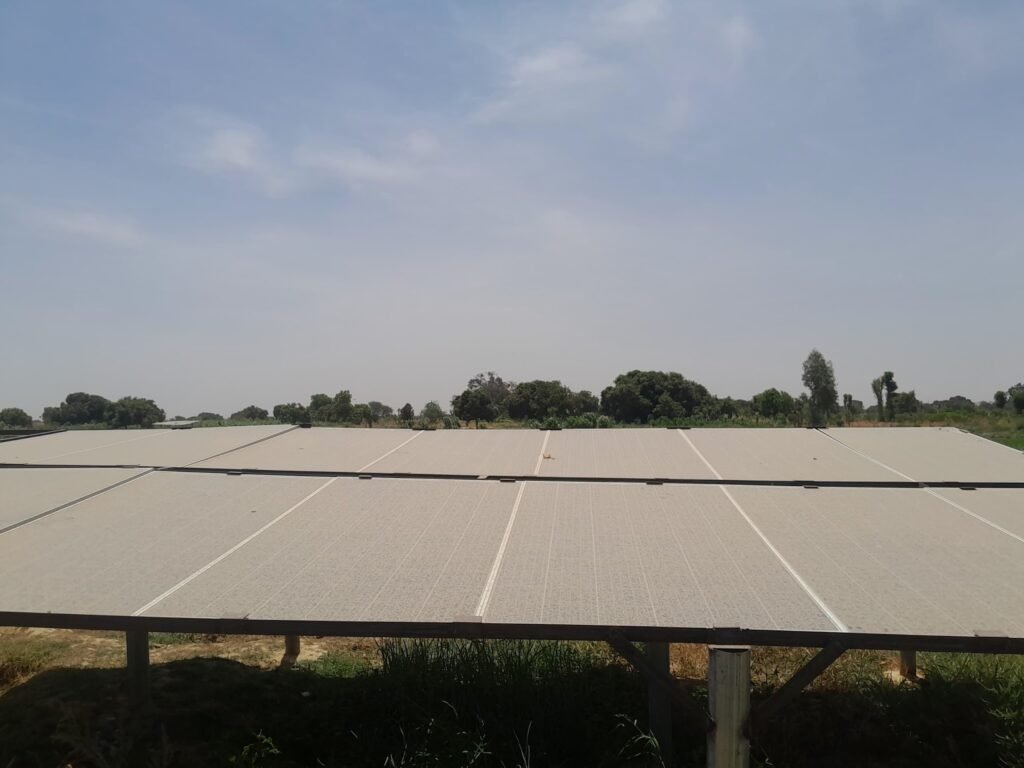
As the structure’s metal frame which anchors glittering solar panels draws energy from the sun, a nearby pumping machine with a fixed pipe gushes clean water steadily into a narrow earthen channel, spreading life across the field.
A few years ago, Nura, a farmer in Dundaye, Sokoto state, north-western Nigeria, spent over ₦4,000 a day on fuel to power a water pump that irrigated his rice, onion, and vegetable fields. In 2023, he decided to try something new and bought four solar panels.
Today, his crops are entirely irrigated by a solar-powered system, which has reduced his costs and increased productivity.
“I used to spend over ₦480,000 fuelling my petrol-powered generator in just four months, which was more than ₦1 million a year,” Nura told The Liberalist. “But after spending around ₦500,000 to set up the solar panels, I no longer spend anything on irrigation. Everything is fixed. I just start the pump whenever the sun is out.”
Before using solar-powered irrigation, Nura adds, he harvests about 70 bags of rice. However, after embracing the system, he harvests as many as 120 bags of rice from the same hectares of farmland. He also used the same system on his onion farm, increasing his harvest from 20 bags to 35 bags per season.
“When your rice or onion farm is not short of water, it doesn’t give room for pest infestations, which are usually caused by drought. Also, I don’t have to wait for the rainy season to grow crops like vegetables,” Nura stated.
The increase in productivity and the reduction in costs are pushing Nura and many other farmers to fully adopt solar-powered irrigation systems. This adoption is steadily growing in Nigeria, especially in the northern part of the country.
Solar-powered Irrigation As a Lifeline
While there are no official data on the number of solar-powered farms in Nigeria, observations and interviews suggest that adoption is gaining popularity. For instance, Horti Nigeria, a Dutch-funded program focusing on enhancing food and nutrition security, has provided solar irrigation to over 2,000 farmers in Ogun, Oyo, Kaduna and Kano states, while Solidaridad West Africa, an international civil society organisation working to promote sustainable production, has served over 1,300 fish farmers in just one state. Nigeria’s National Economic Council is now urging more farmers to use solar, and has directed the Minister of Budget and Economic Planning to fund the production and distribution of pumps to farmers nationwide.
This shift comes at a critical time for Nigeria, where climate change is making traditional farming increasingly difficult. Rising temperatures and unpredictable rainfall are threatening food production, and according to the United Nations, more than 30 million Nigerians are currently facing acute hunger. A recent study shows that rain-fed agriculture could drop by 20 percent in productivity over the next decade in West Africa if adaptive technologies like solar irrigation are not widely adopted.
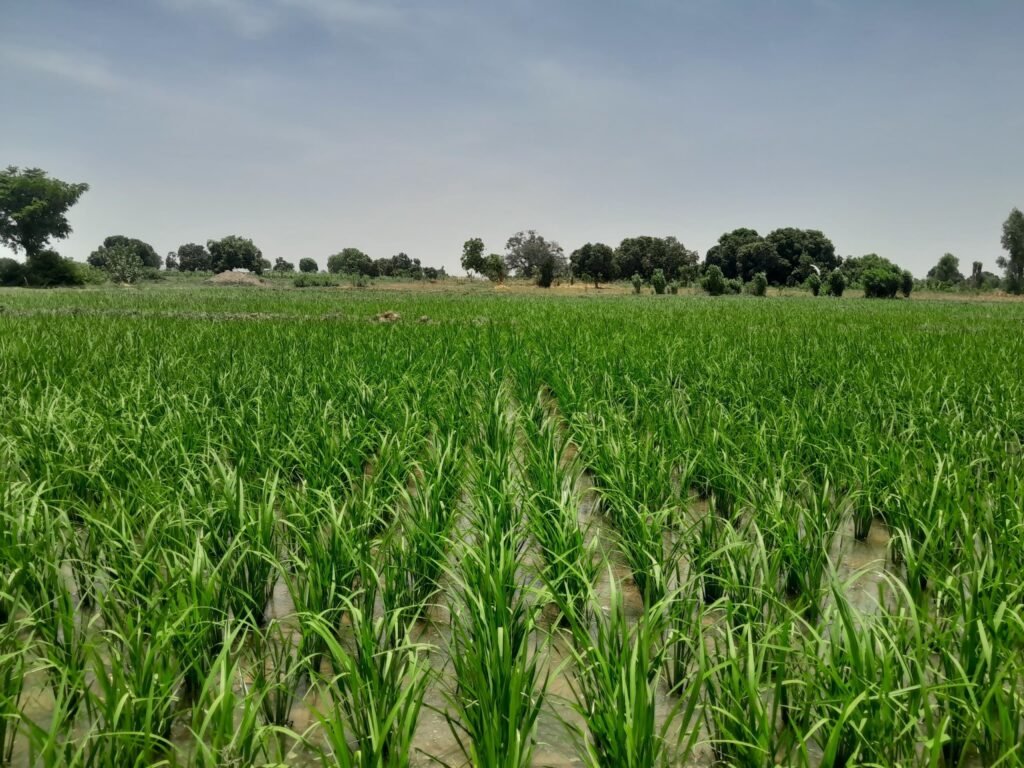
In states like Sokoto, climate change is rapidly reshaping agriculture. Rising temperatures and erratic rainfall have intensified flooding, making traditional farming unsustainable. The transition to irrigation was a necessity, not a choice. In 2024, Sokoto state experienced significant flooding, affecting more than 219,000 individuals and approximately 23,534 farmlands, with an estimated 12,742 hectares submerged.
Sokoto, situated in Nigeria’s semi-arid northwest, experiences frequent droughts due to its climate. Studies indicate that the probability of drought occurrence in the state is approximately 58 percent with a recurrence interval of more than half a year. Unreliable rainfall patterns and rising temperatures lead to poor crop yields, affecting food security and farmers’ incomes.
Farmers are now adopting solar-powered irrigation systems to help recover from flooding and ensure long-term resilience. Equally, the shift offers an economically viable option for the farmers. Instead of purchasing exorbitant fuel, these farmers utilise the sun with a solar-powered system to pump water from boreholes and rivers into their farmlands.
“Solar irrigation holds significant potential to increase crop yields by allowing farmers to plant and harvest regardless of the season,” Dr. Aliyu Abubakar, a lecturer at the department of Soil Science and Land Resources Management in Usmanu Danfodiyo University, Sokoto told The Liberalist. “Northwestern and eastern Nigeria are especially ideal for solar-powered systems due to abundant solar radiation, averaging 5.5 to 7.0 kWh/m²/day. Adopting solar irrigation reduces production costs, improves farmer livelihoods, and builds resilience against climate change.”
By switching to this process, farmers are also reducing agriculture’s dependence on fossil fuels, thereby stressing Nigeria’s commitment to achieving net-zero emissions by 2060.
Petrol and diesel-powered pumps contribute to greenhouse gas emissions, accelerating global warming. Due to its reliance on fossil fuels, agriculture accounted for 16.2 billion tonnes of carbon dioxide in global greenhouse gas emissions in 2022, according to a recent report by the International Energy Agency.
Also, the International Renewable Energy Agency says solar irrigation is one of the most effective ways to reduce agriculture’s carbon footprint. A separate study by the Food and Agriculture Organisation found that solar-powered irrigation systems can boost agricultural productivity in the Sahel and reduce carbon emissions compared to fossil fuel-powered pumps.
Switching to solar energy to water their crops allows farmers like Nura to not only save costs but also reduce their carbon footprint.
Another study by Horti Nigeria says solar-powered irrigation systems can reduce emissions by nearly 200kg of carbon dioxide per hectare each year, making a real difference in addressing climate change.
Going for the Less Troubled
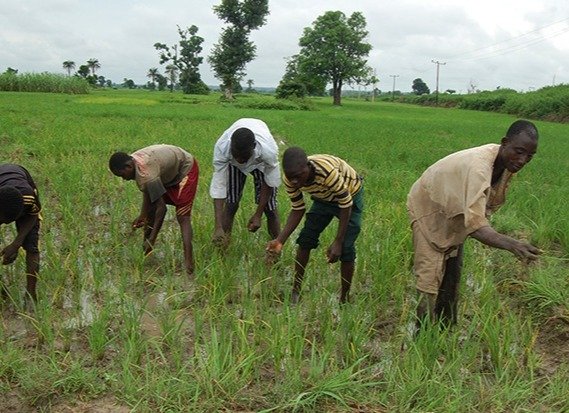
Sometimes, Yusuf Sani, a 28-year-old farmer in Dakingari, Kebbi state, feels like throwing in the towel on rice farming. He has used different petrol-powered generators to pump water into his farmland. But instead of generating more water, the machine generates more problems for Sani each day: sometimes the engine stops working for the whole day, some other times it works for only a few hours and then stops.
For these reasons, Sani’s rice field displays narrow yellowish leaves that lack vigour and stand limply in the shallow water. “I used to harvest 15 bags of rice from my farmland,” Sani told The Liberalist. “But in 2023, a friend of mine advised me to switch to a solar-powered irrigation system in order to ensure a stable water supply to my farm.”
Sani says he started by buying three solar panels and got an engineer to install them on his farm. Today, if there is one thing Sani never worries about on his farm, it is the epileptic water supply.
“After installing the panels, my rice field is constantly soaked in water because, unless there’s no sun—which is uncommon—the solar-powered irrigation is not prone to faults.”
“Last year alone,” Sani said, “ I harvested over 40 bags of rice from the same farmland where I was getting barely 15.”
But the solar-powered system also comes with its own significant challenges. For fear of theft, Abdulrasaq Nura says he has been keeping vigil on his farm, including sleeping there, ever since switching to the system, adding that failing to do so would result in the panels being stolen.
The high initial installation cost and required maintenance technical know-how also remain significant hurdles for many Nigerian farmers. For instance, Kabiru Muhammed, a farmer in Sokoto, shares his desire to adopt the system but lacks the capital for the initial setup.
“I need around ₦500,000 to buy good panels, but I do not have that kind of money yet. We hope the government could be of help to us in this regard.”
Despite being a climate-threatened region, Sokoto state’s own spending on agriculture and irrigation raises some concerns about how much of its climate-resilience efforts are reaching farmers. For instance, in 2026, the state government allocated ₦64.7 million to enhancing food production and productivity, including ₦41.2 million for intensive crop and vegetable production, a programme that specifically covers irrigation. However, only ₦4.2 million had been spent on the programme at the end of the first quarter,
The government approved ₦1.65 billion in June 2026 for conventional inputs like fertilisers and seeds, but a review of the budget reveals that allocations for modern and decentralised climate control systems like solar-powered irrigation remain absent.
The state also spent ₦270 million on the Kware Irrigation Scheme in 2024. While the spending covers broader agricultural needs, experts say greater investment in climate-resilient irrigation could complement these efforts.
Nevertheless, the substantial long-term advantages of solar-powered irrigation continue to incentivise its adoption in the state and beyond.
India offers a useful example of how the burden of paying for solar irrigation can be shifted away from individual farmers. Under the government’s PM-KUSUM scheme, farmers installing standalone solar agricultural pumps can receive up to 30 percent central government support and at least another 30 percent from their state government, leaving the farmer with at most 40 percent of the cost. Banks equally finance part of that contribution, potentially leaving a farmer to sometimes provide only 10 percent upfront.
This intervention also further allows farmers with grid-connected pumps to solarise them and sell excess electricity to power distribution companies. As of July 2026, the programme had sanctioned more than 846,000 standalone solar pumps and installed about 757,000, according to India’s Ministry of New and Renewable Energy. Dr. Aliyu Abubakar believes that the model provides a lesson for Nigeria, where the high upfront cost remains one of the biggest barriers for farmers like Kabiru Muhammed.
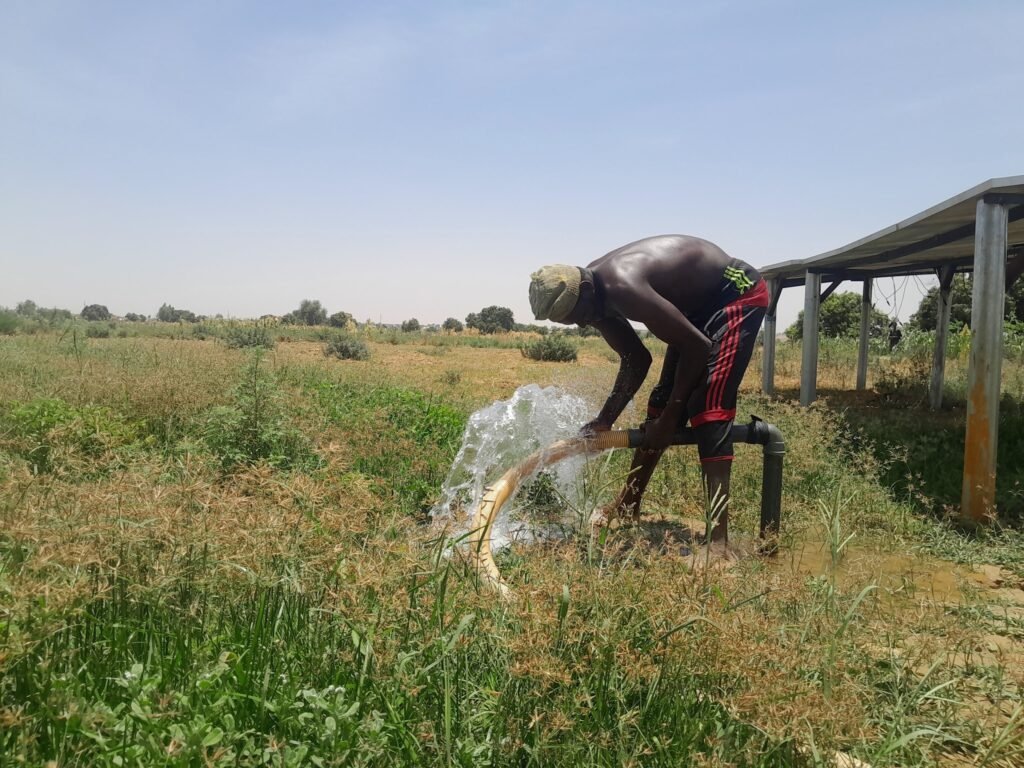
He said to overcome these barriers, government agencies and development partners must provide solar irrigation facilities through loans and subsidies, adding that “stakeholders must target these interventions strictly toward registered cooperatives and genuine farmers rather than political farmers, prioritising regions with long dry seasons where the need is greatest.”
On their own part, Horti Nigeria recommends insurance programs and financing options, such as pay-as-you-grow and micro-leasing, should be bundled and made more accessible to farmers.
“Looking ahead, solar irrigation will inevitably expand across Nigeria,” Dr. Aliyu Abubakar concludes. “Abundant solar resources and rising fuel prices, which drastically increase the cost of traditional diesel irrigation, make solar energy the most viable long-term solution for sustainable agriculture.”
All efforts to speak with the Federal Ministry of Agriculture and Food Security about the government’s efforts to promote the adoption of solar-powered irrigation among farmers proved abortive. Emails sent to the ministry through the contact details listed on its official website received no response, while the listed phone numbers were unreachable at the time of filing this report. The Sokoto State Ministry of Agriculture also did not respond to calls seeking its comments.