
For decades, flying across West Africa has felt like a luxury reserved for the few. A trader moving goods from Lagos to Dakar can pay more for a single ticket than for a long-haul flight to Europe, while families often discover that a vacation to a neighbouring country costs more than travelling outside the continent.
Chris Appiah, ECOWAS director of transport and communications, puts it that “a trader traveling from Lagos to Dakar pays upwards of $3,000 for a ticket.” The result is a region where movement is expensive, business coordination is difficult, and integration exists more in treaties than in daily life.
The problem, however, has never been the aircraft or the airlines alone. When passengers buy a ticket in West Africa, most of the money does not pay for fuel, pilots, or maintenance. Appiah explains that “buying a typical ticket in West Africa on any of the airlines, you realize that about 64 percent, sometimes it will be 70 percent of the ticket price is as a result of taxes and charges.”
Governments, not airlines, have quietly become the biggest beneficiaries of air travel, loading tickets with levies that have little connection to aviation services.
This heavy tax burden did not emerge overnight. Over time, aviation became an easy source of revenue for governments facing fiscal pressure. Travelers were assumed to be wealthy, thus governments extract money through aviation taxes.
According to the African Airlines Association (AFRAA), West Africa charges passengers an average of $110 in taxes, charges, and fees per international departure—more than three times what passengers pay in the Middle East ($34) or Europe ($32). Even on regional African routes, passengers in West Africa pay about $68 on average, compared to $34 in the Middle East and $32 in Europe. Unsurprisingly, nine of the ten most expensive African countries for regional flights are located in West Africa.
Passengers can face dozens of separate charges on a single ticket, while airlines navigate more than a hundred different fees. According to Appiah, these taxes are against the International Civil Aviation Organisation’s guidelines “and suppress demand rather than support growth.”
By late 2024, the imbalance had become impossible to ignore. Data from the African Airlines Association shows that West African passengers pay some of the highest aviation taxes in the world, averaging over $100 per international departure, far above rates in Europe or the Middle East. Nine of Africa’s ten most expensive countries for regional flights are in West Africa.
“Our charges are sometimes 67 percent more than any other region on the continent,” Appiah warned, explaining why non-West African airlines have thrived while local carriers struggle.
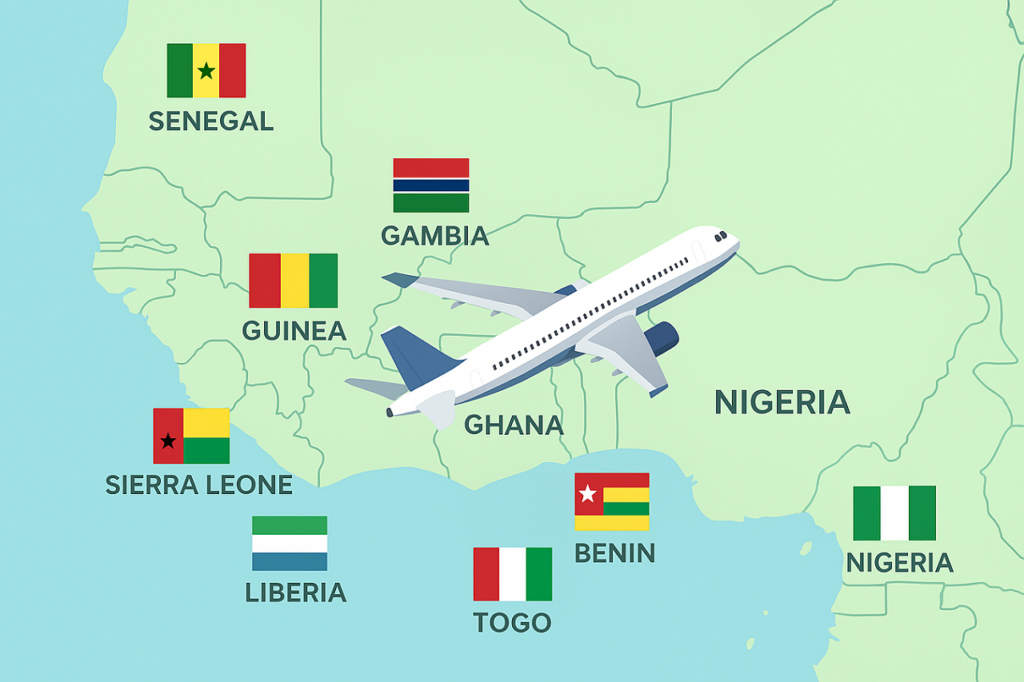
Against this backdrop, ECOWAS took a rare and decisive step. In December 2024, Heads of State approved a sweeping reform that will take effect on January 1, 2026. Four major aviation taxes, the Ticket Tax, Tourism Tax, Solidarity Tax, and Foreign Travel Tax, will be abolished entirely. Two of the most common charges, the Passenger Service Charge and Security Charge, will be reduced by 25 percent.
“This measure responds to long-standing concerns over the high cost of flying in West Africa. Lower airfares will support regional mobility, strengthen airlines, and deepen economic integration,” noted ECOWAS Commission.
If implemented faithfully, aviation analysts believe the impact could be transformative. They estimate that ticket prices could fall by as much as 40 percent, with more conservative projections still pointing to double-digit reductions. Routes that currently cost $500 could drop closer to $300 or even $250. Business travel would become routine rather than prohibitive, and regional tourism could finally open up to middle-class families who have long been priced out of their own neighbourhood.
The reform also carries regional significance beyond cheaper tickets. It aligns with the Single African Air Transport Market (SAATM), an African Union initiative aimed at liberalising air travel across the continent. While SAATM has struggled with slow and uneven implementation, ECOWAS’s action positions West Africa as a potential leader rather than a laggard. African Union studies suggest that full liberalisation could boost intra-African passenger traffic by over 50 percent, revealing how much economic potential excessive government intervention has stifled.
Meanwhile, the success of the reform is not guaranteed. Removing taxes does not automatically ensure lower fares if airlines absorb the savings. Recognising this risk, ECOWAS has mandated international airports to submit five-year commercial plans and established a Regional Air Transport Economic Oversight Mechanism to monitor compliance and outcomes.