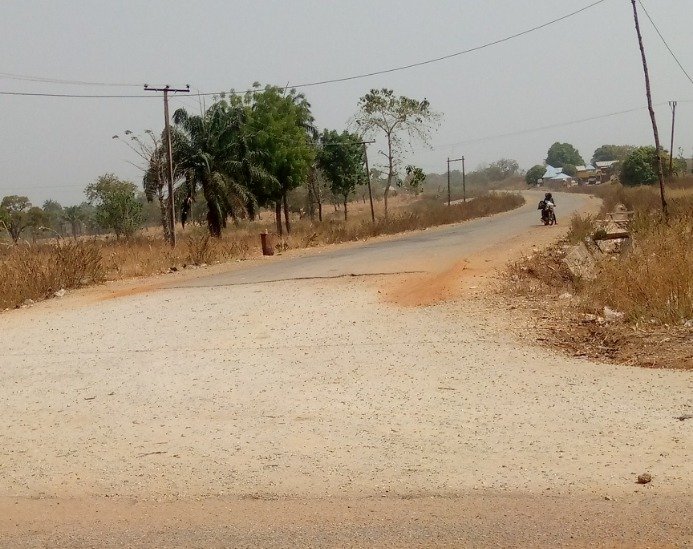
The Wamba-Wanse road is a vital link between residential areas, schools, hospitals, and markets in Angwan Rimi community and other neighboring villages in Nasarawa state. But for decades, this road has remained in ruins. The federal government approved ₦14 billion for the construction of the 49-kilometre project, awarded it to Uniglobe Construction Engineering Limited in 2014, and set a completion time of four years. However, 12 years later, the road remains unfinished, abandoned, and forgotten, The Liberalist can report.
_______________________
In early January, community leaders of Angwan Rimi in Nasarawa state could no longer swallow their pain. They gathered to discuss the myriad challenges bedevilling their community. Amid the tense silence, their conversation turned to the ₦14.2 billion Wamba-Wanse road project. This project remained incomplete for more than 10 years. The deteriorating condition of the road worsens every year.
Musa Aliyu, a tea seller in the community, tried to speak about the road, but his voice trembled with grief. The poor condition of the road brings back lingering memories of his brother’s burial.
Two years ago, construction workers left a heap of sand beside the road. His cousin brother, Hassan Umaru, got in an accident at 7pm after tripping on the sand with his motorcycle. He sustained multiple injuries and was rushed to the hospital. His family members waited for his recovery, but eventually, the incident threw them into mourning when Umaru’s death was announced.
“Instead of spreading the sand on the road, the construction workers did not. It leads to his death. After abandoning this road, it has brought a great setback to us,” Aliyu told The Liberalist.
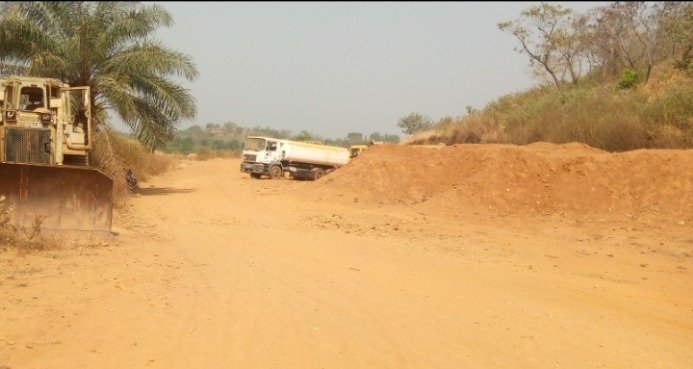
The accident that led to Umaru’s death was avoidable if the construction workers had finished the road. But the residents were left in the dark as to why the road remains uncompleted. The misery added to their woes and lamentations.
On his part, Shammah Madaki, a farmer residing in Mbasha, dreamed of seeing his community connected to a good road. When he saw construction workers in the neighbouring villages, he was emboldened with hope, which he believed could trigger development.
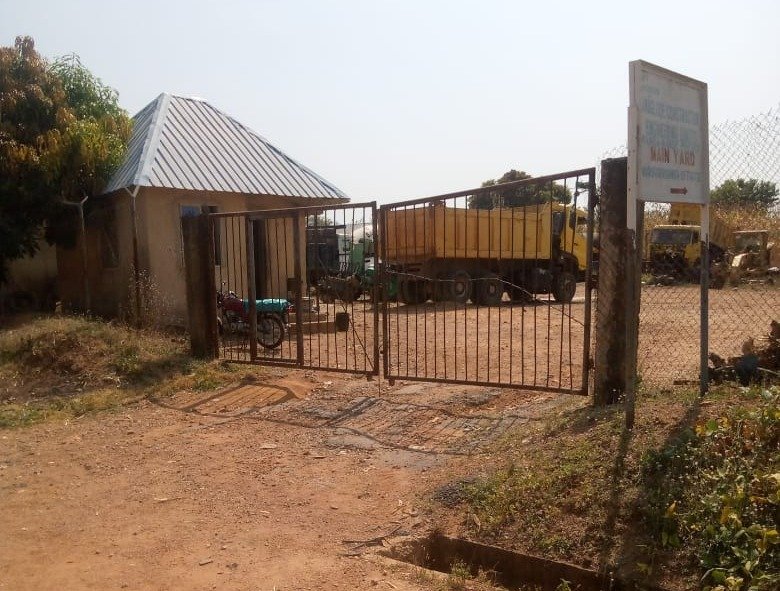
However, Madaki wakes up every morning to walk on a dusty road. His dream of seeing a tarred road seems shattered, and his fears were compounded when he could no longer see the construction workers for several years. Now, anytime he passes around their encampment, he only sees one old security guard overseeing their equipment.
As despair began to overwhelm Madaki, he remembered the longer route they had to follow after the construction workers badly graded the road. Traveling to the neighbouring villages by road became a heavy price he and other residents had to pay for the deplorable condition of the road.
“Even the way they graded the road is not good. We find it difficult to go to Kwara. If we want to go to Kwara, we must go through Sisinbaki because the road is not good. A motorcycle can not follow it,” Madaki said.
Over seven villages in Wamba Local Government of Nasarawa state were connected to the Wamba-Wanse road. The road cuts across Angwan Rimi, Marmara, Jidda, Angwan Jatau, Angwan Gimba, Kwara and Mbasha.
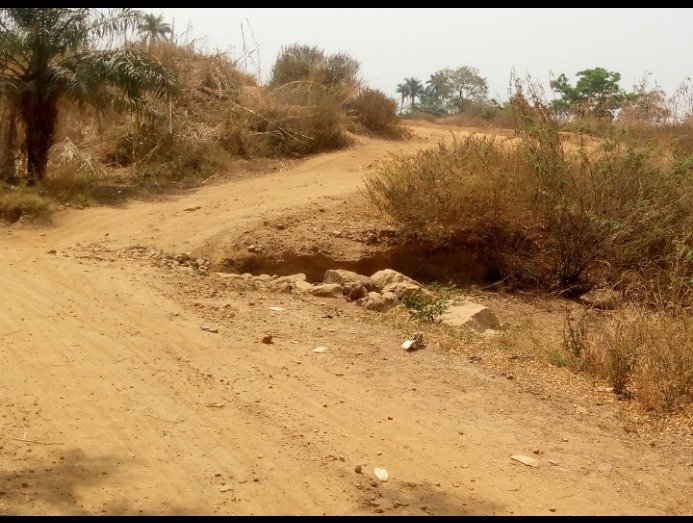
It also connects the Wamba community to Wanse in Plateau state. A well-maintained road would allow Wamba villages to transport farm produce into neighbouring Plateau, Borno, Bauchi, and Kaduna states. Since the residents of the seven villages are agrarian farmers, this infrastructure would boost their harvest, economy, and livelihoods across the villages and beyond their state
But for several years, farmers, commuters and motorists have worn long faces whenever they talk or pass by the road. And many residents and village heads who spoke with The Liberalist said it is extremely difficult to navigate the road due to its poor condition.
The Abandoned ₦14.2 Billion Wamba-Wanse Road Project
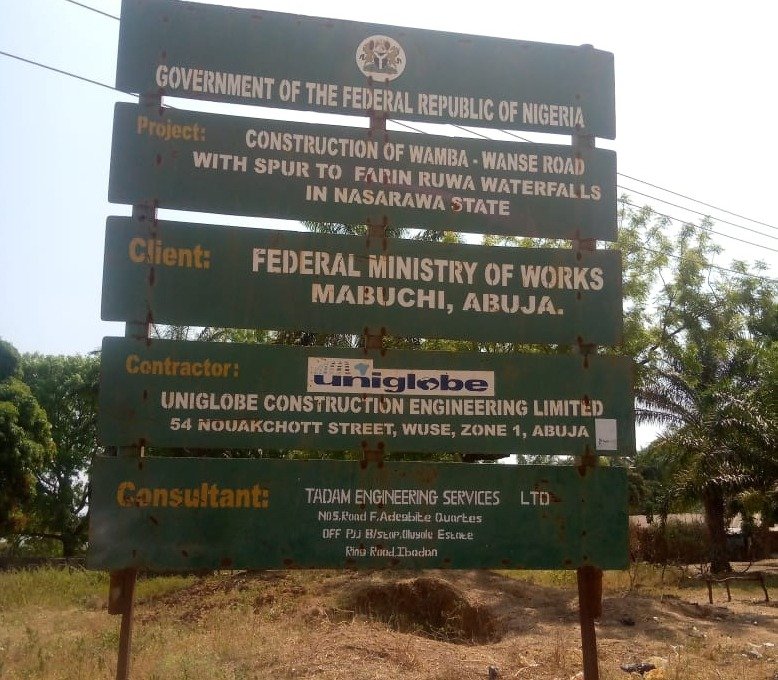
To ease the suffering of residents and address the challenges of the broken road in the Wamba community, a document retrieved from the Bureau of Public Procurement reveals that the Federal Executive Council (FEC) approved a staggering ₦14.2 billion in December 2014. Under the administration of former President Goodluck Jonathan, this funding was designated for the construction of the 49-kilometre Wamba-Wanse road project in Nasarawa state.
The project, awarded to Uniglobe Construction Engineering Limited, aimed to facilitate the movement of community members and farmers across the seven villages in the Wamba local government. Construction commenced in January 2015 and was expected to be completed in four years.
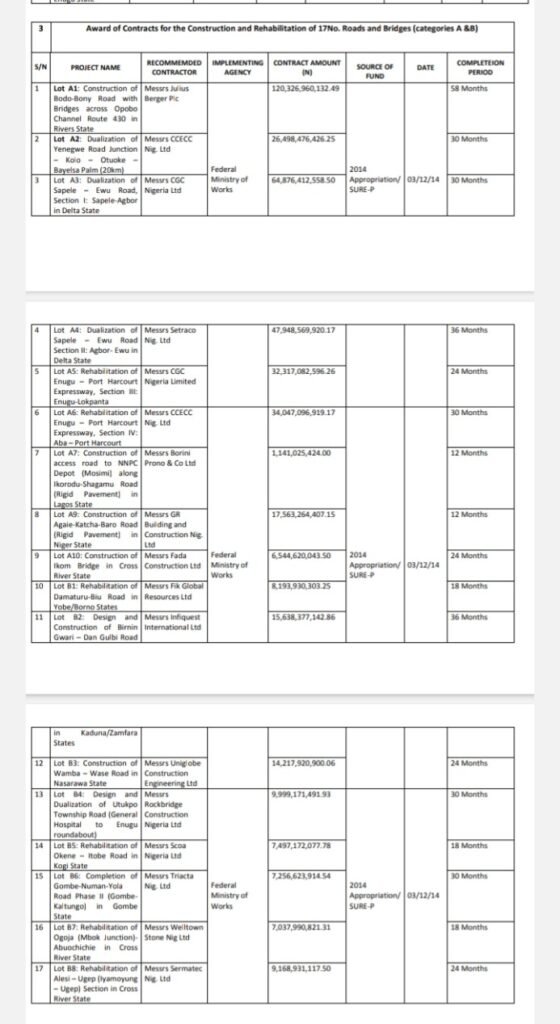
However, an on-site assessment of the project, coupled with interviews with residents and local chiefs, The Liberalist can report that 12 years after the project began, barely six kilometres of the 49 km were constructed, while other parts of the roads remain abandoned.
When this reporter visited the site in January 2026, the tractors reflected a story of abandonment, with construction equipment in its rusty state. There was no single construction worker of Uniglobe Construction Engineering Limited in sight, apart from two hired guards who watch the rusty tractors on a daily shift.
In 2024, a report listed the road project as one of the 14 federal government–abandoned road projects in Northern Nigeria. Nonetheless, at the time of filing this report, many residents remain disheartened because the approved Wamba-Wanse road project has been commissioned but has remained abandoned for years without completion.
A further search for the payment records of the project shows that ₦220 million was appropriated in 2015 for the Wamba-Wanse road project, and in another document retrieved from the BudgIT, an online database for tracking budget release and performance, shows that in 2017, the project appeared in the list of revised federal government ongoing projects.
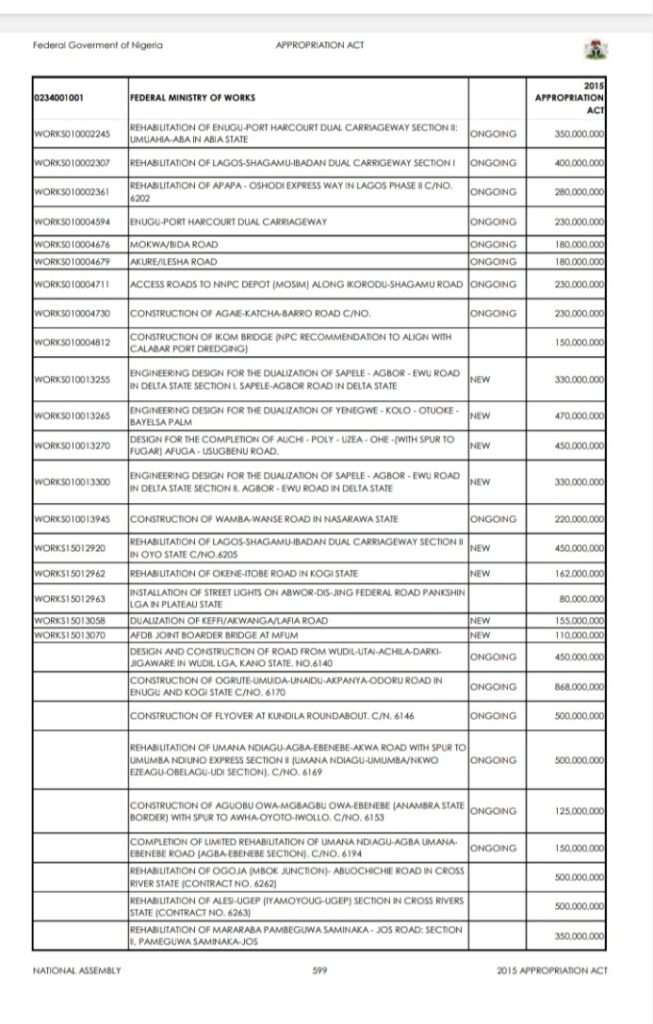
In the list, ₦2.13 billion was certified and ₦220 million was documented as paid on the released document of 2017. The project also carries the same ₦14.2 billion approved amount with the same company awarded, but it appeared under Plateau state, with a slightly different name, which is written as “Construction of Panyam-Bakkos-Wamba road: Wamba-Wanse section in Plateau State.”
All documents obtained show that only a small portion of the approved funds had been released by the government, citing underfunding on the project which prolonged its completion.
Idris Kore Shammah, a village head in Angwan Rimi, lamented bitterly over the abandoned road. He said the government has kept mum despite multiple inquiries from the local authorities about the condition of the project.
Joseph Kpanja, another village head from Mbasha, said when they asked about the status of the project, the construction company complained about a lack of funding from the government.
“They always tell us that nobody paid them for the second phase of the project,” he said.
However, a worker from Uniglobe Construction Engineering Limited, speaking to The Liberalist on the condition of anonymity for fear of victimisation, revealed a significant discrepancy in the project’s progress. While the source could not confirm the exact total, they stated that funds were released to construct 15 kilometers of the road. Despite this funding, less than seven kilometers of work has actually been completed.
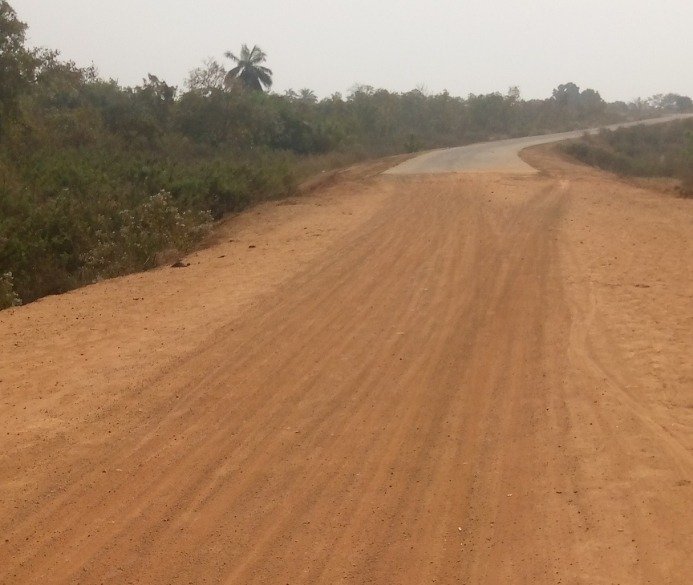
Mustapha Bala, the community leader of Kwarra and other villages connected to Wamba-Wanse road, said the contractor complained about the variation in the prices of bitumen and cements which led to delay in the construction.
“The contractor said bitumen was previously sold at ₦13,000 but the price has now increased to ₦30,000 per kilogram. Because of this variation, he realised that if he continued the work at that old rate, everything would fail. So he is seeking the federal government’s approval for a variation to march the new price.”
Bala also disclosed that when he tried to connect the contractor to Hon. Jeremiah Jerry Umaru, a federal lawmaker representing Nasarawa North Central, to seek government assistance for the project, the contractor refused and later disappeared without a word. Other residents also revealed that when the lawmaker arrived in their villages, he promised to intervene on the road, but they are yet to hear from him.
Contractor Reacts
Anslem Ijebor, the contractor for Uniglobe Construction Engineering Limited, confirmed the company received the contract but claimed it was never properly funded.
“The contract was awarded in 2014 but never funded,” Ijebor told The Liberalist. “When we mobilised equipment in 2015, we couldn’t start work until 2018 because the Federal Ministry of Works had not provided an approved road design.”
Ijebor revealed that while the initial mobilisation fee was set at ₦2 billion, the government released only ₦70 million in 2015. This paltry sum stalled progress immediately.
Between 2015 and 2019, the company performed grading and filling, raising a certificate for ₦824 million. According to Ijebor, the government took two years to settle this debt, paying in small batches of ₦100 million and ₦200 million.
Currently, the company faces a new financial hurdle. Between 2021 and 2023, Uniglobe raised a certificate for ₦1.15 billion that remains unpaid. Ijebor also noted that the rising costs of bitumen and cement require a government price review, which has yet to happen.
Meanwhile, an investigation into Uniglobe Construction Engineering Limited via the Corporate Affairs Commission (CAC) confirmed the company was registered in 1995 (RC73559) and remains active. However, the CAC filing lists the company’s nature of business as carpentry and upholstery, which contradicts its operations in civil engineering. Despite this discrepancy, records show Uniglobe was awarded multiple major infrastructure contracts, including the Ohafia-Oso federal road in 2013 and the Wamba-Wanse project.
Federal Ministry of Works Keep Mum
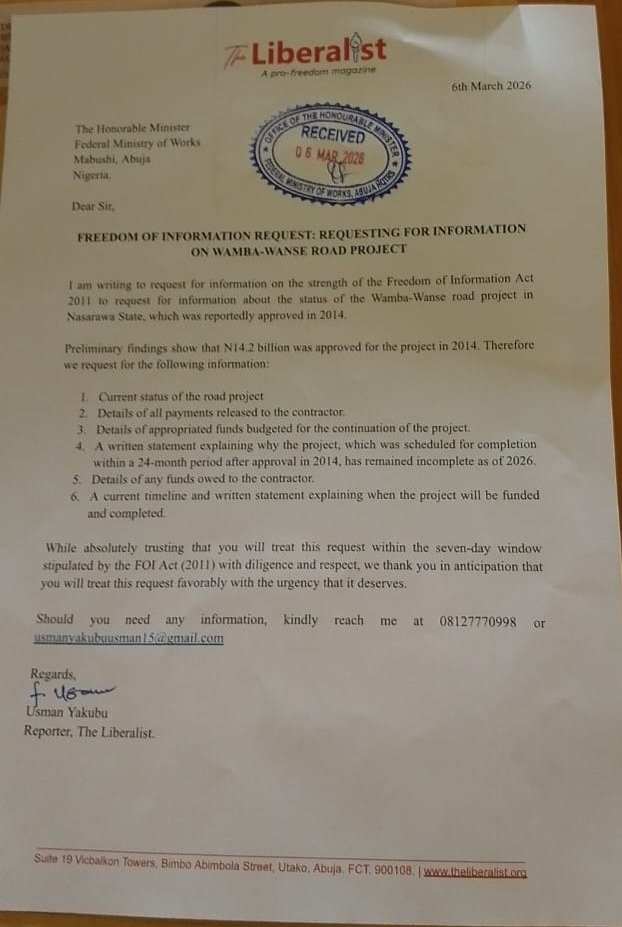
In a further attempt to acquire the details of the abandoned Wamba-Wanse road project, including budgeted funds for its continuation and evidence of payments released to the contractor, The Liberalist sent a Freedom of Information (FOI) request to the Federal Ministry of Works on March 6, 2026.
Although the Ministry duly acknowledged the request, it failed to provide a response within the seven working days stipulated by the FOI Act of 2011.
Patients, Victims Trapped in Villages
While questions linger over the project, residents have continued to bear the brunt of the government’s lack of diligence in completing the road.
In Kwara, another village connected to the Wamba-Wanse road, life is unbearable for residents. Patients and victims are trapped in villages without good roads. For many patients, accessing health care is akin to a death sentence. Their plights are far worsened by the poor, unfinished road.
Umar Mohammad, a retired civil servant residing in Kwarra had witnessed the gory incidents many times.
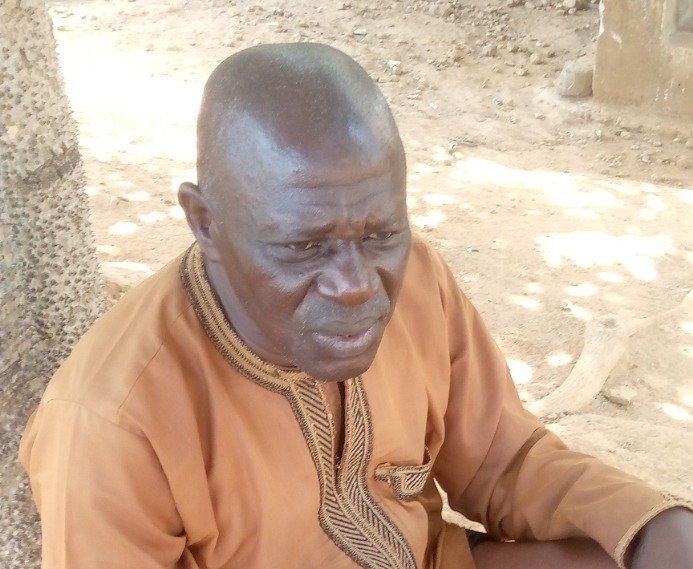
One evening, a horrible incident triggered an outcry in the village. Heavily armed thieves came in the middle of the night. They terrorised people from other parts of the village, shooting one of the youths. The residents tried to mount the road in a hurry, but they had to drive the motorcycle slowly to avoid potholes and heavy stones. Before reaching the halfway point of the journey, the patient died on the road. They returned to the village with the corpse.
“We tried to rush him to the hospital, but to no avail. He died on the road,” Umar said.
Narrating further, Umar still remembered the moment marauding kidnappers take advantage of the bad road to kidnap people and kill whoever resists their dangerous raid. This happened in another evening in Mangar. A resident tried to resist and escape but the kidnappers gunned him down.
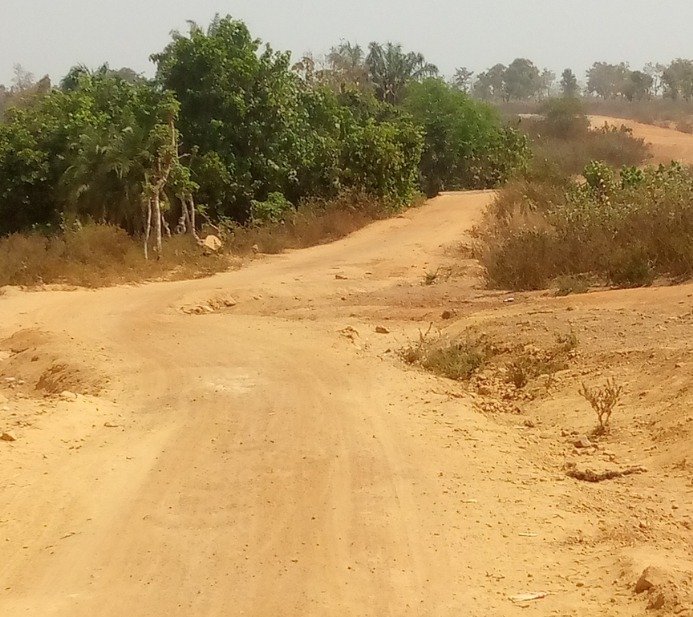
Critically ill residents frequently face extreme anxiety while travelling long distances over the ruined road to reach town hospitals. Mohammad highlighted that women are the primary victims, often requiring referrals to the Wamba General Hospital when childbirth complications arise. These women must endure excruciating pain while being transported on motorcycles.
“If a child is in a difficult position and it overpowers the nurses, they tell you to go to the Wamba General Hospital. That is where the dread of the road strikes the patient’s heart. It’s a big problem for us,” Mohammad said.
Ramatu Abubakar, a resident of the neighbouring village of Marmara, echoed this severe hardship. She noted that while the few completed kilometres reached her village, women in more distant areas often bleed and require urgent treatment. However, the road is so treacherous that even motorcycle riders refuse to transport them to the hospital.
School Children Are Not Left Out
As patients suffer without good roads to access medical treatment, across the villages, children who dream of schools are equally restricted from attending classrooms. They have no good road to use when going to school. Muhammad Abdullahi, another resident in Kwara revealed that public schools in villages are short of teachers, and parents prefer private schools in the neighbouring villages and towns, but the poor condition of the Wamba-Wanse road had shattered their dreams.
Concerned by the situation, Mohammad looked and pointed at the road. He wondered why roads alone could differ the aspirations of the children in his village. Most importantly in the modern age of widespread civilisation and digital technology.
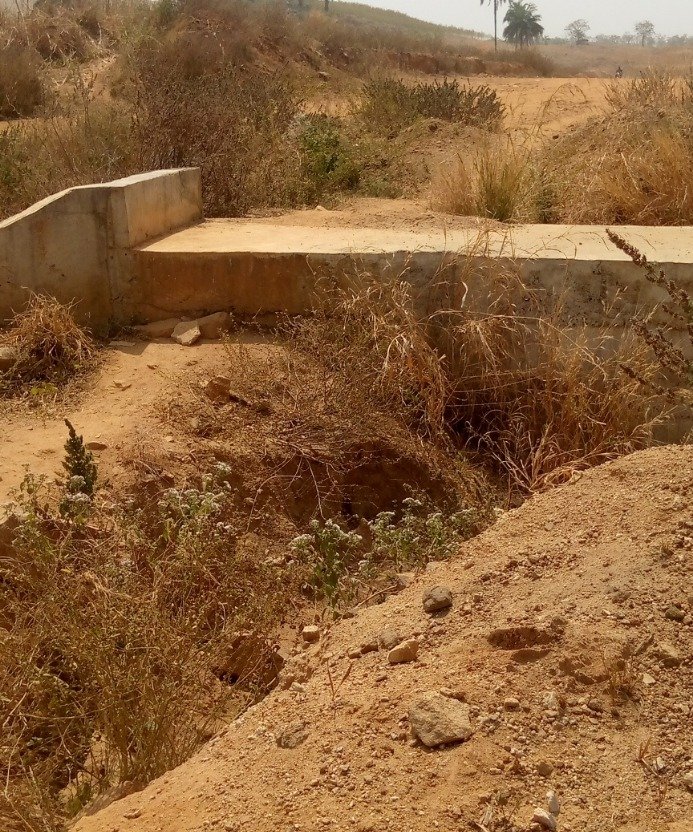
The troubles become worse during the rainy season. The children trek a long mile to their schools, traversing the muddy roads.
Many parents have to relocate them to the town, entrusting them to relatives or friends in order to secure their children’s dreams and safety.
“The children have to remove their shirts and shoes because of mud along the road. The road is extremely bad. And whenever they are back from the long trek, they will have to thoroughly wash their legs and some parts of their bodies,” Abdullahi said.
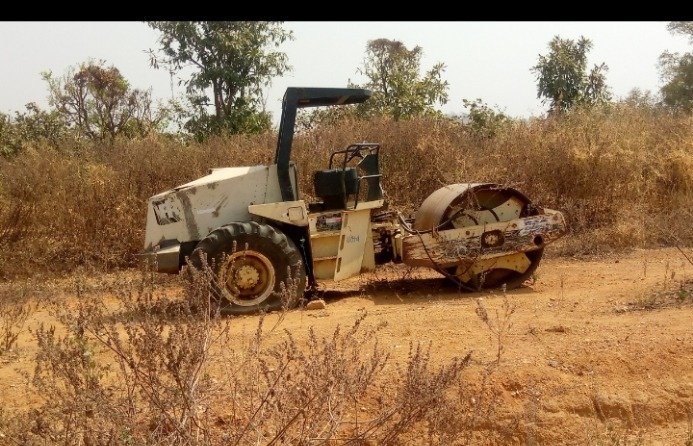
The most difficult challenge facing school children in the villages is transportation. The bad road not only discouraged them, but it also cast a forbidden shadow on their future. As Nigeria grapples with the issue of children who are out of school, if children in the Wamba community could no longer access roads to their classrooms, this will also add to the number of 20 million out-of-school children recorded across the country in 2026.
Residents Crowdfund to Build Bridge
Fifteen years ago, the Wamba-Wanse road was completely inaccessible to residents in Marmara village. A long, hollow riverbank stood between them and neighboring villages; nobody could cross the wide ditch.
Abubakar Bala, a 45-year-old farmer in Marmara, said the need for a bridge required urgent intervention. Consequently, residents wasted no time gathering funds. Some sold their cassava to donate, while others engaged in group farming to sell harvests and contribute.
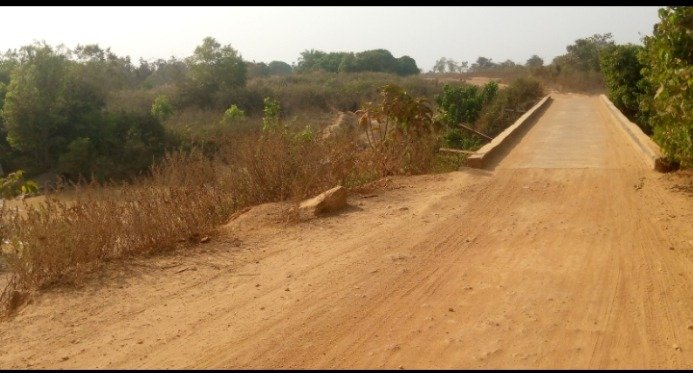
“We taxed ourselves. Most of us get our money from farming. We used to do community farming where many of us joined to cultivate large farms. Others did hard labour to generate the money,” he said.
After raising over ₦1.5 million, community leaders travelled to Lafia, the state capital. There, they registered for a World Bank support program that covered the remaining costs.
“We constructed that bridge at the rate of ₦5.5 million. At that time, things were not expensive. After we generated our portion, the World Bank released the rest of the money,” Abubakar told The Liberalist
When the bridge was in good shape, Bala transported guinea corn, maize, beans, and soybeans to markets beyond his village. Buyers previously arrived with cars and lorries to load produce in large quantities during both rainy and dry seasons. Currently, however, everything has stalled because the bridge is very weak. Bala now depends on selling to small local buyers or keeping the harvest for his family.
“Even if I harvest, I can’t transport it because cars can’t enter the village. We used to carry our harvest to Wamba town in the evening. Sometimes buyers come during the dry season, but the bridge remains the problem, especially during the rainy season,” he said.
The major bridge in Marmara village remains a difficult challenge. Without it, many residents are isolated. During a visit, this reporter observed that the bridge had become narrow, dusty, and cracked. Only a few motorcycles traverse the weak structure during the dry season. With a steep riverbank on its left side, the bridge’s condition underscores the urgent need to complete the Wamba-Wanse road.
While the residents’ efforts provided a solution for years, Bala said the bridge has become old and weary. Parts of the structure have cracked after years of bearing the burden of vehicles. As old wounds return, residents are once again yearning for a new bridge. They are eager to see construction workers reach their village to build both a sturdy bridge and a motorable road.
This report was produced as part of the HumAngle’s Strengthening Community Journalism and Human Rights Advocacy (SCOJA) project, supported by The Kingdom of Netherlands Embassy in Nigeria.