
Economy · News
African Unity Key to Surviving Trump’s Tariffs, Says Economic Policy Analyst
Lanre-Peter explained that African unity is a catalyst for economic integration, following U.S. President Donald Trump’s new tariff policy.

Listen to this report
AI narration · about 4 minutes
 Quick brief
- Lanre-Peter Elufisan stated that U.S. President Donald Trump's new tariff policy imposes up to 50 percent tariffs on African goods, ending benefits from the Africa Growth and Opportunity Act (AGOA).
- Elufisan highlighted that Africa trades only 15 percent among its countries compared to 30 percent with the U.S., China, and others, and poor industrialisation limits refining raw materials into finished products.
- He noted that despite 54 of 55 African countries signing the AfCFTA, challenges like lack of a common currency, security issues, and limited free movement hinder full implementation and unity.
AI-generated from the story.
Share the summary
Unity is crucial to Africa’s economic prosperity, especially amid the trend of protectionism from the United States and the worsening conflicts in Sub-Saharan Africa, noted Lanre-Peter Elufisan, executive director of the Ominira Initiative.
Speaking at the Liberalist Centre’s virtual event on Friday, April 25, Lanre-Peter explained that African unity is a catalyst for economic integration, following U.S. President Donald Trump’s new tariff policy.
On April 2, President Trump enforced new tariff policies, imposing a maximum of 50 per cent on goods coming from Africa. African countries previously enjoyed free access benefits from the Africa Growth and Opportunity Act (AGOA).
However, it looks like with the new Trump tariff, AGOA has come to an end because all African countries have been placed on universal 10 percent tariffs while some got even more.
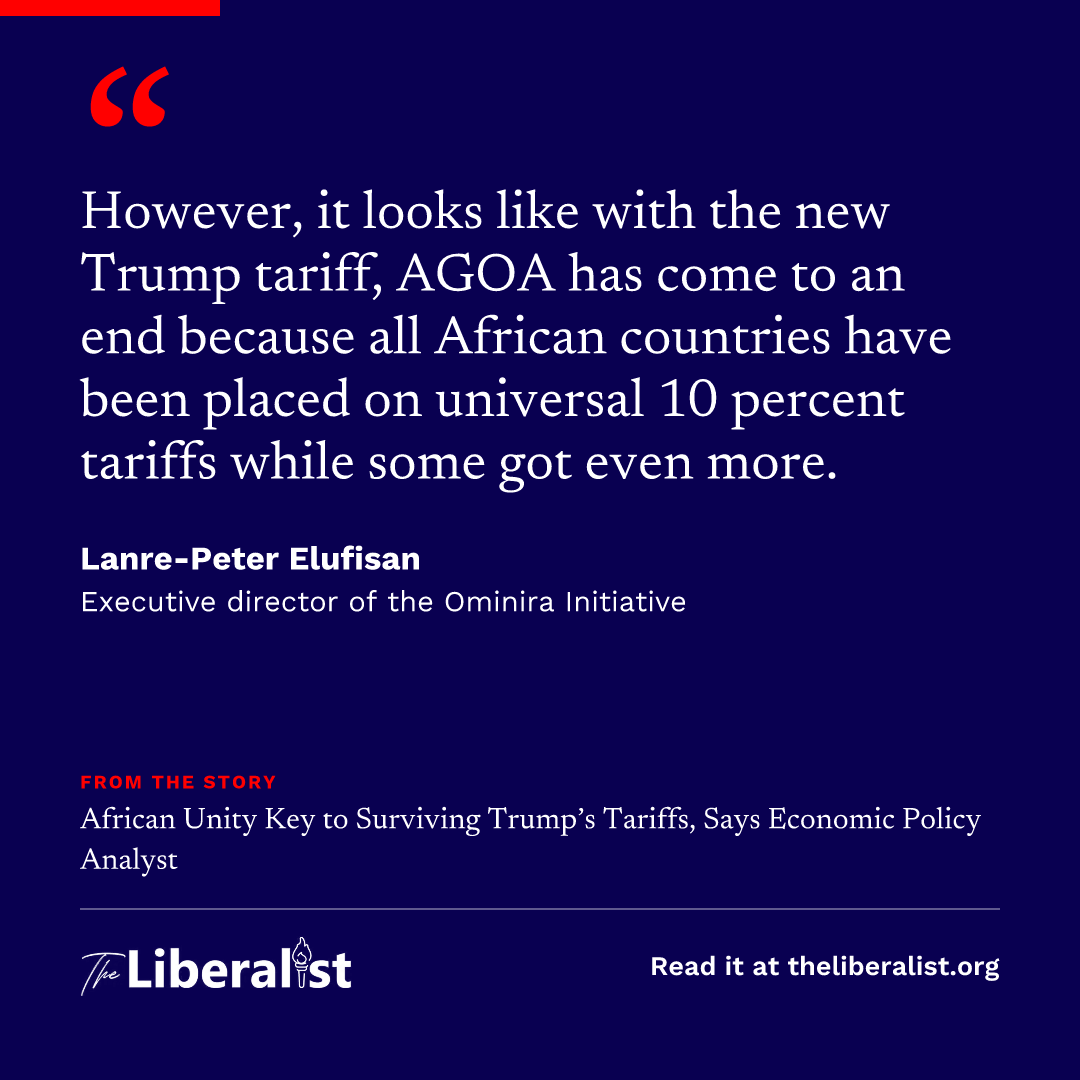
“However, it looks like with the new Trump tariff, AGOA has come to an end because all African countries have been placed on universal 10 percent tariffs while some got even more,” he said. “So, what happens to all those products that Sub-Saharan Africans have benefited from under the AGOA programme?”
“Although there are criticisms of the AGOA, it helped the African continent to diversify the exports of some of our goods. Now, that is one clear impact of Trump’s tariffs.”
Elufisan emphasised Africa can circumvent the impending trade plunge by leveraging the African Continental Free Trade Area (AfCFTA), but only after addressing some systemic challenges such as low intra-African trade and poor industrialisation.
“African countries trade more with the U.S., China and other countries at an aggregate rate of 30 per cent and barely up to 15 per cent with themselves,” he said. “If Africa is to be another powerful bloc like the European Union (EU), structured change is required.”
He cited the continent’s poor industrialisation and limited capacity to refine its raw materials into finished products as major barriers, despite its abundance of resources.
“As a matter of fact, Africa should have the best chocolate products in the world because, between Ivory Coast, Ghana and Nigeria, we have enough cocoa to do anything in the world,” Elufisan said. “Africa has raw materials and is poorly industrialised to refine them; hence the exports of raw products.”
Elufisan also highlighted several trade gaps preventing Africa from becoming a unified bloc like the European Union, noting the advantages enjoyed by the EU, such as a common currency and a high level of trade integration
“In Africa, we do not have that luxury of one currency. We have too many security challenges, from Congo to Sudan to Mali. We now have the Alliance of Sahel States (AES) and the junta-led governments pushing back against neo-colonialism. All of these challenges that exist on the continent today are in a way obstructing African unity,” he explained.
Quoting 19th-century French economist Frédéric Bastiat, Elufisan added, “If goods don’t cross borders, soldiers will,” stressing the importance of free movement across the continent.
“We first have to let goods cross borders, but before we let goods cross borders, we first need to let people cross borders. Africans should freely move on our continent, and goods should be able to move freely on our continent,” he said. “When we put those two things ahead, it would be easy for the continent to be a bloc, which comes with many benefits.”
While 54 out of 55 African countries have signed the AfCFTA agreement, Elufisan noted that signing is different from implementation, and unity is essential to realise its full potential.
The April webinar themed “From Trump Tariffs to Regional Opportunity: AfCFTA and the Future of Intra-African Trade” is part of the Liberalist Centre’s monthly event series advocating for economic and individual freedom across Africa.
Follow to get an email when we publish
Get The Liberalist Weekly
Every story we published this week, in your inbox each Friday. Free.
Share this story
Reporting like this takes time on the ground. Help keep it going.
Donate