
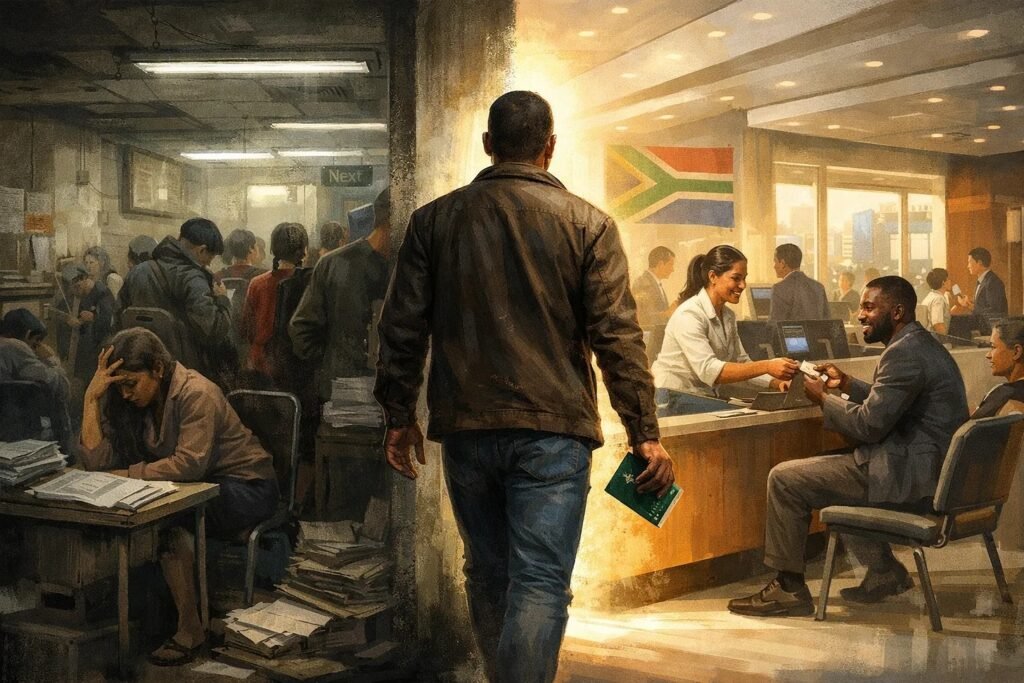
Standing in line for hours at a cramped, dirty and diabolically inefficient Home Affairs to get ID documents has been a rite of passage for South Africans for decades. But that may be coming to an end.
Home Affairs Minister and member of the Democratic Alliance (DA), Dr Leon Schreiber, has created a partnership with banks across the country, equipping private bank branches with the ability to process national IDs. The banks already have the infrastructure needed to process these IDs, all the while avoiding the usual onerous paperwork and queues that Home Affairs had become famous for.
This is just one step towards fixing Home Affairs, but it is definitely a step in the right direction. Government bureaucracy, exacerbated by unmotivated and under-trained public sector employees, wastes countless hours of every South African’s life. For every hour wasted in sparsely located Home Affairs, citizens could be working, playing or resting.
Now, with banks being able to provide more of these services, at a fraction of the cost to the fiscus than before, getting an ID can be just an errand, and not a daytrip.
Minister Schreiber promises that this is just the beginning, and that his reforms of Home Affairs will continue to make the department more efficient and cost-effective. For once, I am looking forward to monitoring the activities of a government department.
Schreiber’s appointment is definitely one of the small victories of the Government of National Unity (GNU). But not everyone seems to think that it’s a win.
The Economic Freedom Fighters (EFF) condemned “attempts to privatise Home Affairs”. Their statement cites South Africa’s shortfall in providing formal documentation for all citizens. But what’s lost on them is that the old, purely public-sector led Home Affairs is what caused this shortfall.
Critics of these reforms are not defending good public service. They are defending the very queues, delays and insecure legacy systems that made Home Affairs such a national embarrassment in the first place.
On X and elsewhere pundits have decried that banks are stepping on the government’s turf, and eroding state power. They see Home Affairs outsourcing its services to banks as essentially the government giving up on providing a service.
But I have to ask: so what?
Over the last few decades the government has proven that it cannot run Home Affairs effectively. The entire department has become synonymous with the slowest, most agonisingly dull ring of Hell.
South Africans require services that Home Affairs provides. It is unimportant that the department provides these services, or if the government provides these services. What matters is that the services are delivered.
And under the old dispensation, it was not being delivered efficiently, if at all.
We should not be clinging to keeping the state relevant for its own sake. If the government does not need to run something or be involved, it shouldn’t. Government run operations are, by their very nature, inefficient.
They take a simple service, tag on dozens of middlemen, unnecessary committees, corrupt procurement contracts, and have it all run by dead-eyed government employees who’d rather be doing anything else.
The government doesn’t have an incentive to do a good job. It gets paid regardless. It gets bailed out regardless. The private sector, on the other hand, is compelled to perform well because if it fails, it dies.
The increased privatisation of Home Affairs services and duties is ultimately a good thing. There may be hurdles along the way. Nothing is perfect. But it doesn’t need to be perfect. It just needs to be better than what it was before. And there is no way that anything can be as bad as what Home Affairs has been putting South Africans through for the last thirty years.
This article was first published by RationalStandard.