
On a Sunday morning in Kampala, Uganda’s capital city, heavily armed military personnel shut down NTV Uganda, Spark TV, and The Daily Monitor. Media watchdogs described the move as a disproportionate and opaque restriction on press freedom, noting that the authorities failed to provide evidence or cite any specific broadcast to substantiate their claims.
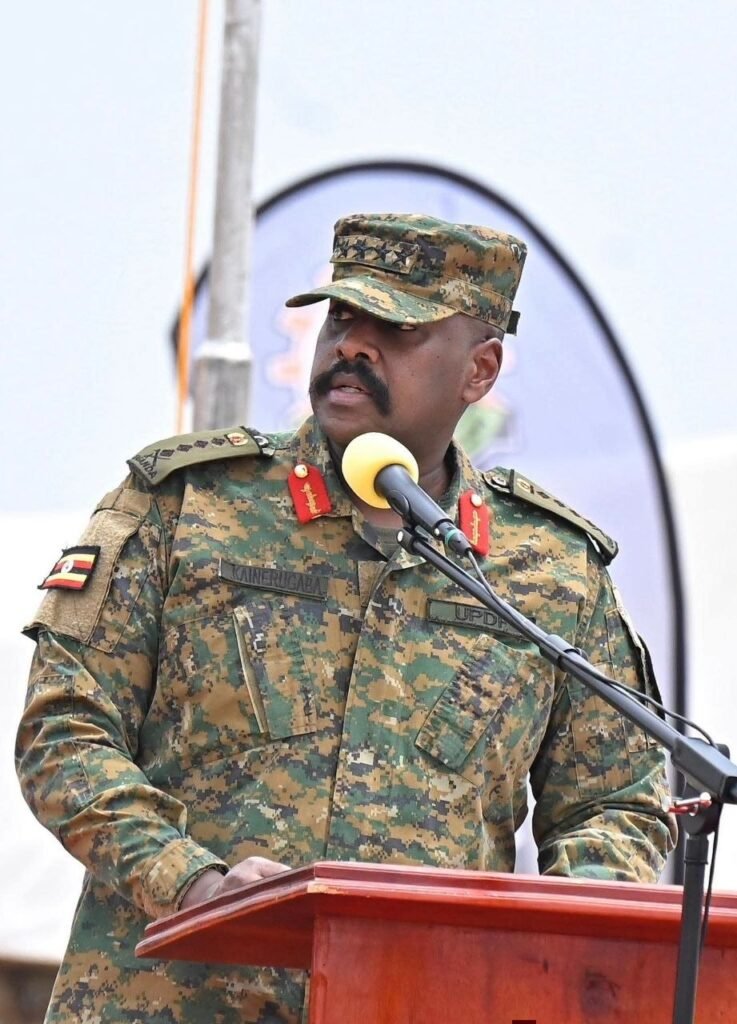
The soldiers acted on the directive of Muhoozi Kainerugaba, the Chief of Defence Forces. Taking responsibility for the siege, the General did not invoke the familiar “national security” justification often used by authoritarians to mask repression. Instead, he declared, “In Uganda, I do not believe in a free press! The press should be guided by cadres of the revolution.”
He further bragged about his unchecked authority, saying, “I have the power in Uganda to shut down ANY media house I want to… This power was given to me by my great father.” The General publicly threatened to arrest Susan Nsibirwa, the Managing Director of Nation Media Group, before retracting the threat.
The violent shutdown of Nation Media Group reflects a broader assault on press freedom across Africa. Analysts note that when a state deploys soldiers to forcibly shut down a private media organisation simply because it criticises the government, it signals the collapse of civil liberties.
Uganda has followed this path before. In 2013, state security forces laid a 10-day siege to the offices of The Daily Monitor. The raid occurred after the newspaper published a leaked intelligence letter detailing an alleged plan to eliminate political rivals and groom President Yoweri Museveni’s son, Muhoozi Kainerugaba, as his successor.
Uganda now ranks 141st out of 180 countries in the latest Reporters Without Borders (RSF) World Press Freedom Index. However, the assault on the media extends far beyond Uganda. Just weeks before the Kampala incident, Niger’s military junta carried out a coordinated attack on press freedom. In May, the National Communications Observatory (ONC), a new media regulatory body established by the military authorities, announced the nationwide suspension of nine international French-language media outlets.
Ibrahim Manzo Diallo, president of the ONC, announced the suspension through the state broadcaster, Télé Sahel, cutting millions of citizens off from outlets including France 24, RFI, TV5 Monde, and Mediapart. He claimed the organisations disseminated content “likely to seriously undermine public order, national unity, social cohesion, and the stability of the Republic’s institutions.”
The Broader Trend of Repression
Authoritarian governments and military juntas across Africa increasingly treat independent journalism as an enemy rather than a pillar of accountability. In Burkina Faso, the military authorities recently dissolved more than 100 civil society organisations, imposed a total ban on student unions, and repeatedly suspended independent media outlets to dismantle any institution capable of challenging military excesses.
Analysts note that when authoritarian leaders succeed in their war on truth, the result looks exactly like Eritrea. RSF describes the country as a “news desert.” For three consecutive years, Eritrea has ranked last in the RSF Press Freedom Index, making it the world’s worst country for journalism. President Isaias Afwerki outlawed independent journalism in 2001. Today, the state-run Eri-TV controls virtually all information available to citizens, while authorities punish any deviation from the official narrative.
The regime has held at least 11 journalists, including the renowned Swedish-Eritrean writer Dawit Isaak, incommunicado in inhumane conditions for more than two decades without trial. Eritrea illustrates what happens when authoritarian leaders completely capture the civic space, enforcing silence while the outside world remains largely unaware of the citizens’ suffering.
Global data reflects this worrying trend. In the latest RSF World Press Freedom Index, press freedom fell to its lowest level in a quarter of a century. For the first time in the Index’s 25-year history, more than half of the world fell into the “difficult” or “very serious” categories. The share of the global population living in countries with a “good” press freedom rating has collapsed from 20 percent in 2002 to less than one percent today.
Anne Bocandé, RSF’s Editorial Director, attributed the crisis to “authoritarian states, complicit or incompetent political powers, predatory economic actors, and under-regulated online platforms.”
The repression is not limited to military governments or authoritarian regimes alone. Even in countries that remain formally democratic, authorities increasingly rely on legal instruments rather than soldiers to silence critical journalism. For instance, Nigerian authorities have weaponised the Cybercrimes Act to arbitrarily arrest, detain, and harass investigative journalists who expose corruption. The country scored just 37 out of 100 on the safety indicator, with authorities increasingly exploiting legal loopholes to bypass the higher threshold required in civil litigation.
“In 2026, a new red line has been crossed. The weakening of media independence, whether through economic pressure, authoritarian overreach, or conflict, poses an existential threat to democracy everywhere,” Anne said.