
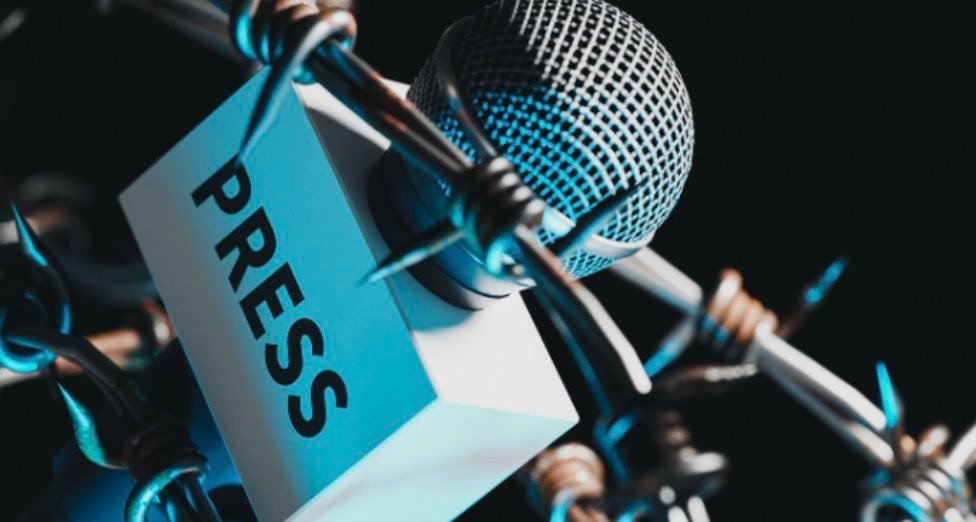
Several African countries continue to struggle to ensure that journalists and media organisations operate without fear of censorship or intimidation, the 2026 World Press Freedom Index published by Reporters Without Borders (RSF) reveals. According to the report, global press freedom has plummeted to a 25-year low. While a few nations like South Africa and Namibia continue to champion transparency, the broader continental trend shows a disturbing rise in repression of media freedom across all levels.
The RSF assesses nations on a scale of 0 to 100 where higher scores indicate greater freedom. This ranking combines data on media abuses with surveys from journalists, researchers, and human rights defenders. The final score rests on five pillars: political climate, economic reality, legal framework, social context, and security. For the first time, 94 of the 180 evaluated nations fall into the “difficult” or “very serious” categories.
While physical violence remains a constant threat, the legislative indicator suffered the most significant global decline this year. RSF said 60 percent of all countries experienced a deterioration in their legal environment. Many African governments now weaponise criminal charges, cybercrime acts, and anti-terrorism laws to incarcerate journalists and bankrupt newsrooms. For instance, a report revealed a new landscape in Kenya where the law is increasingly being weaponised to silence dissent and suppress public interest reporting. The report shows 24 percent of abuse of court processes forming a central mechanism for targeting journalists, while the use of vague and overly broad legislation constituted 29 percent of the weaponised instruments.
Eritrea remains at the absolute bottom of the global ranking, occupying the 180th position for the third consecutive year. As the continent’s largest prison for journalists, Eritrea suffers from abysmal scores across all five RSF’s press freedom report components. The government maintains an iron grip through a complete state monopoly on information. Since banning all independent media in 2001, the Ministry of Information has ensured that no editorial autonomy exists, and the sole broadcaster, Eri-TV, operates exclusively as a state propaganda mouthpiece.
The Sahel region also remains a dangerous hotspot for media repression. Niger Republic recorded a drastic fall, plummeting to 120th position from 83rd following a military coup that shattered its political and security indicators. The ruling junta aggressively controls broadcasting and silences dissent. For instance, the communications minister suspended the private channel Canal 3 TV simply for broadcasting a show that rated the performance of government ministers. Authorities subsequently arrested the station’s editor-in-chief Seyni Amadou, accusing him of disturbing public order.
Even stable democracies are twisting digital regulations to criminalise independent journalism. Benin dropped to 113th from 92nd due to its draconian Digital Code and the heavy-handed actions of its regulatory body, the HAAC. This body has censored and suspended news websites like Bénin Web TV and Crystal News, threatening their economic survival under the guise of combating unauthorised content. Tanzania also fell to 117th from 95th on the ranking following authorities showing zero tolerance for press coverage of political opposition. Police recently arrested reporters Mariam Shaban and Jenifer Gilla merely for documenting a banned opposition protest.
Nigeria, the continent’s most populous country, made a little progress by climbing to 112th position from 122nd on the ranking. Despite this progress, RSF still describes the country as “one of West Africa’s most dangerous and difficult countries for journalists, who are regularly monitored, attacked and arbitrarily arrested.”
On a more positive note, South Africa and Namibia remain the press champions of Africa, ranking 21st and 23rd respectively. Their success stems from strong legal frameworks that protect reporters from direct state interference. For instance, in 2021, the Constitutional Court of South Africa ordered changes to the law on intercepting communications in order to safeguard the confidentiality of journalists’ phone conversations and the need to better protect their sources. While in Namibia, the parliament passed a law on access to information that is supposed to facilitate investigative journalism. These nations prove that a free press can thrive when supported by democratic institutions and laws that safeguard the confidentiality of sources.
However, the 2026 RSF Index shows that fundamental freedom of the press in Africa remains at a troubling point. Dr Gbemiga Bamidele, convener of The Society for Journalism Enhancement Initiative, recently urged African governments to stop justifying media restrictions as a matter of national security. “A restricted press does not enhance security, it conceals insecurity,” he said. He added that across Africa, governments often justify restrictions on the media in the name of national security.