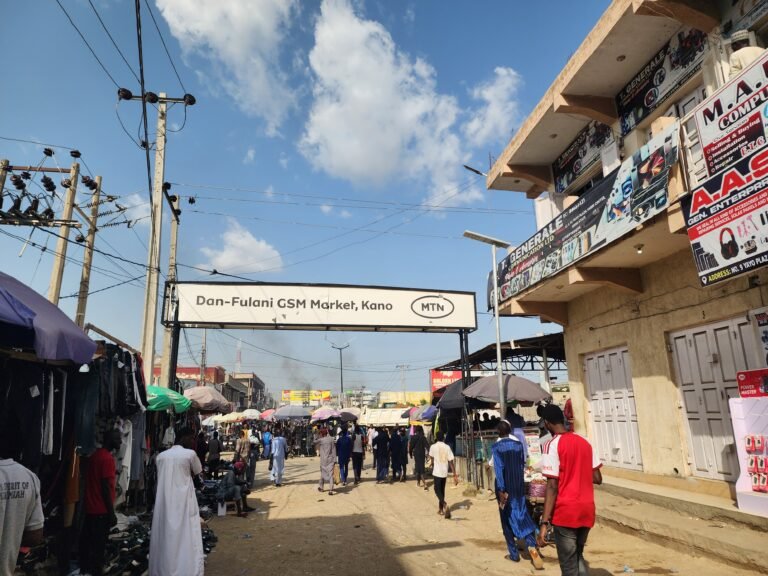

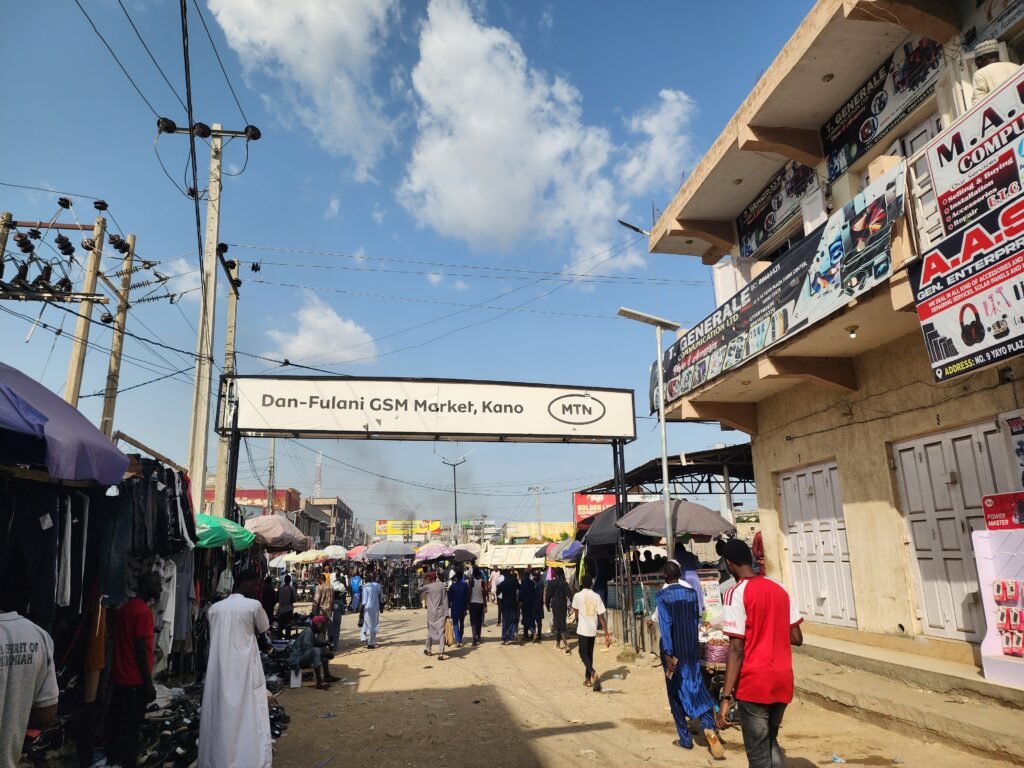
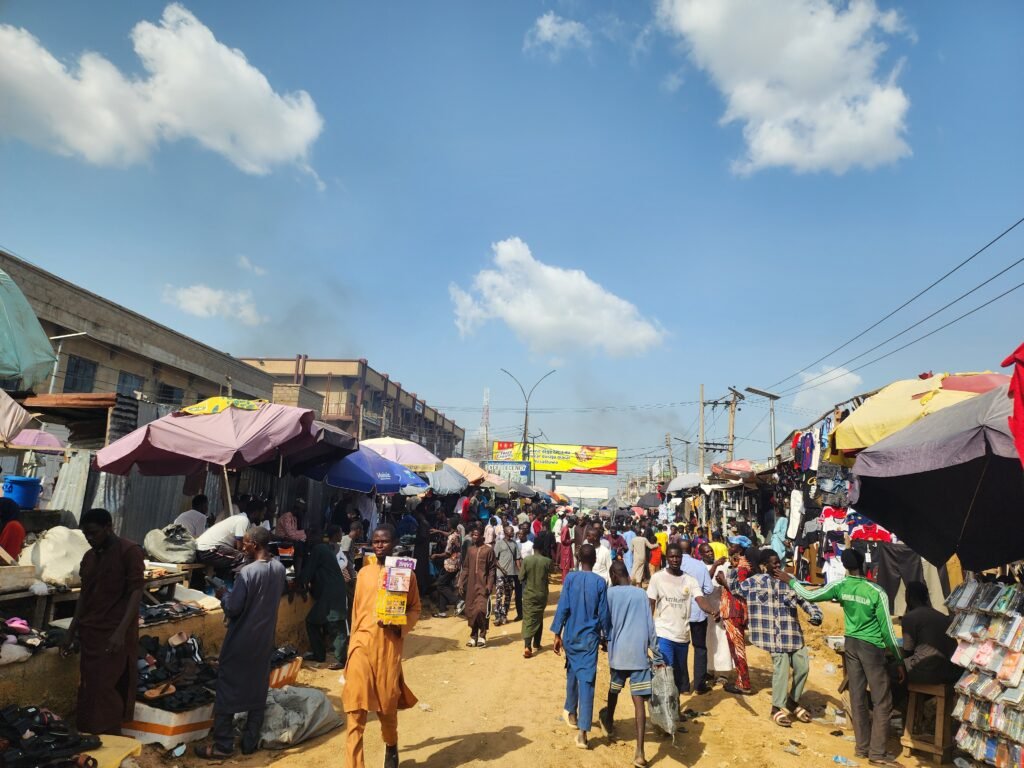
On a Sunday afternoon at the Dan-Fulani GSM market in Kano, known to everyone as Farm Centre, the sun is merciless and trade is brisk. Traders shelter under faded umbrellas and makeshift canopies while buyers shoulder their way down dusty lanes hung with phones, chargers and cables.
Yahaya Muhammad, who is in his early thirties, sells phone cases, earphones, power banks and the like from a shop with wooden shelves and a glass counter. Two assistants serve customers inside while he sits out front on a raised wooden chair, watching the lane. Not everyone who walks towards him wants to buy something.
By four o’clock on the day of our visit he had taken less than ₦10,000. “If you compare the number of customers we get to the number of times tax or levy collectors come,” he says, “the collectors arrive even more often than the customers.”
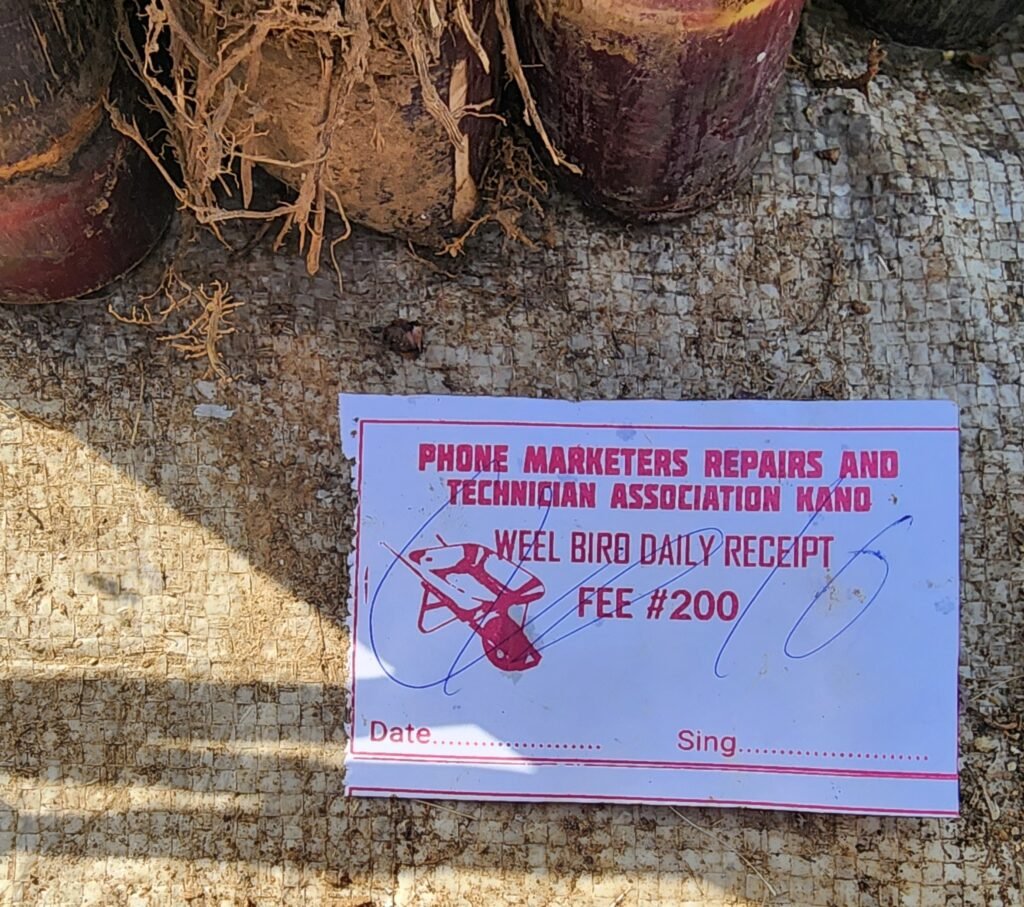
His list of creditors is long. He pays ₦200 a day to the market association, ₦20,000 every four months to Tarauni local government, ₦20,000 to federal tax officials, more than ₦10,000 to the Kano State Internal Revenue Service (KIRS) and ₦15,000 a year to the state signage agency. If he trades six days a week and the federal charge is yearly, that comes to more than ₦160,000 a year.
“If not for God’s grace, I doubt this business could survive,” he says. “Before you finish paying one, another arrives. They come whether you make a profit or not.”
In some months, he says, his profit barely covers the levies. It must also pay his two assistants, feed his family and get him to the market each morning.
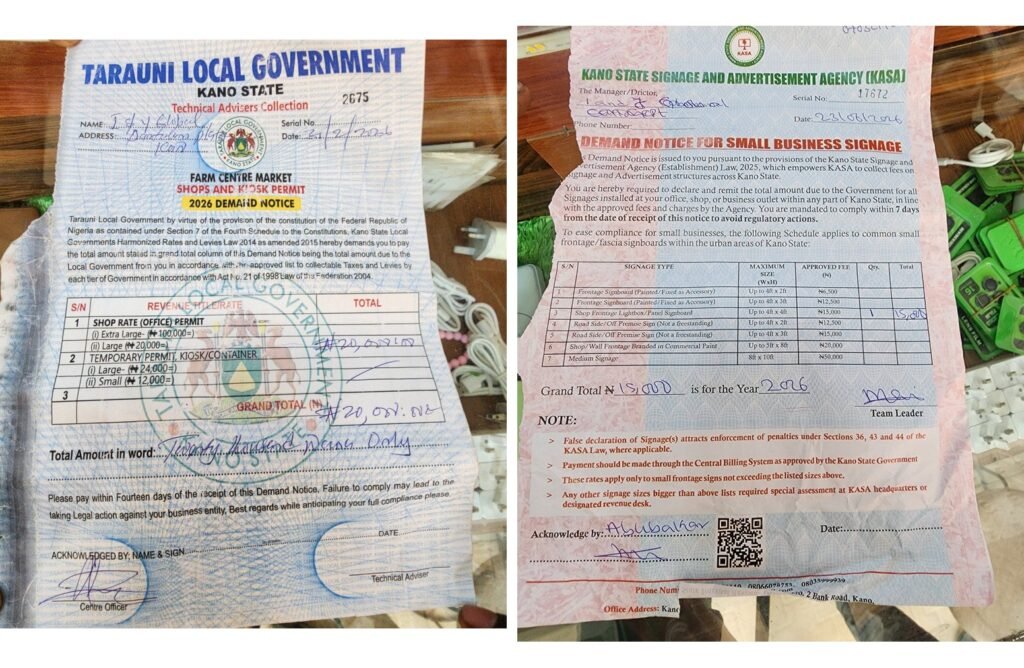
Yahaya’s complaint is one of many other Nigerians lamenting the rising cost of doing business in the country. In July the Central Bank of Nigeria’s business survey found that firms ranked high and multiple taxation as their biggest problem, ahead of insecurity and interest rates. A federal tax overhaul that took effect in January exempts the small businesses from company tax and VAT. It does little about the state and local levies that eat into a market trader’s profits.
Kano was supposed to have fixed this already. In 2022 it passed a law to route state and local revenue through a single, co-ordinated system. Visits to two of the city’s biggest markets, and receipts collected from traders, suggest that the law exists mostly on paper.
At Farm Centre even the hawkers pay. Sugarcane sellers and children selling sachet water hand over ₦200 a day for the right to work the market’s lanes.
Ishaq Danfulani, the market’s chairman, explains the system, in an hierarchical order. He says traders pay the federal government, the Kano state government and Tarauni local government; how much depends on the size and nature of each business.
Federal taxes go to the Federal Inland Revenue Service (FIRS), now renamed the Nigeria Revenue Service. The KIRS and the local government each collect their own, every year.
In reality, traders say officials visit their locations, look over a shop and its stock, and name a figure. The trader’s capital, the goods on display and the type of trade all feature in the assessment.
“For the local government, whether you have a temporary or permanent shop, you will pay ₦12,000,” Danfulani says. A trader with two shops pays ₦24,000 a year, a low-cut shop ₦6,000 and a temporary stall ₦4,000. These figures do not square with Yahaya’s account. He says Tarauni charges him ₦20,000 every four months, five times the rate the chairman quotes.
On top of this the KIRS charges a percentage of each trader’s assessed tax, and the market association collects its ₦200 a day.
Danfulani gives the state some credit: it has built roads around the market. The federal and local governments, he says, take the money and provide little in return. Tarauni LGA collects yearly, monthly and sometimes daily, yet in the past five or six years it has done almost nothing for the market.
Muntari Yarima, a former council chairman, supplied a fire engine; it was later withdrawn. A successor, whom Danfulani calls Cantoma, provided a refuse truck. That too got lost. So the traders’ union now does the work itself, despite the millions collected by the state and local governments.
“Our own union of business owners is now responsible for disposing of the waste. We bought vehicles to dispose of the waste. We are also responsible for security,” he says. “They collect money for sanitation daily, saying it is for sweeping the market, but they are not doing it.”
Food sellers who set up around the roundabout pay daily and monthly levies too, and get little for them.
Not every agency stands accused of double-dipping. Abubakar Muhammad, an official of the Kano State Advertisement and Signage Agency (KASA) posted to Farm Centre, collects fees on the signboards outside shops. The charge is annual, he says, and depends on the size of the sign and on what the trader can afford, a formula that leaves a good deal to the collector’s discretion. Signage fees used to be collected by local governments, he says, but the power now belongs to the state alone, and councils may no longer levy them.
“I have not received any complaints about local government officials or other agencies coming to collect signage revenue apart from KASA,” he says.
A Law on Paper
The muddle is not for want of legislation. In December 2022, under Abdullahi Umar Ganduje, then the governor of the state, Kano enacted the State and Local Government Revenue Administration (Consolidation and Codification) Law, 2021. It was meant to end precisely the sort of overlapping charges that Farm Centre’s traders describe.
The law folds the revenue rules of the state and its councils into a single code, and gives the KIRS sole authority to assess, collect and account for all state revenue, tax and non-tax alike. Section 29 sets up a State and Local Government Joint Revenue Committee to harmonise collection across the two tiers. Among its duties is to teach the public what it owes, and to whom.
Interviews with traders show that on that score it has failed. Agencies still collect separately, with little sign of co-ordination, and most of the traders interviewed for this story had never heard of the law.
Danfulani remembers it working, briefly. Traders were to pay once, through a single channel serving both the state and the council.
“During the previous government, particularly under Ganduje’s administration, it was okay,” he says, “but now every agency is collecting taxes by hand.”
Mahmud Yusuf, a tax and fiscal-policy analyst in Kano, blames turf wars. The state is entitled to personal income tax and some business fees and levies; councils to tenement rates, market fees and other local charges. Where those powers overlap, the two tiers squabble over who collects. They also quarrel over how revenue is shared, because councils differ in population and economic activity, and so in what they can raise.
Councils that feel short-changed by the joint arrangement, Mahmud says, have revived their own collection committees. Traders then get two visits instead of one.
“The effectiveness of these laws depends on their implementation,” he says. That takes political will and agencies with enough independence to stick to their defined roles.
The joint committee was supposed to tell traders about the law. Mahmud thinks it has not tried very hard, and that it would struggle if it did: many Nigerians distrust their governments too much to engage with them.
Information about who may collect what ought to be published where traders actually look, including on social media, he says. Mostly, it is not.
“In my view, the State and Local Government Joint Revenue Committee has not adequately fulfilled its mandate,” he says.
“Just ignore them”
Ignorance has a price. Mahmud recalls a trader who had paid all her taxes, only for men claiming to be from the KIRS to keep turning up at her shop demanding more. She reported them. From her description, the KIRS said, they were not its staff, and she should disregard them. It offered no proper way to report the men and made no effort to catch them.
“Simply telling taxpayers to ignore unauthorised collectors does not adequately address the problem,” says Mahmud. Revenue authorities need a channel through which traders can report impersonators, and the will to act on what they hear.
Not every extra demand comes from government, he admits. Some of it preys on traders’ uncertainty about what they owe.
“Imagine a trader who does not know what to pay, how to pay or which authority is entitled to collect a particular tax,” he says. “Such a trader becomes vulnerable whenever someone arrives demanding payment.”
The remedy, he argues, is for every taxpayer to know what is owed, how to pay it and who is entitled to collect it.
Cloth and Levies
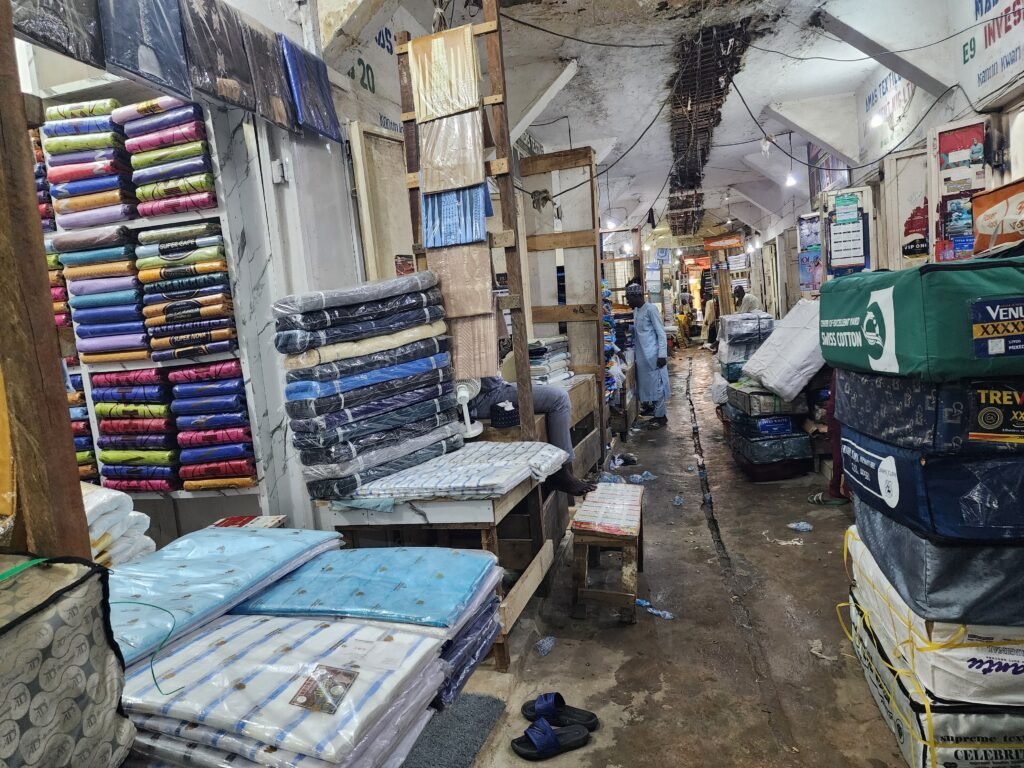
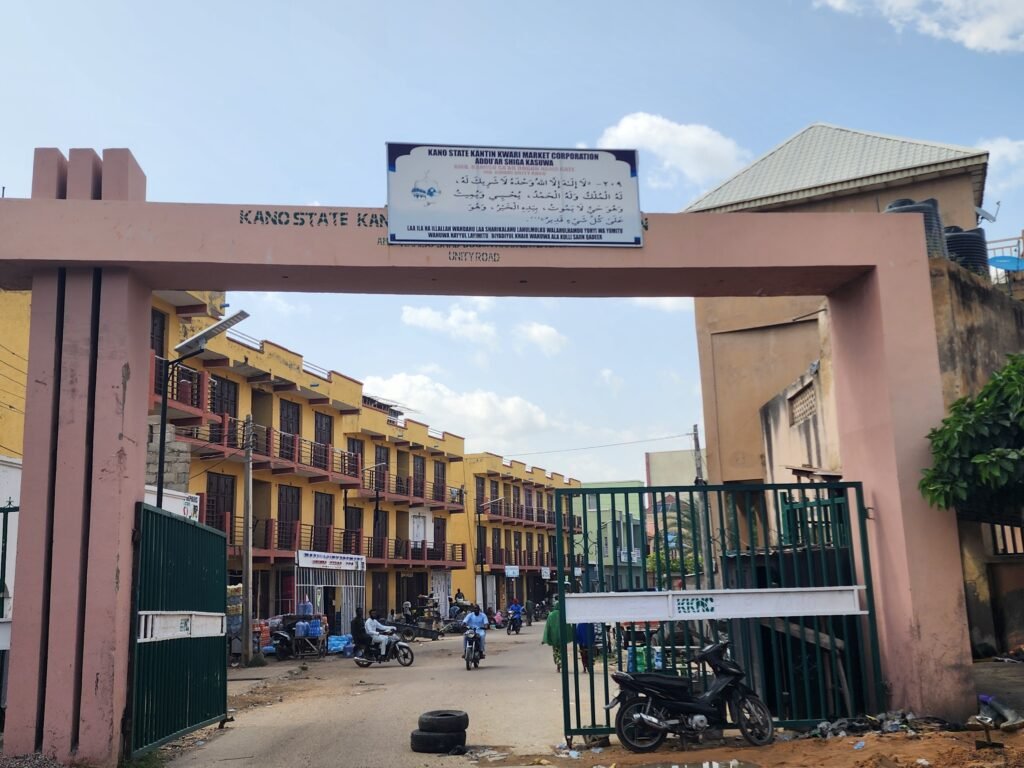
Across the city in Fagge local government area, Kantin Kwari, one of Africa’s biggest textile markets, dresses the part. Men in flowing kaftans and embroidered caps move through the crowd, some haggling, some hauling loads, some leaning on rails to watch the street go by.
Most corridors are lined with cloth from floor to ceiling. In Gidan Alaramma, one section of the market, bundles of brocade in glossy stamped bags are stacked high on both sides. Alhaji Adamu, who has traded here long enough to remember how the market used to work, watches from his shop as an assistant haggles with a customer over a length of fabric. Between calls to passers-by, he lists his own outgoings.
“The first tax is for the state government, which I paid yesterday. I paid ₦3,000 because we pay as a group,” he says. There is also a monthly sanitation levy of ₦1,000 and, sometimes, ₦6,000 a year in shop rates to the local government.
Traders who do not band together fare worse. They are charged ₦15,000, ₦20,000 or as much as ₦50,000, depending on how well they bargain with the state’s collectors. A tax that varies more than threefold with the taxpayer’s haggling skills is not much of a system.
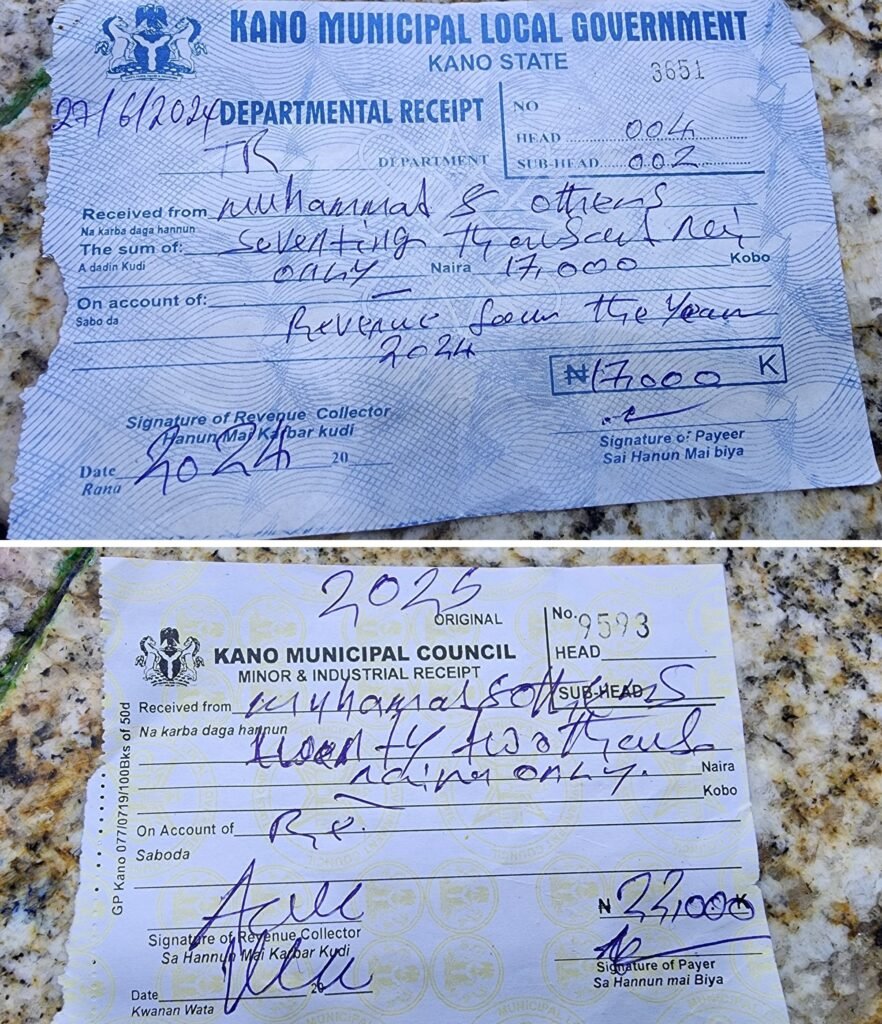
Traders here also want to know where the money goes.
That matters, because Kantin Kwari is a big contributor to Kano’s internally generated revenue. Its growth, analysts say, depends on a tax system that is predictable and does not overburden the people who trade there.
Research by the Liberalist Centre, a pro-freedom think-tank in Nigeria, found that traders in the market pay annual state taxes of ₦20,000-50,000 and local-government levies of about ₦50,000, plus a scatter of informal charges. More than half of those surveyed said overlapping taxes had caused them direct financial strain. Some had closed or moved their shops as a result.
Yusuf Yunus, who chairs the traders in Gidan Alaramma, does not object to paying tax. His complaint is about what happens to it.
“The problem we sometimes face is that the money is not being used properly,” he says. “You will see many business owners who do not want to pay.”
His members pay shop rates, sanitation levies and two separate local-government taxes.
Reform from the top
Kano’s problem is Nigeria’s in miniature. Federal, state and local governments all tax the same small businesses, often for the same services, and unofficial or poorly documented charges make it hard for owners to know what they are legally required to pay.
In June 2025 President Bola Tinubu signed four laws to overhaul the system: the Nigeria Tax Act, the Nigeria Tax Administration Act, the Nigeria Revenue Service (Establishment) Act and the Joint Revenue Board (Establishment) Act.
Taiwo Oyedele, Nigeria’s minister of finance, who chaired the presidential committee behind the reforms, said more than 90 percent of small, micro and nano-scale enterprises would no longer have to worry about compliance. “These businesses are now exempt from paying corporate income tax, charging VAT, deducting withholding tax, or remitting PAYE for their staff,” he said.
The laws took effect in January 2026, promising simpler administration, an end to duplication and better collection. In March, the government introduced a presumptive-tax regime for small businesses, meant to make compliance easier and coax informal firms into the system. The Joint Revenue Board also prohibited road taxes, levies and stickers collected at checkpoints, whether by states or by non-state actors.
None of this has translated to real enforcement. The central bank’s business expectations survey for July 2026 still found taxation to be businesses’ biggest complaint.
According to the report, 70.8 percent of respondents named high and multiple taxation as their most pressing constraint, ahead of insecurity (69 percent) and high interest rates (66 percent). Bank charges, unclear economic laws and poor infrastructure trailed behind.
The pattern is not new. A 2020 survey by PwC, a consultancy, found that 49 percent of small businesses said taxes and levies consumed 20-40 percent of their income or profits, and 28 percent found local-government charges the hardest to comply with.
Nigeria has between 39.6m and 41.5m of them, according to the National Bureau of Statistics, and 99.8 percent are micro-enterprises. They produce an estimated 48-50 percent of GDP and account for 84-87 percent of jobs.
Audu Bello, an economist at Usmanu Danfodiyo University in Sokoto, says that piling levies on them makes profits harder to come by and survival less likely. “That might even lead them to stop the business,” he says.
It also deters people from starting firms at all, he argues, and pushes up prices as traders pass the levies on to their customers.
“Small businesses should be exempted from any level or form of taxation if you want to promote entrepreneurship and employment,” says Dr Bello.
No Comment
The KIRS did not respond to repeated requests for comment.
A letter delivered to its headquarters in Kano on October 13th was acknowledged but not responded to.
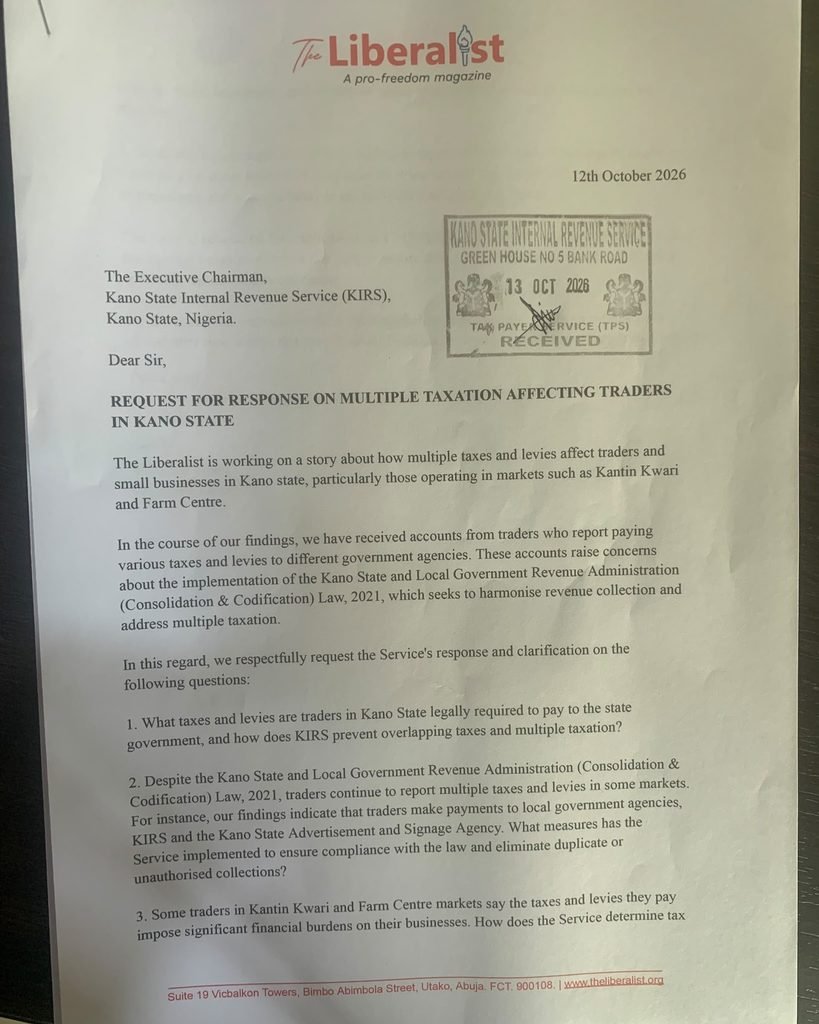
The Liberalist called and sent an email and WhatsApp messages to the contact details listed on the agency’s website. One of the WhatsApp numbers responded and referred the publication to another contact identified as Abubakar, he requested an email address to which he could send the Service’s response of which he was provided.
However, following several follow-ups, Abubakar said he was awaiting approval from the Executive Director of KIRS before sending the response.
____________
This story was produced under the Accountability Reporting Project on Bureaucratic Barriers to Businesses in Nigeria, supported by the Ominira Initiative Freedom Fund.