
This story was supported by the Pulitzer Center.
_________
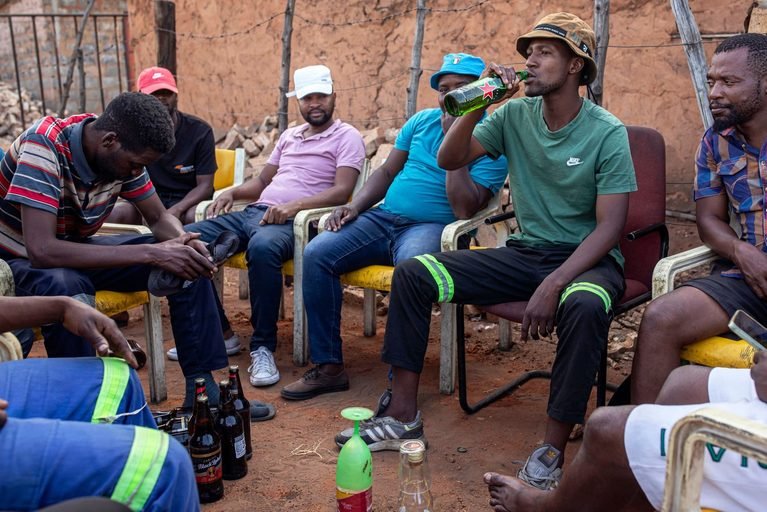
In Maru, a municipal town in Zamfara state, gold mining is not an industry in the formal sense. It is a part of people’s everyday life. The hustling and bustling in the town feels like it is constantly inhaling and exhaling men between the mining sites and the settlements. At dawn, some motorcycle riders are already dusty after returning from night work at the sites. Others are just leaving, carrying shovels, diggers, and sacks tied to the back of their seats.
“If you were born here, you would most likely be a gold miner,” one local miner quips while speaking to this reporter.
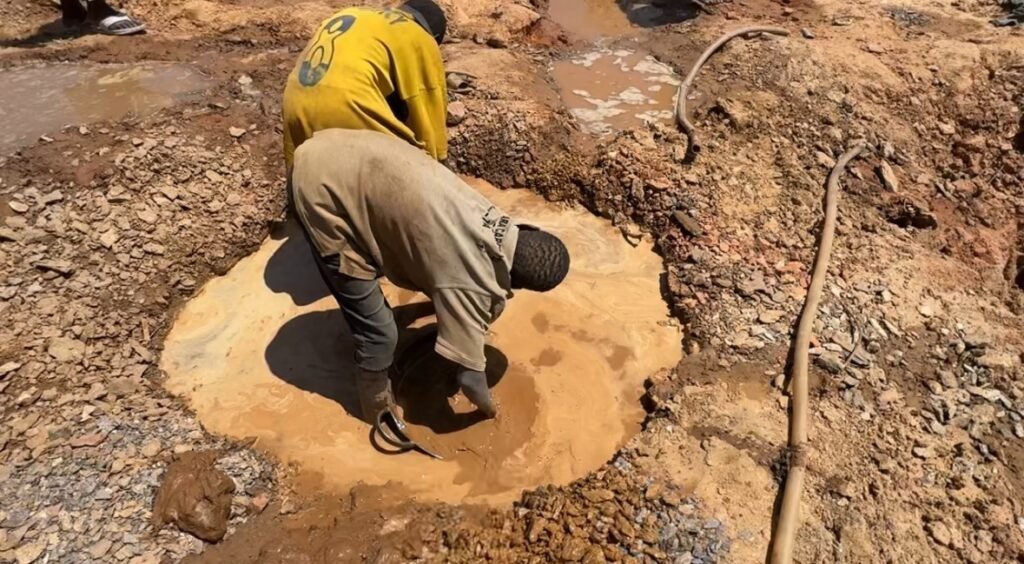
The Liberalist interviewed scores of people whose entire lives depend on gold mining in the town, among whom is Aliyu Suleiman, a 45-year-old who has been mining gold for 35 years. Another is Shamsudeen Ibrahim, 32, who has been mining for 12 years. Raw extraction is so common in Maru that after rainfall, when water collects in open ground, people gather around stagnant pools. They use simple tools to wash the soil and test if the water carries traces of gold. Children play with still water by imitating the process of extracting gold mixed with sand. Here, kids grow to know there is massive gold to mine.
“You see, anyone who doesn’t have a source of income and discovers that if he goes out [to mine], he will get what to eat and feed his family, he doesn’t have to wait for someone to give him permission,” says Aliyu. “In Maru, God has blessed us with gold. So it depends on you to go out and get it.”
Despite the abundance of gold deposits in this area, Aliyu says they cannot move around freely because terrorists have taken over so many mining sites. Residents narrated how terrorist attacks on mining sites in Maru communities of Gobirawa Chali, Damaga, and Lugga last year left 28 people dead, of which 20 were miners, because some armed groups were fighting over control of gold sites.
“There are some places where the terrorists are occupying, and are mining there,” Aliyu continues. “This business you’re seeing involves everybody. Everybody that you can imagine.”
In Zamfara, having gold is one thing; being able to trade it for money is another. According to Section 1 of the Nigerian Minerals and Mining Act, all mineral resources across the federation are vested exclusively in the Federal Government, and the law explicitly criminalises any extraction or processing of solid minerals, including gold, without a valid licence issued by the Ministry of Solid Minerals Development. Since Aliyu and his fellow miners operate without government approval – and sometimes under terrorists’ watch – they can only trade it on the black market outside government reach. Middlemen working for terrorists deploy the same tactic, refining their blood-stained gold in the local black market. Interviews with several locals well-versed in the knowledge of the shadow gold economy revealed that gold mined by terrorists in Zamfara, especially in Anka and Maru, moves through a network of traders and middlemen, or “dealers” as they are popularly called, and takes a long, discreet journey to a gold market in Gusau. The sources gave a vivid description of how to recognise this market.
“You will see shops with the tools and equipment for gold mining,” Aliyu says. His claim was corroborated by at least seven other local sources during separate interviews. “That’s how you will recognise the market and enter to sell [the gold].”
The Liberalist grasped this description and set out for Gusau in search of the popular gold market.
The Open Secret Market
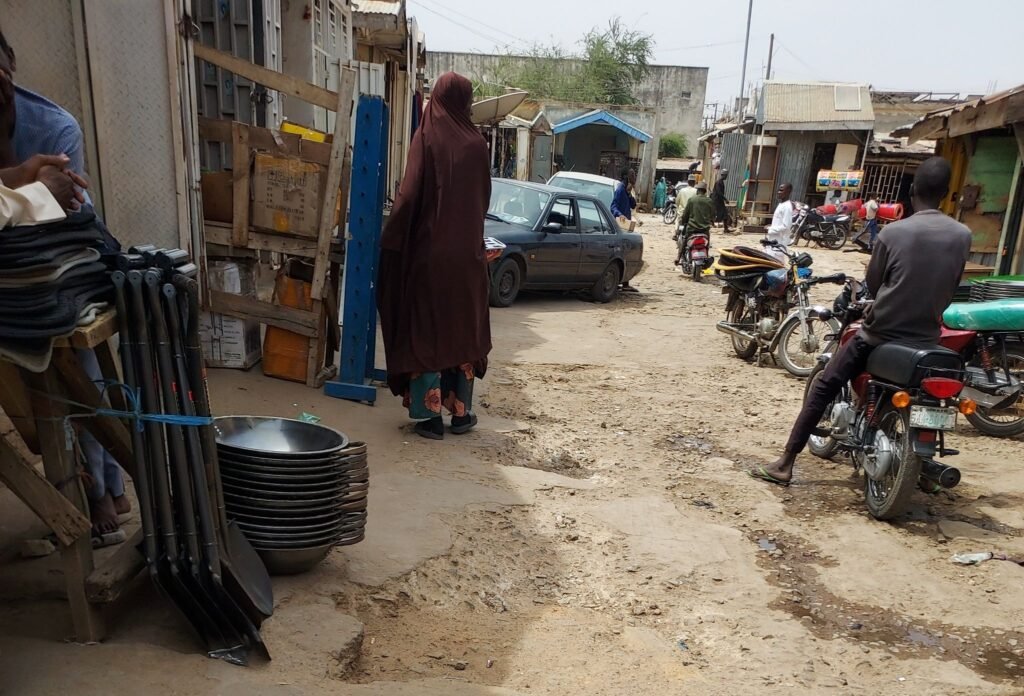
On a Saturday morning in March 2026, the heat settles over Gusau early. The sun beats down on the rust-coloured roofs of Polo Market, where narrow paths, barely five metres wide, are already filling with traders arranging their goods and buyers moving from stall to stall. The steady growl of traffic from a nearby tarred road drifts into the market, mixing with the occasional honk of motorcycles.
At first glance, Polo Market appears no different from countless commercial centres across northern Nigeria. But a walk into its inner lanes slowly reveals another world. Behind stalls selling household items are rows of small metal workshops. Their entrances are low and dark. Some are no larger than a single room, some are a bit wider. Charcoal smoke drifts lazily out of the doorways, carrying the smell of heated metal.
The walls are stained black with soot. Metal tools hang from nails hammered into wooden beams. In the corner of one workshop, two small furnaces burn charcoal, their tops already turned red. To an outsider, the shops resemble ordinary blacksmith’s sheds where farmers come to have hoes, axes, or plough blades repaired. Many of these workshops do not repair farming tools; they refine gold. Across the market, several stalls openly display the tools that sustain the region’s artisanal gold mining economy. Long-handled shovels lean against rough wooden walls. The heavy iron heads of pickaxes lie arranged on a table. Nearby, wide metal pans, the kind miners use to wash crushed ore, are stacked in uneven piles on the ground.
On one side of what looks like a hallway, thick pieces of carpet rest on a table. To most passersby, they might look like ordinary household mats, but miners use them differently. During processing, the carpets are spread wide while pulverised rock and sand are washed with water. As the muddy mixture runs across the fabric, tiny particles of gold settle and cling to the fibres.
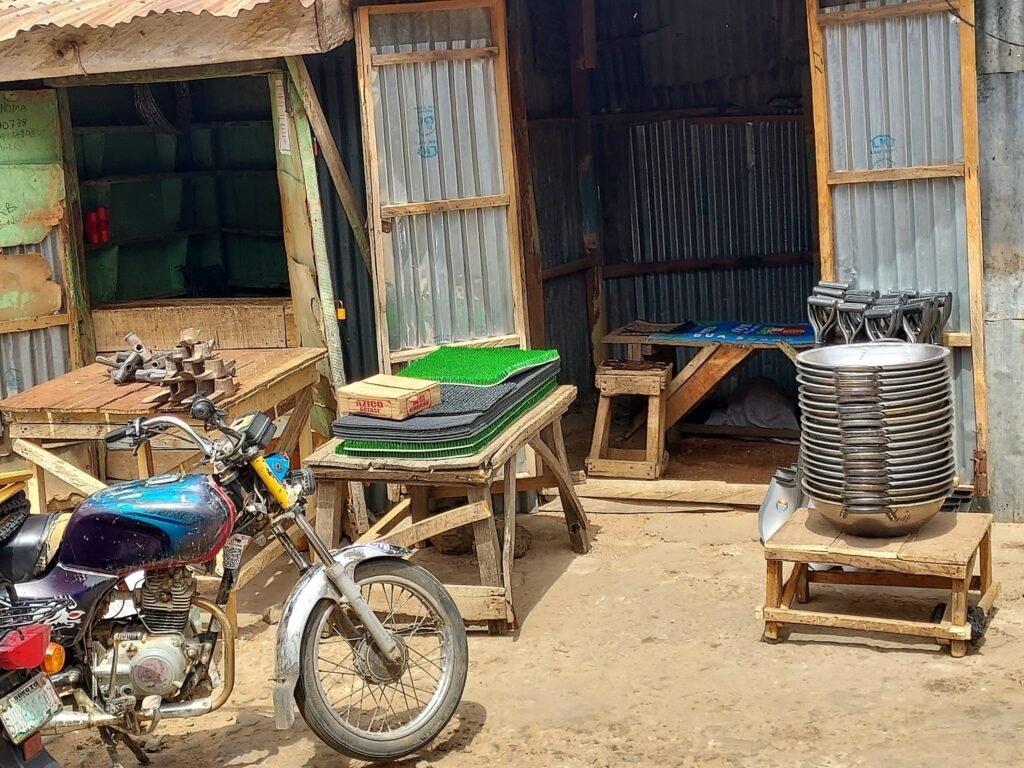
Many of these items could easily pass for everyday tools of manual labour, the kind bricklayers or builders might use. For those who know the mining trade, however, the clues are unmistakable. These are instruments of gold mining. It is this concentration of mining tools and refining workshops that earned Polo Market an unofficial nickname among miners and traders: the gold market.
Miners working for terrorists repeatedly described Polo Market as a crucial stop in the journey of the gold they dig. After long days working in deep pits scattered across rural communities, the gold-bearing ore they extract often travels to Gusau, where refiners in Polo Market process it. Several miners explained that the raw veins, which are chunks of rock or sand streaked faintly with gold, are crushed, washed, and heated until the precious metal can be separated from the stone.
The trade involves more than just civilians. Men who work in terrorist-controlled mining sites told The Liberalist that people connected to the armed groups also bring gold veins to the Polo Market. According to them, gold brokers, also known as ‘dealers’, sometimes transport ore on behalf of terrorists and deliver the packages to market refiners. In this way, miners say, gold extracted under the control of armed groups passes through the same market lanes as ore dug by ordinary labourers. While the Polo market is widely known in Gusau and other areas of Zamfara, especially in communities with a high concentration of gold mining, it is rarely discussed openly within the market itself. Before entering the area where the metal workshops were clustered, a local gold broker, whom this reporter had inquired about the market and its gold-refining business, offered a warning.
“Be careful when asking about gold here,” Mustapha Salisu, a local gold broker, warned. “People in this market don’t like talking about it.”
During a visit to Polo Market, this reporter walked into one of the workshops posing as someone interested in refining gold. A goldsmith sat beside a small charcoal furnace, slowly turning a metal wheel to feed air into the fire. With each turn, the embers burned brighter, casting a soft orange glow on the dark, soot-covered walls.
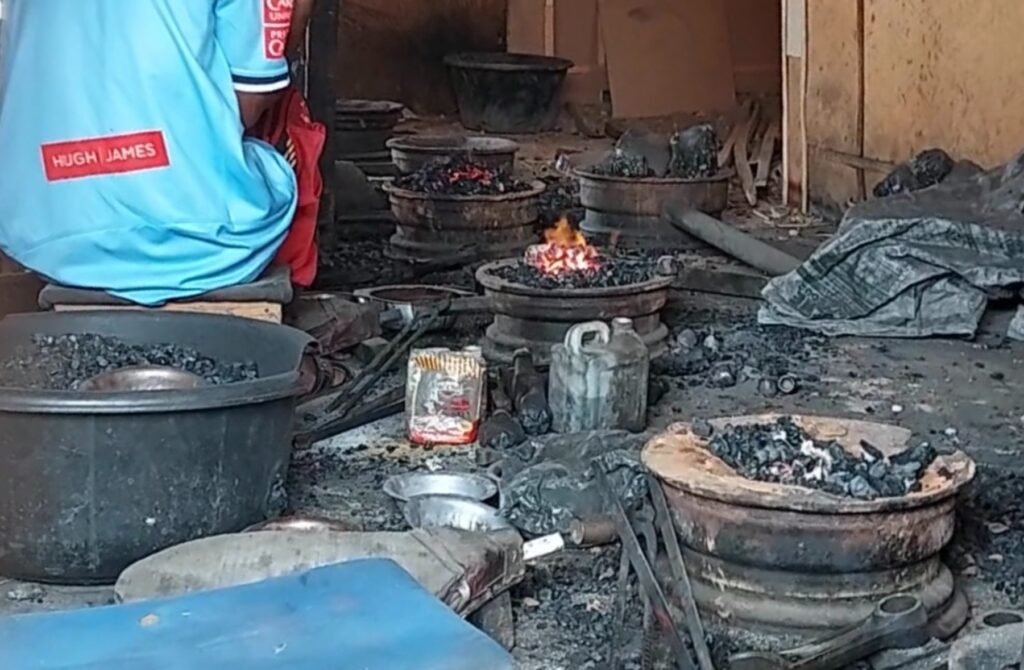
When the reporter told him he had gold to refine and asked about the cost, the man did not respond immediately. He kept turning the wheel, watching the fire, as if the question could wait. Around him, the workshop was scattered with tools. Hammers and pliers lay on the worn floor. Small crucibles sat near the furnace, blackened from repeated use. The air smelled of charcoal and hot metal. After a moment, he looked up, studied the visitor quietly, as if deciding whether to answer at all. From the next shop, the steady sound of hammering filled the silence. When he finally spoke, he said he needed to see the gold. Without it, he would not say anything. To do so, he added, would break the market’s rules.
The atmosphere and the people The Liberalist discreetly spoke to at the market confirmed what locals in Gusau had told this reporter: in Polo Market, gold business is an open secret. Everyone seems to know what happens here, but almost no one talks about it except the dealers and the goldsmith. The Polo Market is one of many transit routes of the gold business. As someone who has worked for various bandit groups for years, Saidu Modi* says only a fraction of the gold they extract for terrorists is refined and sold in Nigeria. Much of it is exported abroad in exchange for weapons and cash.
He recalled the time he was working for terrorist leader Halilu Sububu when he was alive.
“He was not like the others,” says Modi, praising his late slave master. “For him, the gold was not to earn money.”
Modi explained that Sububu treated gold less as a commodity and more as a means to an end. While smaller groups sold their spoils quickly through local dealers, he preferred to stockpile. The gold would be kept in hidden locations, deep in the forest. Then he would disappear.
“They would say he had travelled,” Modi recounts. “When he returned, you would see new guns and other powerful weapons.”
These trips often crossed borders, along routes stretching into the Niger Republic and Libya. The paths suggest a wider network, one that connects Nigeria’s illegal gold trade to arms markets beyond its borders.
Finding Treasure in Terror
The journey Modi described is not entirely new. It mirrors an older network that predates the current conflict by centuries. Traders once moved salt, gold, and textiles across the Sahel and into the Sahara, linking kingdoms such as the Mali and Songhai Empires to North African markets. In the 14th century alone, West Africa accounted for a significant share of the world’s known gold supply, much of it transported across desert routes that historians often compare to the Silk Road, a long and extensive network of trade routes that connected Asia, the Middle East, Europe, and Africa. Today, the road cutting across different African countries has become more dangerous and far less regulated.
Across the Sahel, porous borders and limited state presence have enabled the growth of illegal trade. A 2023 report by the Global Initiative Against Transnational Organised Crime found that gold is increasingly used by armed groups across the Sahel as a store of value and a medium of exchange. It is easy to carry, easy to hide, and almost impossible to trace once melted.
However, for miners at the bottom of this chain – especially those enslaved by terrorists – the returns are small. A gram of gold may earn them only a few thousand naira in a local market. But as the gold moves from one buyer to another and crosses borders, its value increases. By the time it reaches international markets, it can be worth several times more. For instance, as a miner working for terrorists in Zamfara, Hafiz Amadu* says he earned enough just to shoulder his sister’s local wedding expenses and take care of his pregnant wife during childbirth. But terrorists earn more, he narrates, which they use to fund their operations.
“If you are in the bush mining for yourself, the terrorists are the ones who will come and accompany you to the place of their own work,” says Amadu. “And if you try to resist, the terrorist will kill you.”
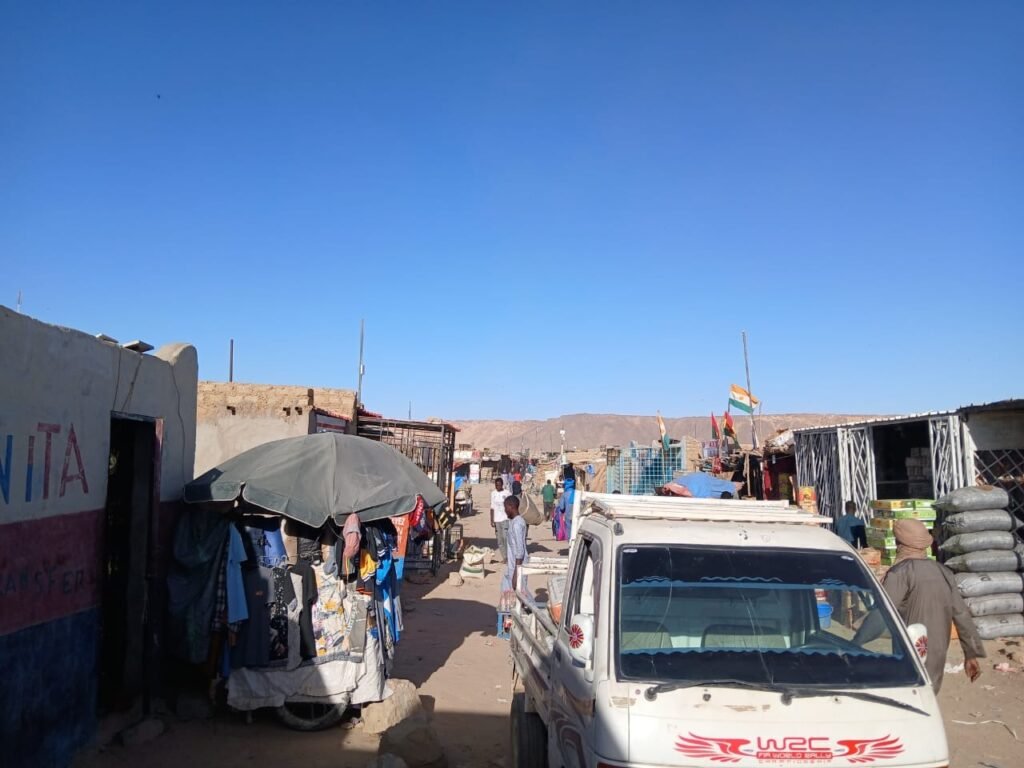
For economic survival, some locals have taken sides with terrorists in a desperate search for gold buried beneath the earth. Kabiru Isa* of Anka town in Zamfara is one such person. When The Liberalist spoke to him in Anka town, he had just finished shovelling the ground looking for what they call “precious stone”. Like him, dozens of slave labourers have left their fate in the hands of terrorists; they work hard on mining sites monitored by men armed to the teeth. They have entered into an unholy pact with the people terrorising their localities. Isa has particularly made peace with them.
“I now have more friends among the terrorists than I do within the communities. I know them so well,” he tells The Liberalist as he unravels his experience working with the armed groups. “We have an understanding about the work we do for them.”
The agreement between miners in Anka and the terrorists is mutually beneficial: locals are allowed to mine on the condition that they give up some of the gold they find. Although Isa says they have chosen to live with this arrangement, the only problem is that “they take more than we want, but without them, others will come and take everything.”
Dozens of his colleagues have been killed on site by rival terrorists, and the group they worked for was unable to protect them, Isa says. Sometimes, when their protectors are overpowered, they flee, leaving the miners at the mercy of the rival group. In August 2024, a rivalry battle occurred between two armed groups led by Bello Kaura and Halilu Sububu, resulting in the killing of several miners in the Bagega and Sumke areas of Zamfara state.
Although they have learned to coexist with terrorists, the unforgiving nature of the mining sites sometimes unleashes terror on the miners. Oftentimes, the earth collapses on them while labouring for armed groups, instantly killing them or leaving them critically injured. Miners fear this kind of death more than an attack from a terrorist group because it is deadlier. Only a few people have survived a mining site collapse; one of them is Salami Ladi*, a miner who works for terrorists in Anka.
One chilling morning in 2024, Ladi left home with some other friends for a mining site in Zamfara. After working for some hours inside the pit, a small crack suddenly spread, causing the pit to collapse. Ladi and all his friends were immediately buried under the soil. He dug through the soil and crawled out of the pit after so much effort, only to realise that his friends were nowhere to be found. He cried for help to get the attention of nearby miners or passersby, but his wailing only caught the attention of Kachalla Baleri, a terrorist leader who was moving around with his gang in the area. Kachalla immediately ordered his boys to seize the gold Ladi and his friends had dug out before the earth collapsed, and to rescue the trapped miners. By the time they finally pulled the miners out, two had suffocated to death, and the remaining two were just holding onto life, critically injured.
From Nigeria to the Niger Republic
The thing about labouring for terrorists: you know how the gold is dug out, but don’t know how it is refined and moved from one point to another. The experience of local miners cohabiting with terrorists in Nigeria is similar to that of those trapped in terrible conditions on mining sites controlled by criminal masterminds in the Niger Republic. The Liberalist travelled far beyond the corridors of Zamfara state in Nigeria to track the illicit gold exploits of terrorists across the Sahel. We spoke to locals, including miners with direct or indirect ties to terrorist mining escapades in the Niger Republic. During our enterprise reporting, we found that gold extraction in Niger is largely concentrated in remote areas, especially in the Tillabéri region, around the Tchibarakaten area and the satellite Djado Plateau. Mining activity also stretches into the Maradi region, close to the Nigerian border.
We matched the descriptions provided by locals with our investigations using Geospatial Information Systems (GIS) to confirm the presence of mining sites in the area. Our analysis, which included satellite data and GIS mapping, identified at least seven major active mining sites in Djado. One of the largest sites is located approximately 6 km west of the ruins of the ancient city. The presence of people engaged in full-scale socio-economic activities further supports the establishment of these operations in the region.
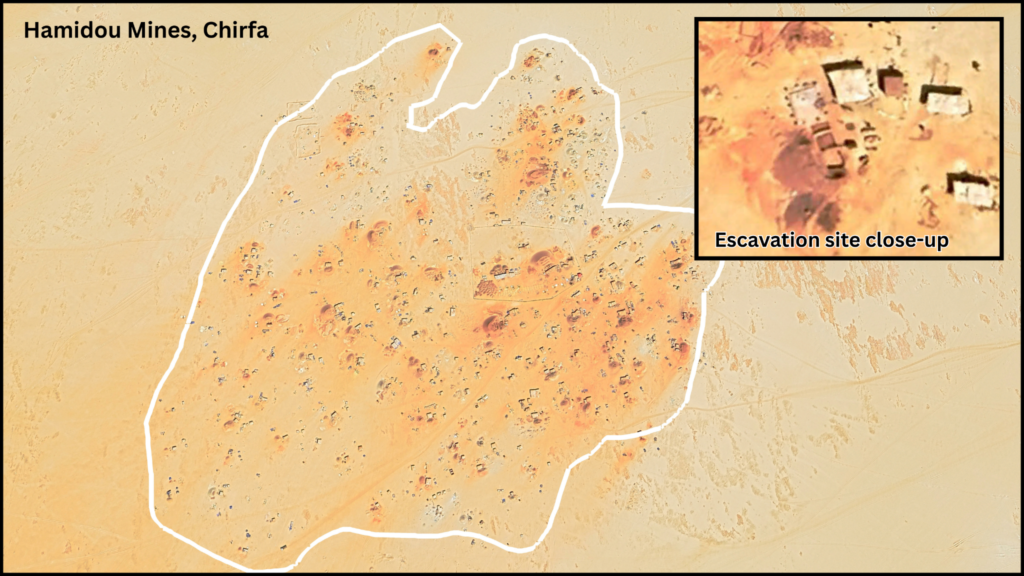
The site features both artisanal and industrial mining activities. In the middle of the desert, sand is abundant, with excavation sites, settlements, and makeshift structures scattered around the mining pits. Some clusters of mines are fenced or walled off, with operations conducted within these enclosed areas.
The Liberalist also discovered another large mine located about 3 km from the first site, and another approximately 10 km from the Djado Plateau. The second site also combines artisanal and mechanised mining operations, leaning more towards the artisanal side, with numerous individual mining activities taking place. In a 2024 satellite image, we counted around 24 separate pits, each large enough to accommodate multiple crews for underground mining.
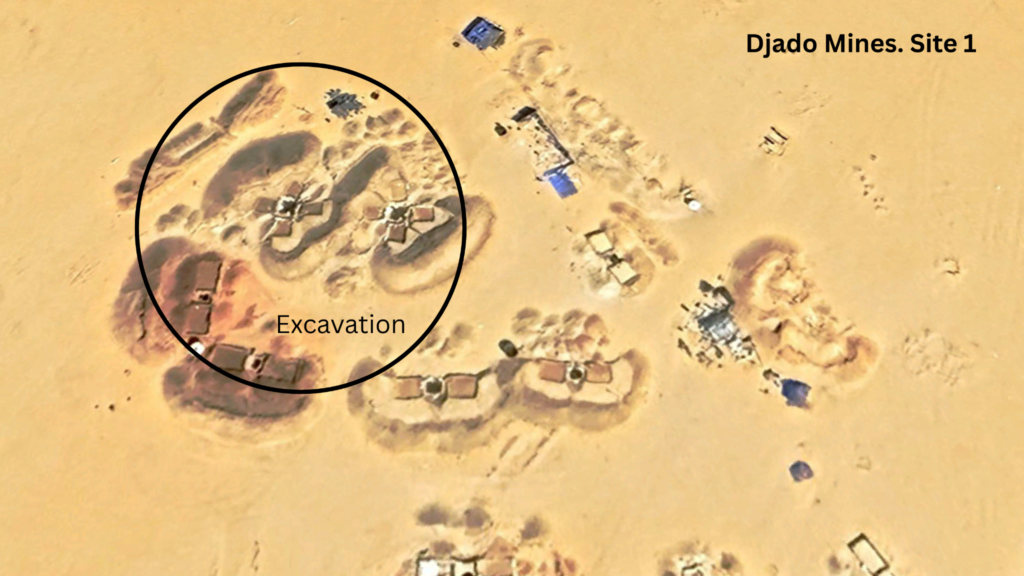
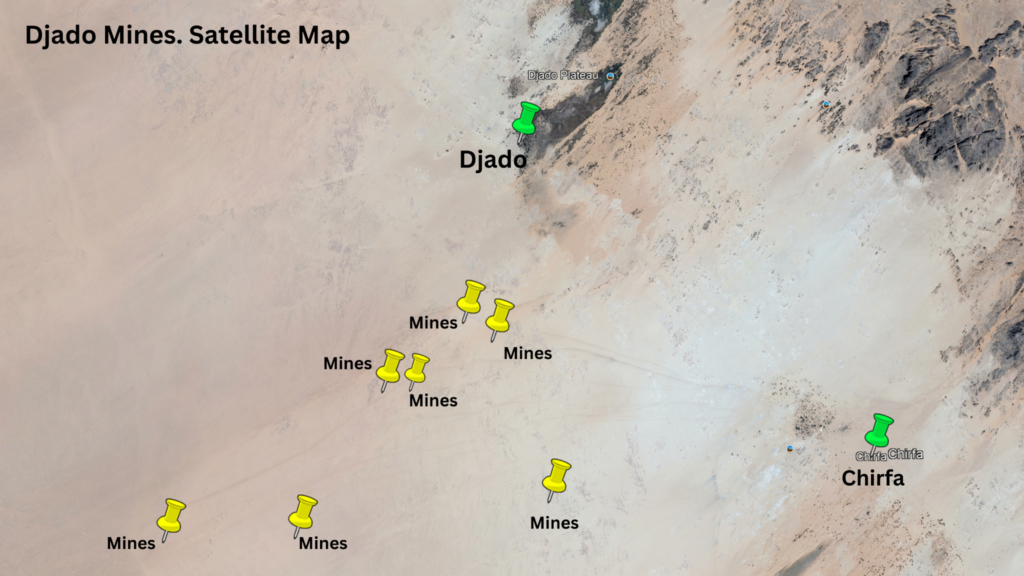
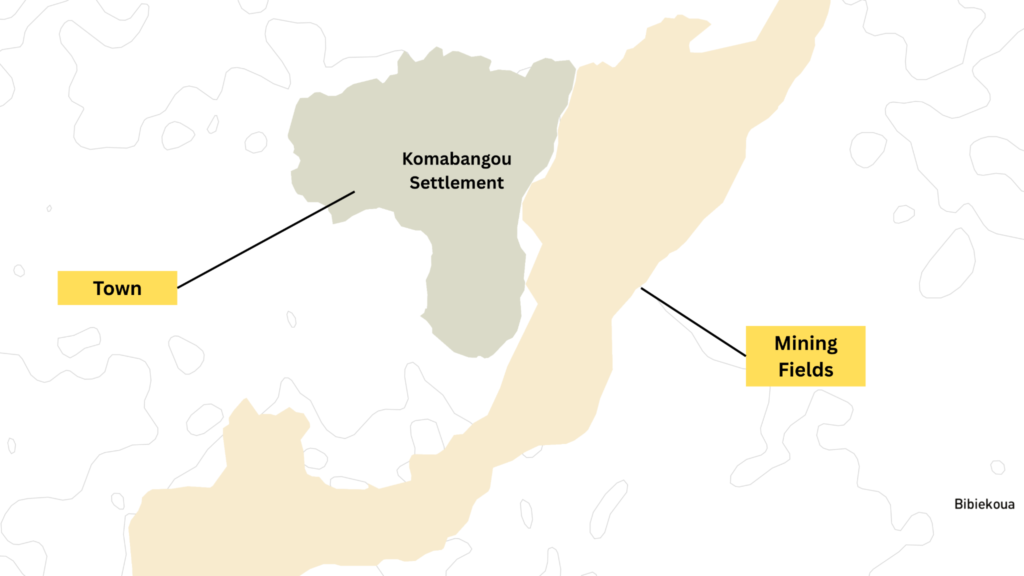
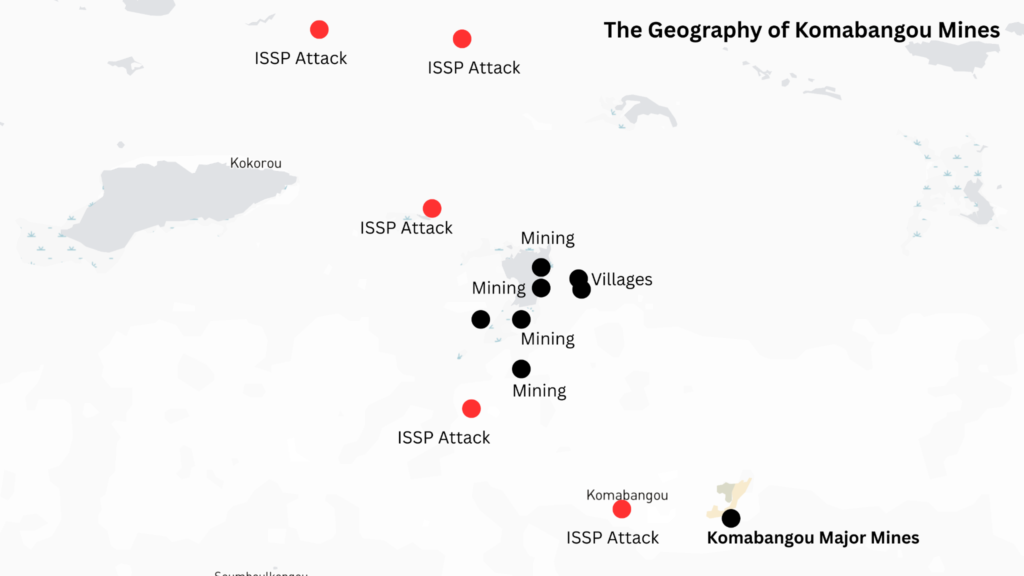
The GIS investigation also explored the Tillabéri region, located approximately 1,150 kilometres from the Djado mines, closer to the capital, revealing many terrorist-controlled mining sites described by locals. This area is a hotspot for criminal activities by rebels, terrorists, and sometimes military operatives patrolling mining environments. One of the largest mines in this region is Komabangou. As shown on the map, the mining area is nearly three times the size of the nearby town. The site is predominantly artisanal, with only a few signs of structured facilities. It features countless holes scattered across the terrain. The estimated area covered by the mining site is about 662,800 square meters, roughly equivalent to 92 football pitches.
Gold Mining for Survival
As insecurity and other uncertainties persist around mining operations in northwestern Nigeria, especially in Zamfara and Katsina states, miners are being pushed farther north and deeper into the Sahel. Multiple sources, including miners and local workers, confirmed that Nigerians are among those working at gold mines in the Djado region of the Niger Republic. They work long hours under extreme desert conditions, often enduring intense heat before finding even the smallest trace of gold. A wide stretch of desert, dotted with makeshift shelters and temporary structures, serves as the backdrop to these mining camps. The settlements, built from straw and reinforced with plastic sheets, offer little protection from the elements.
Miners who have worked in the area describe the conditions as extremely difficult. Musa Maman*, a miner from southern Niger, says he had worked alongside several Nigerian migrants. He described the experience as one of the toughest he had ever had. Another worker explained that shelter is nearly non-existent, with most miners living in fragile huts that offer little protection during rainfall. They also said armed groups force miners to pay levies, and sometimes arrangements with these groups require workers to continue digging for weeks under strict conditions, especially if they fail to find gold, with limited freedom to leave without settling the imposed costs.
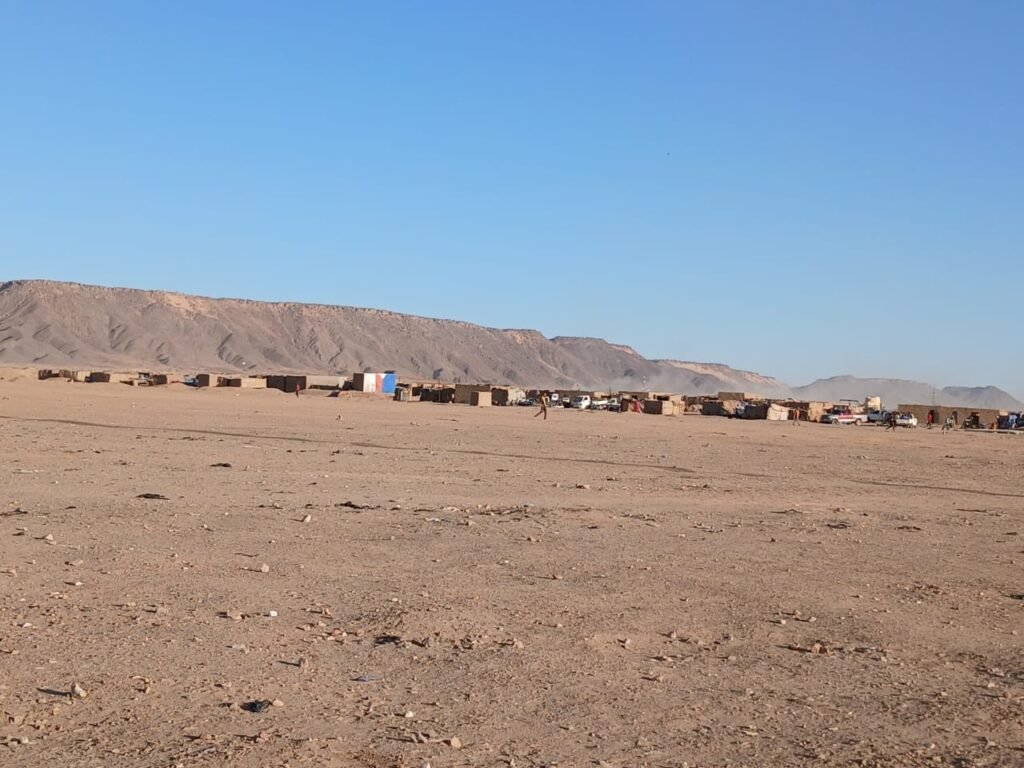
However, gold extraction is Niger’s least contribution to the Sahelian gold economy. Gold traders in Agadez, a town in the north-central part of the country, confirmed that Niger is more of a transit hub than a gold producer.
“Gold passes through here more than people think,” Karim Mahamadou*, a prominent gold merchant, tells The Liberalist. “Some of it comes from inside, but a lot comes from other countries.” He explained that gold from mining sites in Niger and from those sold in Agadez by foreigners is either transported to Niamey, the Nigerien capital city, or finds its way to Libya, where Sabha and Qatrun are the two major centres. In those places in Libya, he says, “you will find people coming from Benghazi, Tripoli, even from Dubai, to buy gold.”
When combined with human testimonies, an open-source intelligence investigation by The Liberalist shows that the route from northwestern Nigeria through the Niger Republic has become one of the most active corridors. The pathway links mining sites and the Polo market in Zamfara to transit hubs such as Djado and Agadez in northeastern and north-central Niger, then moves west to Qatrum in Libya, and finally to Dubai in the United Arab Emirates (UAE).
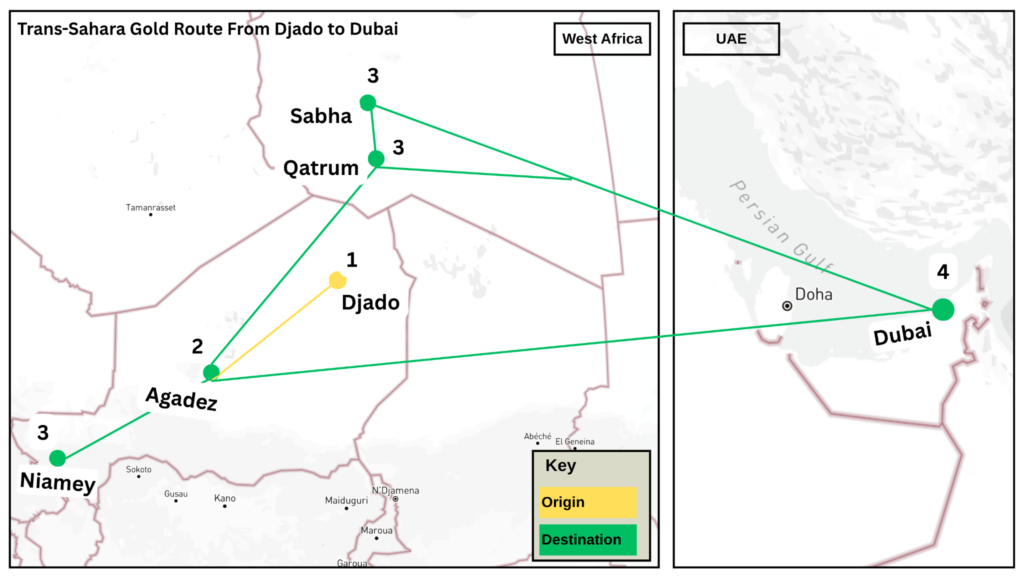
Moving gold across these routes is risky. Locals described road transport as the most dangerous part of the trade.
“If you carry gold by road, you are taking a chance,” a local notes, recalling that in 2022, a large quantity of gold being transported from the Djado gold field to Agadez was attacked and disappeared while under escort. “Too many things can happen on the way.”
Some local miners we interviewed in Niger estimated that about one-third of the vehicles leaving gold-mining sites without a Nigerien security forces escort are attacked.
The local traders and miners’ descriptions corroborated The Liberalist’s findings from other sources. Across the Sahel, the surge in gold mining has given armed groups a new way to sustain themselves. Rather than taking over mines in a visible way, many of these groups operate through control and influence. In some cases, they assert authority over specific mining locations. In others, they focus on the routes connecting the mines to nearby towns and markets, such as Agadez. People moving gold along these paths are forced to make payments or robbed and killed. Some of these payments are sometimes framed as “zakat,” an Islamic form of wealth contribution that, in this context, is demanded rather than given voluntarily, contrary to the dictates of Islamic Law. It allows armed groups to collect revenue without needing to remain physically present at the mining sites all the time. This system means that gold can generate income for such groups even without their consistent presence at the mining sites.
Interviews with locals in Djado confirmed that gold itself is not what is driving large-scale violence across mining communities in Niger. The instability seen in parts of the region is more closely tied to long-standing pressures between farmers and herders competing for the same land and water, especially in areas where resources are already scarce. At the same time, because these places are located in remote areas far from municipal capitals, it limits state presence and makes it difficult to manage tensions or enforce order. Gold enters this picture as a complicating factor, as is the case in many mining communities in Nigeria, where terrorists take control to dig out buried gold.
Mining sites attract large numbers of people and create new economic stakes in already fragile areas. As a result, different groups, including miners, security forces, and armed actors, begin competing over control of access to these sites and the wealth they produce. This competition has, in many cases, triggered clashes; what exacerbated the conflict is the non-state actors’ access to arms.
However, experts in the security and extractive sectors in Nigeria believe illegal mining is a major driver of armed violence in the Sahel. For peace and tranquillity to be permanently restored in the region, the pundits said, security operatives must secure mining sites and take them away from terrorists. For instance, Dauda Garuba, a director at the Centre for Democracy and Development (CDD), West Africa, and a former Technical Adviser at the Nigeria Extractive Industries Transparency Initiative, said the recent intervention of the Sahelian states of Burkina Faso, Mali, and Niger in mining operations is a welcome development to curtail the insecurity. He, however, fears that if the approach by the countries is successful, armed groups operating in the areas will move south into Nigeria.
“The entire state of insecurity in the Sahel, mining has a great role in facilitating it,” says Dauda. “You know those areas in the northern part of the country [Nigeria] are obviously ungoverned. This means, the chances are that life in that part will be harder, given the scale of insecurity we are going to see.”
_________
*To protect their identities and ensure their safety, the names of some gold miners and traders mentioned in this story have been changed.