
This story was supported by the Pulitzer Center.
___________
The story of illegal mining, gold slavery, and terrorism operations in northwestern Nigeria is incomplete without telling the story of a notorious terrorist, Halilu Jamare, popularly known as Halilu Sububu. He remains an undisputed pioneering figure of Nigeria’s blood gold trade. One cannot say for certain when Halilu began his criminal exploits, but his lineage shows crime is a lucrative family trade. Born in 1986 in Sububu village, located in the Maradun Local Government Area (LGA) of Zamfara state, he was the son of Jamare, a notorious cattle rustler who abandoned nomadic herding for highway robbery and a life of crime.
His maternal heritage gave him an undeniable geographical advantage that extended beyond Nigeria. His mother, who was from the Maradi region of Niger, belonged to the Tuareg ethnic group, the vast majority of whom live in the northern part of the country. As a result, he spoke fluent Fulfulde, Tamashek (of the Tuareg people), Hausa, and French. He also had a basic knowledge of Arabic and Kanuri. This heritage earned him the pseudonym Halilu Buzu and gave him access to a network of cross-border connections that would later prove a valuable asset in his operation.
When his father was killed during an operation, a young Halilu was taken under the wing of Gide Goje, another outlaw and cattle rustler who was a contemporary of Halilu’s father. He would soon team up with Shehu Rekeb, an old cattle rustler operating in the area with experience in gunrunning outside Nigeria. With his Niger Republic lineage and Shehu Rekeb’s mastery of the terrain and experience, he forged ties with criminals in the Maradi and Agadez regions and officially began gunrunning. While his cross-border connections helped him gain more contacts, Shehu Rekeb supervised his gunrunning along the expansive Nigeria-Niger border.
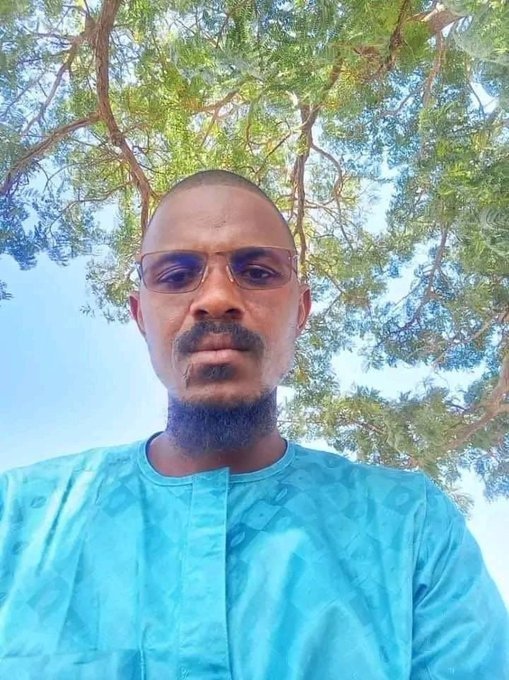
In the beginning, Halilu would collect guns and bullets from terrorists in Niger, bring them into Nigeria, sell them, and take the money back to the assailants for more weapons, according to local vigilante sources in the Tsibiri village of Maradun, who know how the criminal mastermind started his journey. The sources include a 64-year-old local security volunteer fighting rural terrorists who had a past history with Halilu’s root.
For over a decade, between 2014 and 2024, Halilu completely changed the criminal enterprise of rural terrorism, using violent raids to rob artisanal miners of their daily finds and imposing heavy taxes on farming communities. In 2019, the Nigerian government attempted to curb growing rural violence by suspending mining activities in Zamfara. Ironically, it was during this period that the terrorist leader marched his militia into the gold-rich sites of Bagega, Burwaye, and Gando within the Anka LGA and began mining at an unprecedented scale. He deployed an aggressive number of enslaved locals, including children, forcing them to dig. At the peak of his power, he commanded an estimated 1,000 to 1,200 heavily armed fighters spread across hidden locations in Zamfara, Kaduna, and Katsina states. By 2022, he had taken absolute ownership of dozens of pits.
He was known for enforcing a strict peace within the immediate vicinity of his mining fields. In areas like Shinkafi and Anka, he negotiated formal peace treaties with local leaders. As long as villages obeyed his mandates and stayed out of his mining business, his men protected them from rival gangs.
Halilu lived the life of a ruthless criminal, terrorising his immediate village of Sububu, as well as communities in the Shinkafi and Zurmi LGAs of Zamfara state, and villages in the Isa, Sabon Birni, and Raba areas of Sokoto State. Eventually, he settled in Anka after discovering the vast, ungoverned mining sites there.
As he controlled the mining sites in Anka, Rekeb kept and supervised fighters in camps in the Sububu forest, a vast forested area spanning Shinkafi and Maradun. Multiple sources say the gold and guns were traded in the Niger Republic and Libya. And since Rekeb and Halilu spoke Tamahaq, a Berber dialect commonly spoken in Libya and Algeria, it was easier for them.
“Their ability to speak the language and even the dialect helped the duo in the cross-border business of gold and guns,” says Muhammad Babangida, a conflict and security pundit who has researched Halilu’s blood gold escapade for years. His statement was confirmed by Malik Samuel, a researcher with Good Governance Africa, who has extensively researched the link between natural resources and terrorism in Nigeria’s northwestern region. He once visited mining areas in Bagega and even spoke with some of Halilu’s relatives.
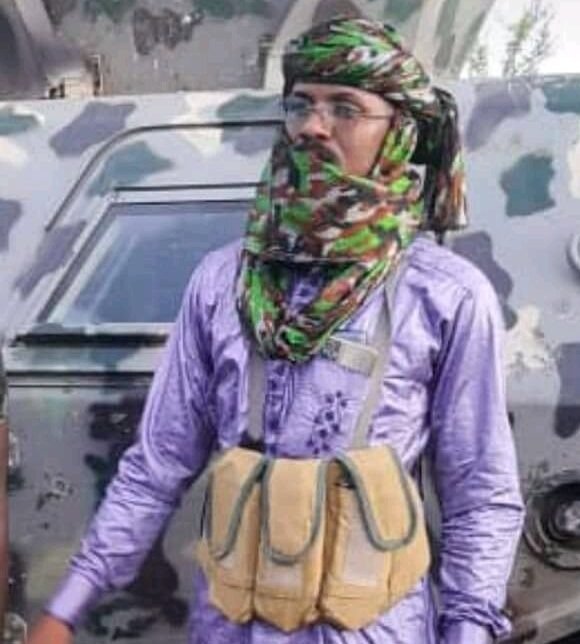
“Sometimes I heard him speaking with his boys, and they would talk about which weapons they got from Algeria and which ones they got from Libya. I know that he took gold to Algeria and Libya, which he exchanged for weapons or money,” Shehu Sububu, Halilu’s uncle, said in a report.
The Liberalist spoke to dozens of sources, including Halilu’s former allies, top commanders, and relatives, to accurately reconstruct the narratives surrounding his massive illicit mining exploits in Nigeria and across the Sahel. We also interviewed experts who have had an interface with Halilu’s foot soldiers to literally demystify how a man with a criminal lineage built an empire of cross-border terrorism sustained by a blood-stained gold enterprise. Although terrorism in Nigeria’s northwestern region took root around 2011 with cattle rustling and kidnapping for ransom, it has since evolved into different brutal enterprises. One of them is the imposition of taxes on farmland and communities, and the latest is gold mining. Since at least 2022, these illicit enterprises have caused the death of an estimated 4,000 people and displaced over 1.3 million people in the country’s northwestern and north-central regions, according to the International Organisation for Migration.
To understand the scale of Halilu’s illicit mining operations, The Liberalist looked into the physical volume of wealth the kingpin dug from the earth. Local mining experts operating within the Bagega and Sumke forest enclaves revealed that a single bag of gold-bearing sand dug from Halilu’s controlled pits yielded an average of 40-60 grams of pure gold per day. At local bush markets in Anka, this raw commodity is traded at roughly ₦52,000 per gram. However, Halilu rarely liquidated his entire stock locally. His absolute control over the dozens of mining sites in Anka, including mining sites in Bagega, Kwanta Kwanta, Damar Manu, Dareta, Kwayakwas, Dan Kamfani, Maigalma, Tungar Daji, Dawan Jiya, Bawar Daji, and Gobirawa, among others, allowed him to stockpile raw nuggets and ship them in large quantities to Niger.
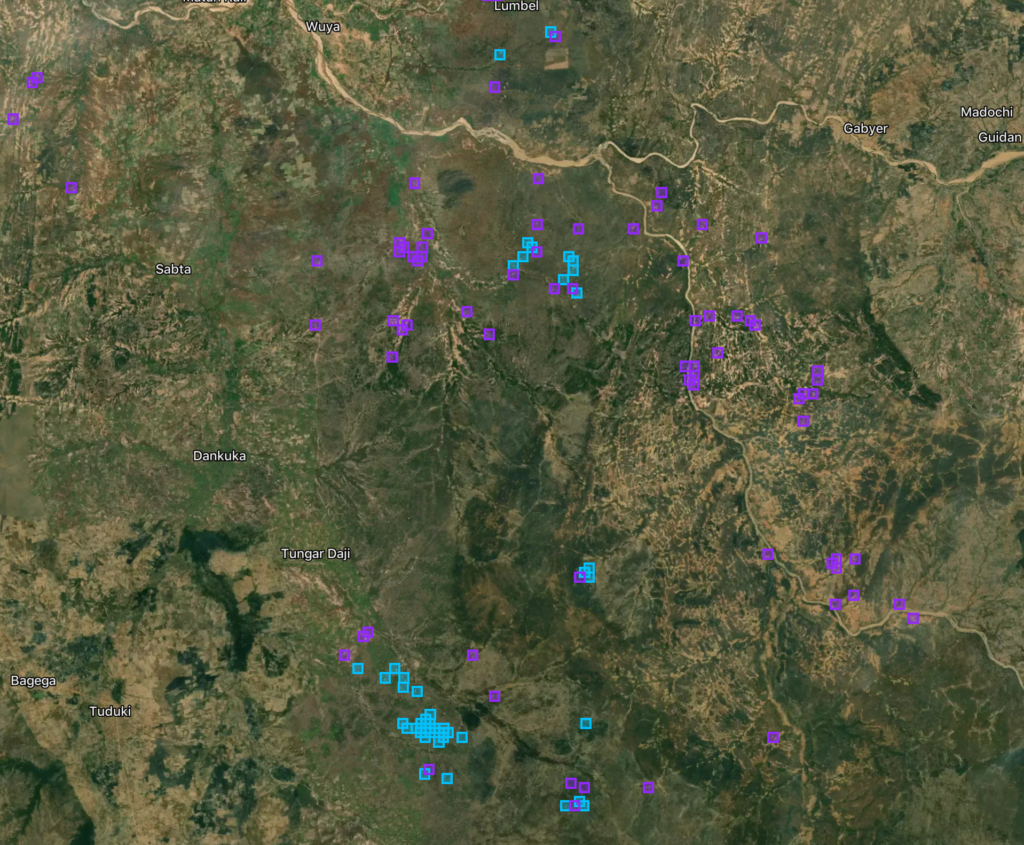
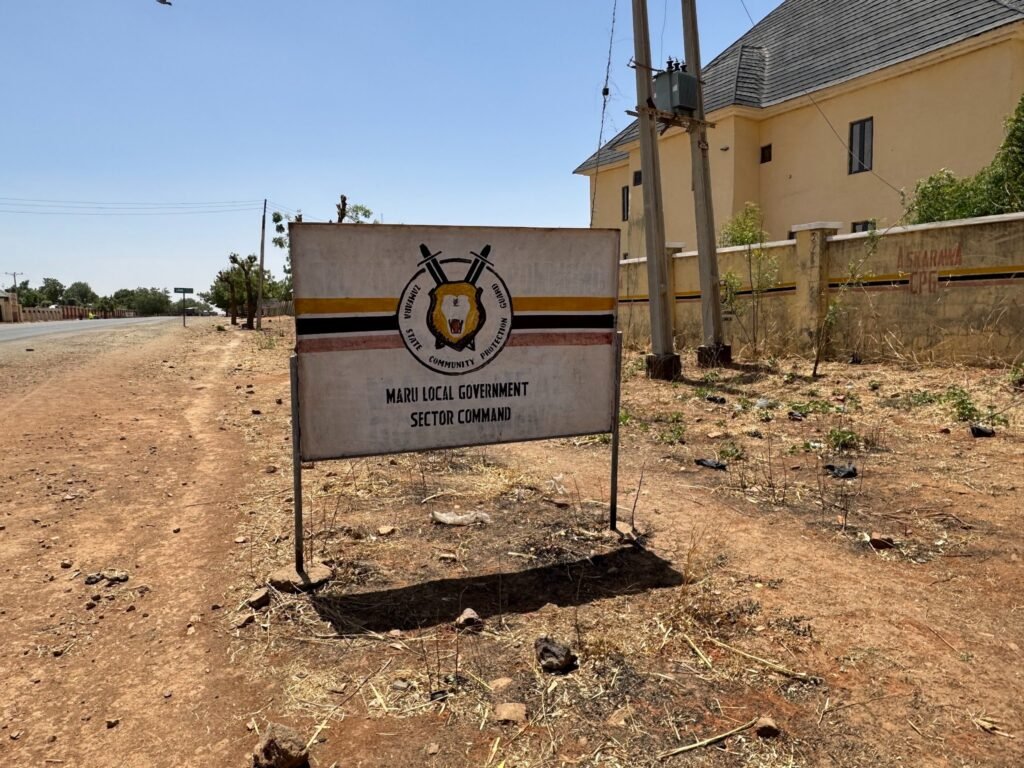
To verify the scale of mining operations in the areas described, The Liberalist used Earth Index, an open-source mapping tool, to identify mining sites in Zamfara. Earth Index uses advanced machine learning models to scan libraries of satellite imagery, allowing users to select a verified example, such as a gold mining site, and instantly map similar visual patterns across a selected area. We manually identify the physical coordinates of our reporter at a mining site in Maru and sites independently confirmed by sources around Tungar Daji. After feeding the tool with samples from the mining sites, it searched for areas with disturbed land and clustered pits, indicative of artisanal mining activity. The search returned 136 predicted locations after filtering to mid- to high-confidence, of which we manually validated 51 sites concentrated around Tungar Daji and Bagega.
The Destination
Gold extracted by Halilu and his boys formed part of the minerals extracted by artisanal gold miners, many of whom are undeclared and exported out of Nigeria and out of government supervision. An investigation by SWISSAID, a Swiss-based international development organisation, reveals that several tonnes of African gold are smuggled out of the continent, much of it ending up in global refining hubs without proper documentation. In its 2024 country analysis, SWISSAID describes Nigeria as a gold-producing country where official records capture only a fraction of reality. While the government reported just 1.96 tonnes of artisanal gold production in 2022, the organisation traced artisanal and small-scale mining (ASM) output to range between 14.3 and 15.6 tonnes during the same period.
“The bulk of the gold produced through ASM in Nigeria remains undeclared,” the report reads.
This is not the first time SWISSAID has flagged discrepancies between official data and data from its own independent investigation. In 2018, for instance, Nigeria’s official gold production stood at 39 kilogrammes, according to the Disaggregated Mining and Quarrying Data produced by the National Bureau of Statistics. Drawing on nationwide field studies conducted by the Federal Ministry of Environment, SWISSAID’s report indicates that artisanal and small-scale mining alone was producing around 16.2 tonnes annually, more than 415 times the official figure. This discrepancy means the vast majority of Nigerian gold production remained undeclared and largely outside state oversight.
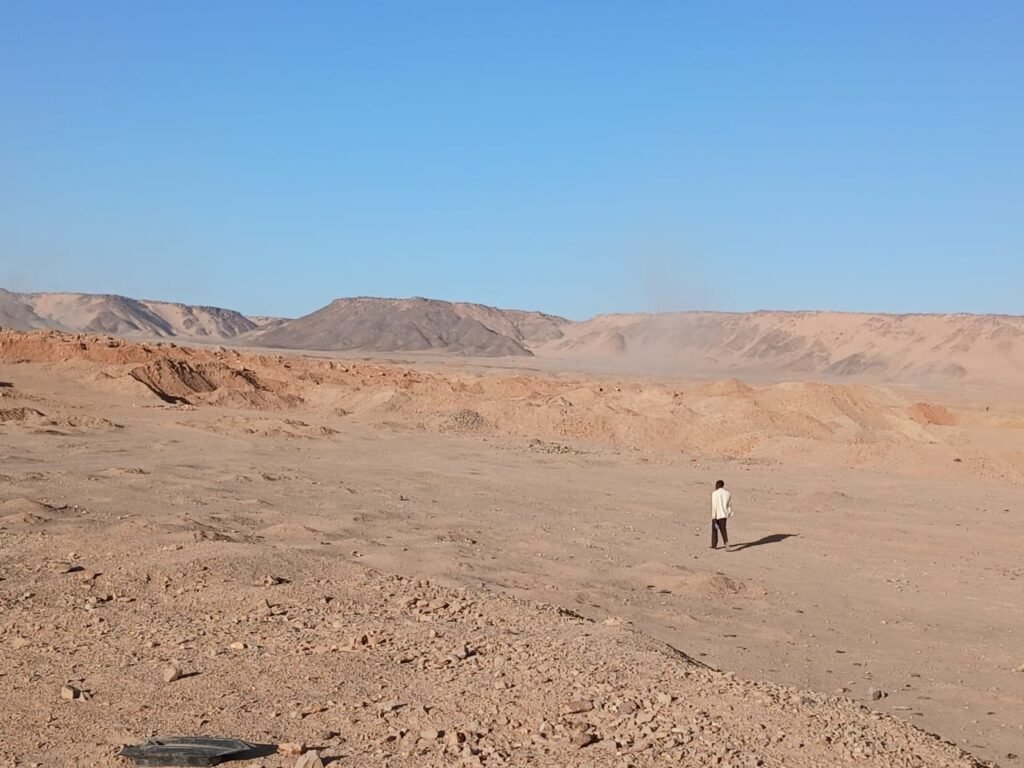
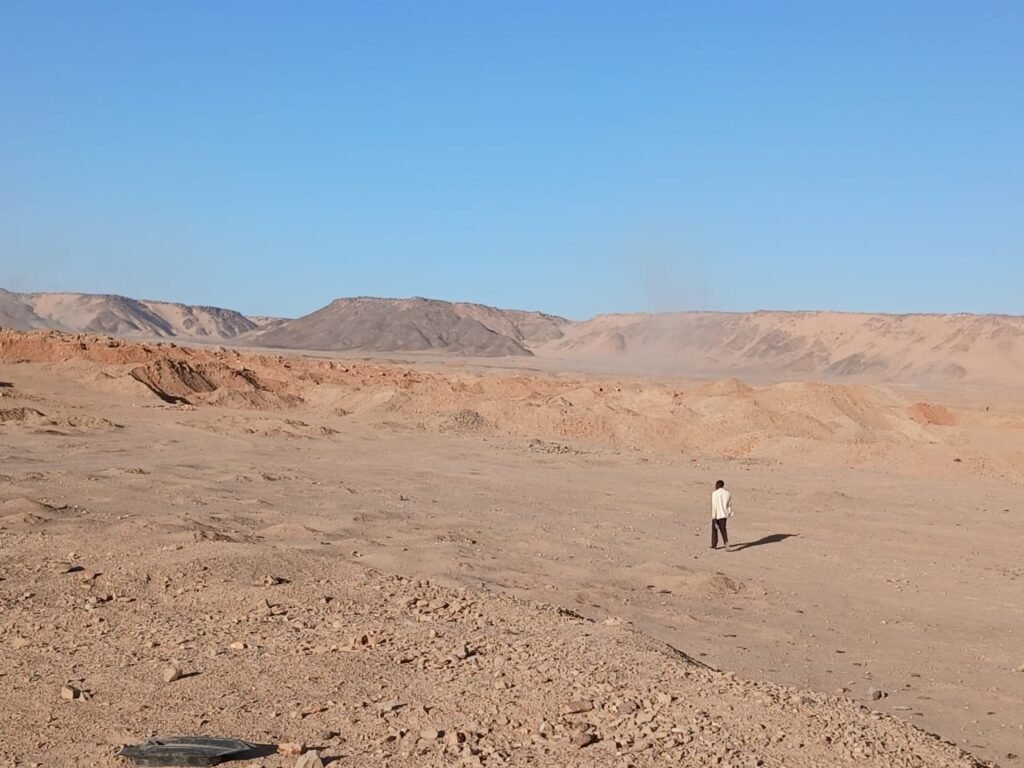
Tracing the destination of Halilu’s gold and his gunrunning operation, The Liberalist travelled to Niger and visited mining sites and trading hubs. Our on-the-ground reporting reveals that as gold mining expanded across northern Niger, another trade grew alongside it: gold for guns. People working around the gold mining sites in Djado said there was a steady increase in the flow of weapons into the region. They link it directly to the insecurity in mining areas and the government’s limited ability to monitor such a vast, remote landscape. Among the most commonly mentioned weapons are locally nicknamed “Turkiya,” a type of handgun associated with Turkish origin, and AK-pattern rifles, which miners say are seen as a basic tool for survival.
Many miners and traders say a large share of these weapons is traced back to Libya. After the collapse of state control following the Libyan Civil War, weapons left behind in military stockpiles began moving across the Sahara. Over time, they entered long-standing desert smuggling routes that already connected different parts of the Sahel. Smuggling networks that already move goods across the desert include weapons among their cargo. Some of those involved do not specialise in arms; they simply add it to their existing trade. Ibrahim Djibo*, a trader in Agadez, described a smuggler known for transporting second-hand vehicles, who also sold rifles, each with several magazines.
In mining areas like the Djado gold field, foreigners, including Chadian nationals, are often recruited as labourers into mining and also work as key brokers in weapons smuggling. “When these people come, they arrive with equipment and weapons for their own protection. And when they prepare to leave, they sell off what they brought, including weapons, for cash or gold,” says Abdoul Sanni*, a local miner who now stays in Agadez. Sanni and his colleagues say an AK-pattern rifle is typically valued at about 18 grams of gold, while a smaller handgun locally referred to as “Turkiya” goes for roughly 5 grams.
The gold-for-gun swap deal, as narrated by miners and traders in Djado and Agadez, has been corroborated by several regional security assessments and conflict research findings. Over the last decade, between 2012 and 2023, the Small Arms Survey, a research project on global small arms issues, documented how weapons stockpiles from Libya have continued to circulate across the Sahel. These flows, the group notes, include AK-pattern rifles and other small arms commonly found in Niger’s border regions, moving through long-established desert trafficking routes.
“Trafficking [in the Sahel] remains a specialised activity that is limited to experienced and well-connected smugglers who traffic sizeable shipments of small arms,” a 2019 report by Small Arms Survey reads. “This type of trafficking tends to develop around active conflict zones. Small to medium-sized shipments of arms are trafficked across borders together with other goods, indicating strong connections among the various illicit markets and trafficking actors.”
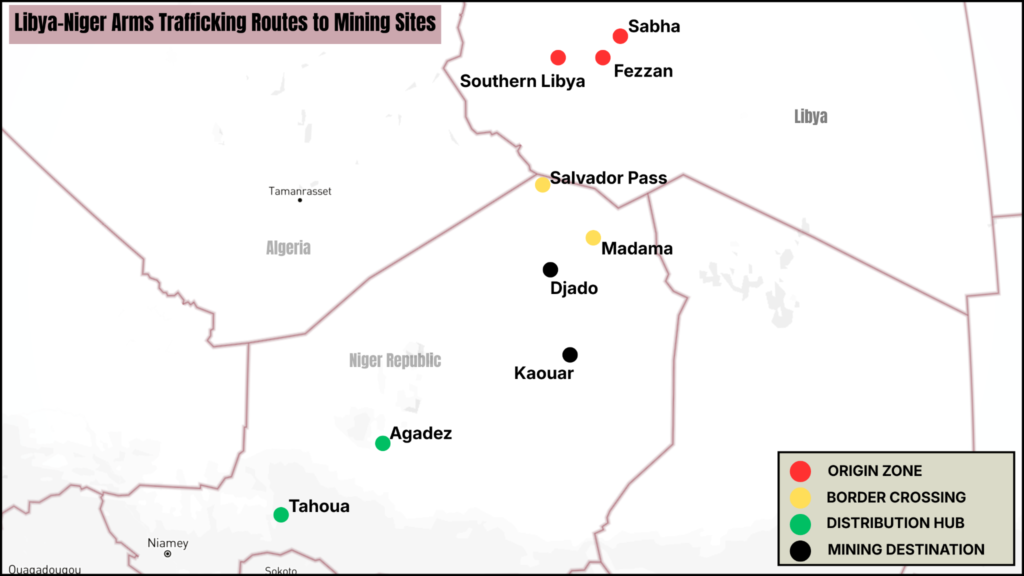
Research by the Global Initiative Against Transnational Organised Crime (GI-TOC) reveals that smuggling in the Sahara and stretching into the Sahel is dominated by logistics-based or multi-commodity networks. The GI-TOC shows that the smuggling networks rarely operate within single commodity chains. Instead, the same people moving migrants, subsidised fuel, and livestock also carry illicit commodities, including gold and weapons. This flexibility allows arms to be embedded within broader informal trade systems, making them difficult to track and regulate.
Interviews with traders in Niger show that the flow of weapons from North Africa to the Sahel parallels the movement of gold from the Sahel to North Africa. Karim Mahamadou*, a prominent gold merchant, tells The Liberalist that the gold sold in Niger exceeds what the country produces. “Many foreigners, including Nigerians, come to Niger to sell gold,” he says. He revealed that most of this gold is further moved to Niamey or Sabha and Qatrun in Libya. “In those places in Libya, you will find people coming from Benghazi, Tripoli, even from Dubai, to buy gold.”
The Liberalist reviewed statements from officials of the United Arab Emirates to examine the discrepancy between Nigeria’s official gold trade data and data from organisations such as SWISSAID. Our findings show that a significant amount of gold from Nigeria and Niger ends up in the UAE. According to a statement released by the UAE’s Ministry of Foreign Affairs, the country imported approximately $489 million worth of gold from Nigeria in 2022. But when we checked the Nigerian Bureau of Statistics’ (NBS) data for the same year, there was no recorded gold trade between Nigeria and the UAE. The only gold trade recorded on NBS was ₦61.71 billion in gold-worth exports to Switzerland, which were traced to the country’s industrial gold mining company, Segilola Resources Operating Limited.
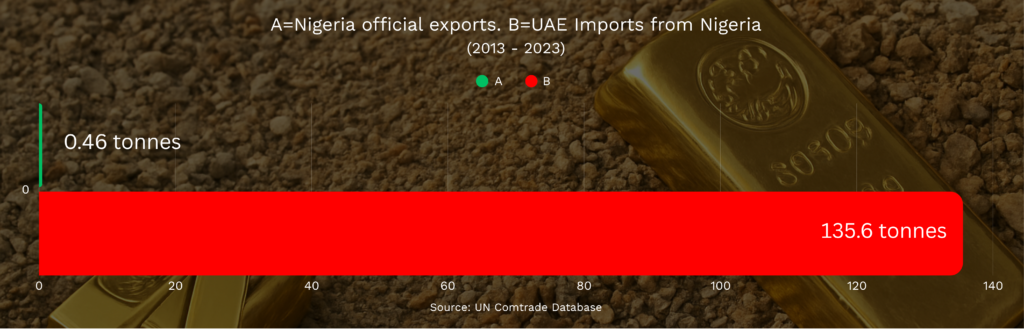
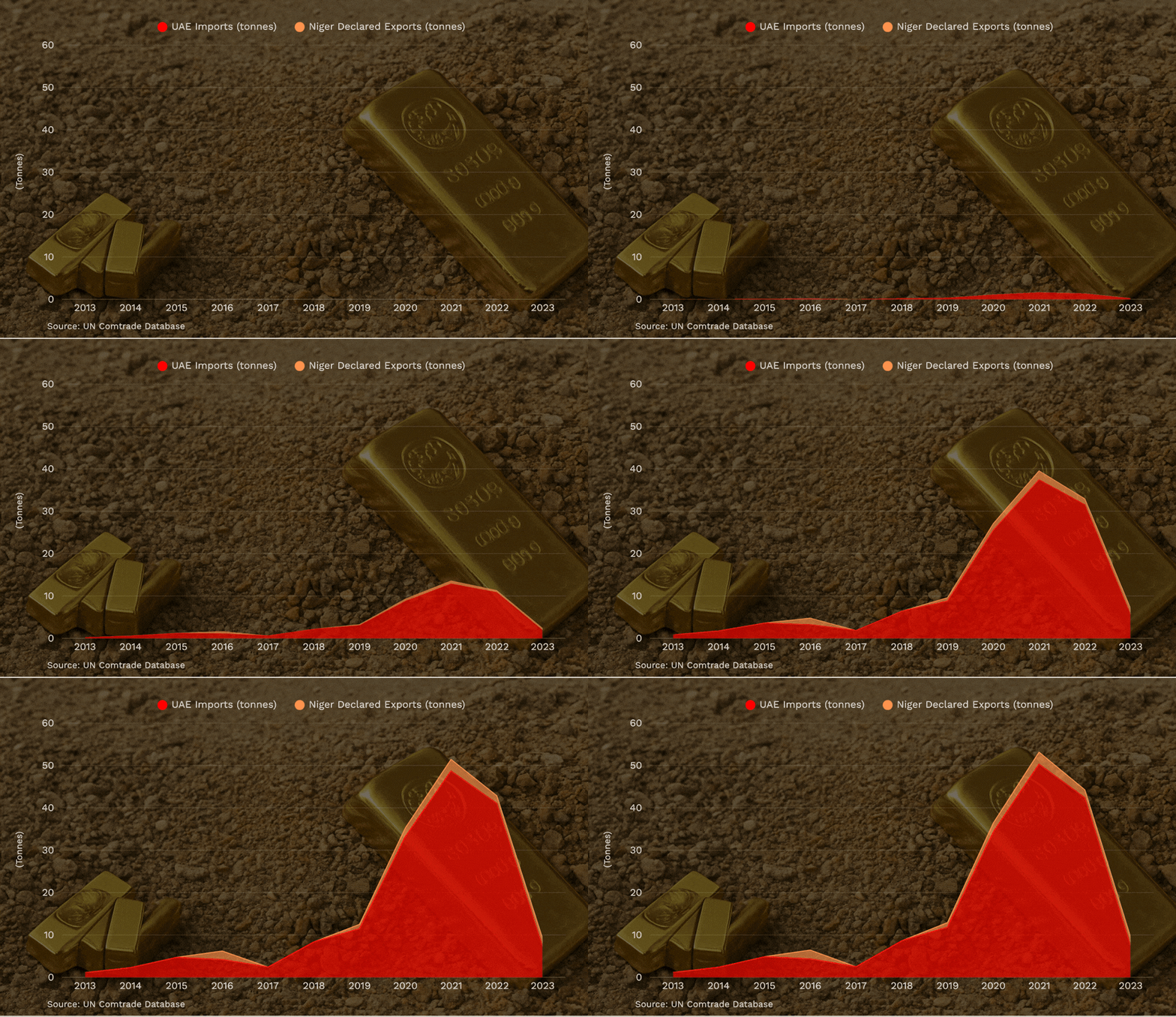
The Liberalist further scoured the United Nations Comtrade database on gold trade between Nigeria and the UAE over the last decade and found overwhelming discrepancies between Nigeria’s officially declared exports and the UAE’s reported imports. The data revealed that the UAE imported 135.6 tonnes of gold from Nigeria between 2013 and 2023. The value of this gold was roughly $19.7 billion, according to the gold price available on GoldBroker.org as of 18th May, 2026. But a check of Nigeria’s official export numbers for the same period reveals the country reported only 0.49 tonnes, worth about $71 million. This means more than 99 percent of gold trade between Nigeria and the UAE during that period did not follow Nigeria’s official channels. This finding was confirmed by the Nigerian government, as the House of Representatives Committee on Solid Minerals acknowledged that Nigeria loses up to $9 billion annually to illegal mining.
Another notable insight from the UN Comtrade data is that the UAE’s imports from Nigeria began to decline after 2016, when they recorded the highest 21 tonnes. It dropped to 18.2 tonnes in 2018 and reached 2.5 tonnes in 2021, its lowest in almost a decade. Meanwhile, imports from the Niger Republic began to rise.
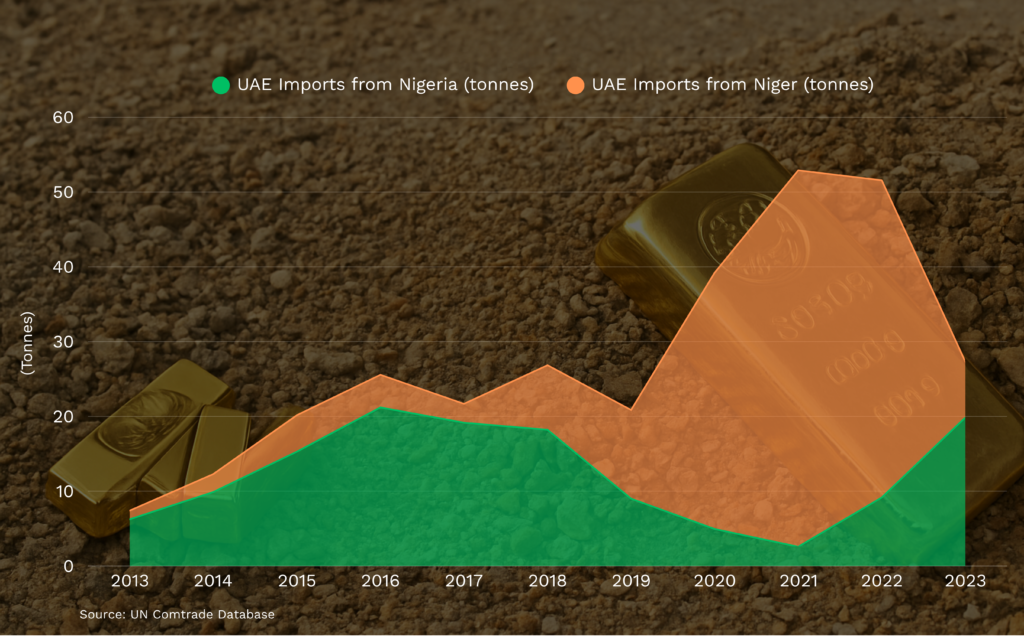
In 2016, the UAE reported gold imports of 4.3 tonnes from Niger. By 2018, that figure had doubled to 8.6 tonnes. The number peaked in 2021 at 50.3 tonnes, before declining slightly in 2022 to 42.4 tonnes.
SWISSAID says the sudden increase in Niger’s gold exports to the UAE could only mean that Nigerian exporters were using Niger as a transit hub in their trade with the UAE. One reason for this rerouting, The Liberalist found, is Nigeria’s bilateral agreement with the UAE in 2021 to track illegal movement of gold between the two countries. This speaks to why Nigeria recorded its lowest gold exports to the UAE in 2021, while Niger’s exports spiked to a record high that same year. Another reason is that it coincided with the rise of Nigerian terrorists, such as Halilu, who were diversifying into gold mining in Nigeria and trafficking into Niger.
By 2024, Halilu’s empire had grown too big for the Nigerian government to ignore. That year, the Defence Headquartres placed him on its high-value wanted list after perpetrating some of the worst atrocities against the Nigerian people and the government. In August 2021, for instance, he led his deadly gang to raid a military outpost in the Marina area of Katsina state, killing multiple soldiers and looting the military weapons.
In early January 2022, when rural communities in Anka and Bukkuyum LGAs tried to thwart his extortion, Halilu orchestrated a brutal massacre unlike anything witnessed before. From January 4 to 6, armed groups associated with him launched assaults on the villages of Rafin Danya, Kurfa, and Rafin Gero, resulting in the deaths of more than 200 civilians and the complete destruction of these farming communities through fire.
A report from the Africa Centre for Strategic Studies shows that Halilu and the network of violent criminal gangs he supplied with weapons were implicated in the abduction and deaths of approximately 9,200 civilians from 2019 to 2024. His operations in gunrunning, cattle rustling, and gold mining disrupted the social structure of the northwestern region, leading to the displacement of more than 700,000 individuals.
When Halilu and other armed groups began to emerge in the northwest forest, the Nigerian government classified them as “bandits,” a term used for groups that rob people for money. This is a distinction from the Boko Haram terrorists in the northeastern region who wage war against the government. But as local banditry began to evolve from highway robbery and cattle rustling to controlling territories, imposing levies, and even attacking military forces, the government applied to the court to proscribe them as terrorists. The proscription finally came in November 2021 when a Federal High Court in Abuja officially declared all bandit groups as terrorist organisations under the Terrorism (Prevention and Prohibition) Act. The court found the bandits’ acts to be in violation of Section 2 of the law that prohibits all acts of terrorism and consistent with Subsection 3 of the same Section that defined “Acts of Terrorism” as “an act willfully performed with the intention of furthering an ideology, whether political, religious, racial, or ethnic, and which involves, causes, or results in attack on a person’s life in the form of grievous bodily harm or death; kidnapping of a person; destruction of government or public facility… and the manufacture, possession, acquisition, transportation, transfer, supply, or use of weapons.”
Halilu amassed so much wealth and influence that he began to plot for the total control of the entire terrorist organisations in the region by bringing them under one umbrella, those familiar with his operations, including former allies and gang members, told The Liberalist. On September 10, 2024, the terrorist released an oddly prophetic video message, urging his fellow bandit leaders to halt the senseless slaughter of impoverished rural civilians, pleading instead for a unified front against the Nigerian government.
Two days later, he ran out of luck.
He was moving through the wilderness, escorted by a massive entourage of nearly 200 fighters riding in a convoy of dozens of motorcycles. Believing his location was entirely secure, he attempted to cross the Mayanchi-Anka highway near Mayanchi village in Maru, only to ride directly into a meticulously coordinated trap. One of the aggrieved terrorist leaders had worked with the military to tell on him. Acting on precise intelligence, Nigerian army ground forces, bolstered by air support, launched a devastating ambush. A fierce, chaotic firefight ensued, leaving him and scores of his elite fighters dead on the asphalt road.
The End
Although Halilu’s death could not magically end terrorism in the northwestern region. There were already more terrorist groups and leaders than the hand could count. In a research work published in 2021, Dr Murtala Rufai, a History lecturer at Usmanu Danfodiyo University, listed 62 different terrorist groups, including Halilu’s, operating in Nigeria’s northwestern and north-central regions. These groups were headed by notorious criminals like Abubakar Abdallah (Dogo Gide), Yellow Ashana, Alli Kachalla, Bello Turji, Yellow Jan-Bros, and Alhaji Ado Aleru, among others. But Halilu’s death did severely fracture the architecture of the conflict. The vacuum left behind triggered an immediate, bloody succession battle that eventually splintered his unified power and influence.
Aliyu Najaja, one of Halilu’s top fighters, and Mati Sububu, a sibling to the slain terrorist kingpin, attempted to take control of the group. And since Halilu was killed alongside several of his top lieutenants, it initially became difficult for the fighters to settle on who should take over after him. It was only natural for Mati Sububu, who had the backing of Halilu’s family, to take over. Mati reached out to Rekeb, who had originally kept his distance during the mourning period; Rekeb promised to continue working with the junior Sububu.
Just like his predecessor, Mati knows the terrain too, and he has contacts with extremists in North Africa, especially Libya and Algeria. With Rekeb’s help, Halilu’s younger brother, Mati, successfully took over the business and continued from where Halilu left off.
During his lifetime, Halilu’s men were divided into two groups. There were fighters who moved through the forests and villages, guarding territories and enforcing control over communities and mining sites. And there were gold traffickers and gunrunners who moved gold out of the country and brought weapons back in. Mati had issues with the first group because some of the fighters felt his only claim to leadership was his status as Halilu’s brother. But the gunrunners had no problem with Mati, especially since their leader, Rekeb, had paid allegiance to the new leader.
He pledged to work alongside Mati, but Najaja accused Mati and others of sidelining him from decision-making. Najaja revolted with some fighters, moved into the Gando forest between Anka and Bukkuyum LGAs, and returned to the old ways of attacking communities and imposing levies on farmland and mining sites.
“In the beginning, Najaja thought Mati Sububu, being his younger, would not be able to shoulder such responsibilities, so he [Najaja] stayed and helped Mati,” a miner slaving for the terror group in Anka, who only gave his name as Abdulmudallimu, told The Liberalist. “When Najaja learnt that other bandits, even outside the Bagega axis, were supporting and helping Mati, he revolted and wanted to be made the leader.”
A former humanitarian worker with MSF who worked for about three years in Anka admitted that the relocation of Najaja to Gando eased attacks on communities in the area. “Najaja’s presence made matters worse for Mati and his boys, but mining activities have continued,” the humanitarian worker, who asked not to be named for security reasons, said. “The scale of activities [mining] can’t be compared to when Halilu was alive, but things have continued.”
Locals told this reporter that mining activities in Bagega and Yar Matankari had reduced following Halilu’s death. A resident of Bagega, who gave his name as Isa, says Mati does not have the capacity to take over the entire operation, and that is why he focused on the main areas of Halilu’s mining operation and abandoned the others. Other bandits’ leaders have now occupied some of the abandoned areas.
“Every pit in this area was occupied by Halilu, which made it difficult for other bandits or people to penetrate the place. Our people from Bagega used to go and work in large numbers. When Halilu died, it was only after about four months that our people resumed working in those places,” says Isa. “Najaja is staying around Makakari, and he has another camp in Maigalma. I’m not sure whether he is into mining now, but I know it’s been difficult for Mati to enter these areas because of Najaja’s presence. Na Atama, another bandit leader, now controls areas on the threshold of Sunke Forest from the Maigalma axis.”
Halilu had the terrible realisation that in the lawless forests of Northwest Nigeria lie gold, and in the vast desert of the Sahel scatter weapons, enough to fund and sustain his criminal enterprise. This was true during his lifetime, and even truer after his death.
____________
*To protect their identities and ensure their safety, the names of gold miners mentioned in this story have been changed.