
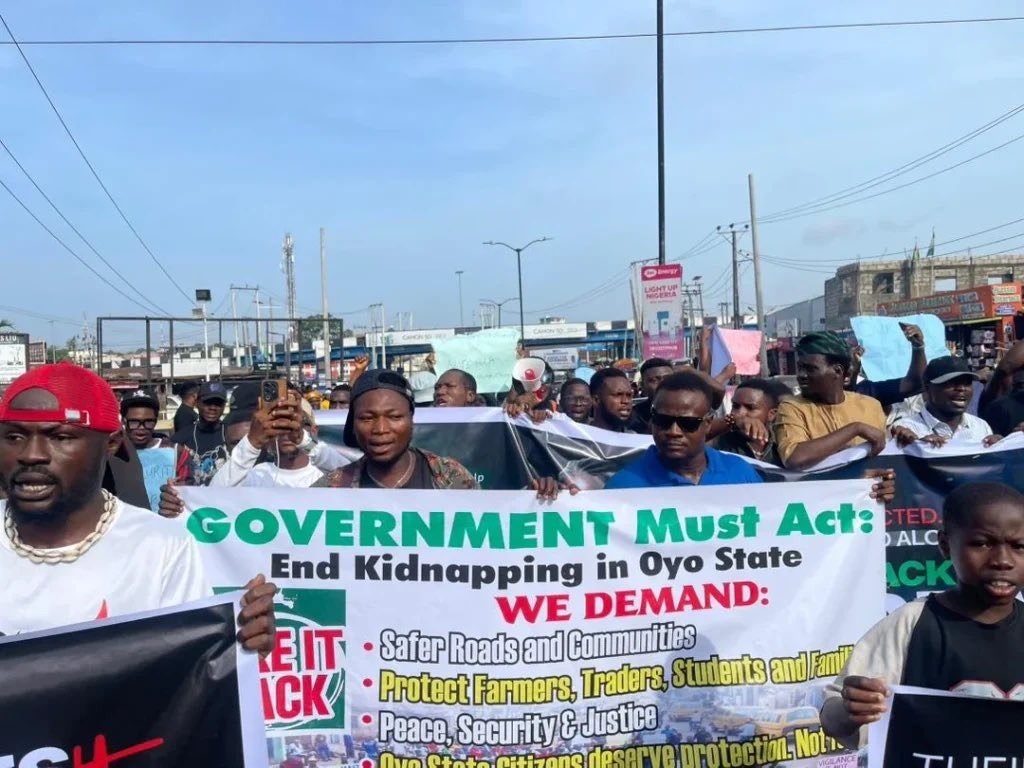
Last month, gunmen attacked a school in Ahoro-Esinele community of Oyo state and abducted dozens of students and teachers. Beyond the immediate security implications, the incident signals that insecurity in Nigeria is becoming an affront to personal liberty. When citizens cannot travel, attend school, or go about their daily lives without fear of violence, violence fundamentally compromises their freedom.
For many Nigerians, freedom once meant democracy, elections, and constitutional rights. Today, freedom feels more practical and far more fragile. Freedom is Haruna travelling without the fear of abduction. It is Chima sending his children to school and expecting their safe return. It is Tade driving on Nigerian highways without rehearsing emergency phone calls in his head. True freedom means living without a constant calculation of danger, a taste of freedom that is quietly disappearing.
People often see Oyo as one of the relatively peaceful states in the country. The tragedy of the school kidnapping in Esinele community was not simply a case of criminals abducting children. Nigeria has unfortunately witnessed too many such incidents. Public shock now competes with public exhaustion. What made the moment particularly different and quite revealing was how Nigerians responded to it.
Nigerians immediately began calling for national prayers, private security sprang up everywhere, and discussion around safer schools began. Political parties conducted primaries, and party members voted in the process. Citizens adjusted psychologically within hours, almost instinctively. That adjustment is where the danger lies. How does a society become so familiar with fear that abnormality begins to feel normal?
For many Nigerians, the fear is now a lived reality. How could a normal act of sending a child to school, or resuming at your place of work, now come with a burden of anxiety? For years now, interstate travel has caused anxiety for many citizens; farmers think twice before going to their farmlands, and business owners calculate the risks before opening shops. Nigerians facing these new realities now have to organise their lives around fear rather than opportunity.
The damage goes beyond economics or politics. Over time, insecurity changes how citizens think, behave, and relate to society itself. Once people begin organising their lives primarily around survival rather than opportunity, they fundamentally alter the meaning of freedom. Thomas Hobbes once argued that the state bears the primary responsibility to protect citizens from violence and disorder. Without security, every other right becomes unstable. One may possess freedom constitutionally but lack it in practice. Nigeria exemplifies this contradiction.
Citizens still possess rights on paper, but many can no longer exercise them. How free is a trader who fears interstate travel, a student whom school insecurity frightens, or a farmer whom violent attacks prevent from entering farmland? Gradually, insecurity transforms citizens into cautious survivors. For me, the most disturbing aspect of the crisis is how deeply we have normalised this into our national consciousness. We now casually identify “dangerous roads” the way people discuss traffic routes. People now associate some states or even communities with kidnapping risks.
Friends and families routinely track journeys in real time, not out of affection alone, but out of genuine fear. Conversations that should sound alarming now sound normal. What insecurity destroys first is confidence. Once people lose confidence in safety, they restrict their movement, businesses suffer, and even ordinary social interactions begin to change. This explains why insecurity affects even those whom criminals never directly attack, and how fear radiates through our social interactions. A kidnapping in Oyo changes the behaviour of parents in Ogun; violence in Kaduna alters travel decisions in Lagos; attacks in Benue influence food prices nationwide. Even people far from the violence begin to change how they live.
Nigeria, the giant of Africa, remains one of Africa’s most energetic societies; her citizens are entrepreneurial, mobile, ambitious, and deeply adaptive people. However, insecurity slowly suffocates those sterling qualities. Wherever uncertainty dominates daily life, certain things will happen: people stop taking risks, businesses slow down, and survival becomes the priority.
The long-term implications worry me the most, especially for younger Nigerians. We are raising a generation that may begin to see instability as normal. Many young people are already learning survival instincts before civic confidence. That psychological inheritance may outlive the violence itself.
Hannah Arendt, a German philosopher, once warned that fear weakens public life because frightened societies eventually retreat inward. Citizens withdraw from participation, trust declines, and collective purpose begins to erode. Nigeria increasingly shows symptoms of that retreat. People avoid public spaces more cautiously, communities increasingly view unfamiliar faces with suspicion, and citizens no longer rely on government’s institutions but on private security arrangements. Rich Nigerians who can afford it now buy layers of personal protection, while poorer citizens absorb vulnerability directly.
What emerges from all this is unequal freedom, because insecurity ultimately creates two nations within one country: those who can afford protection and those who cannot. The Oyo incident, therefore, should not merely provoke temporary outrage or placard displays, as Nigerians have done after several previous tragedies, including the Chibok abductions. It should force a deeper national reflection about what Nigerians are slowly losing beneath the headlines. Security does not simply mean preventing attacks; it means preserving the conditions that allow ordinary people to live freely.
No society truly progresses when parents fear schools, travellers fear roads, farmers fear land, and citizens fear uncertainty more than poverty itself. In the end, insecurity does more than take lives. It changes how people live. And when citizens begin organising their entire lives around fear, freedom itself starts to disappear.
____________
Oluwatosin Ogundeyi is the Executive Director of the Institute for Free Market and Entrepreneurship West Africa. He is based in Ibadan, Nigeria. He can be reached at ogundeyi@ifreme.org.