
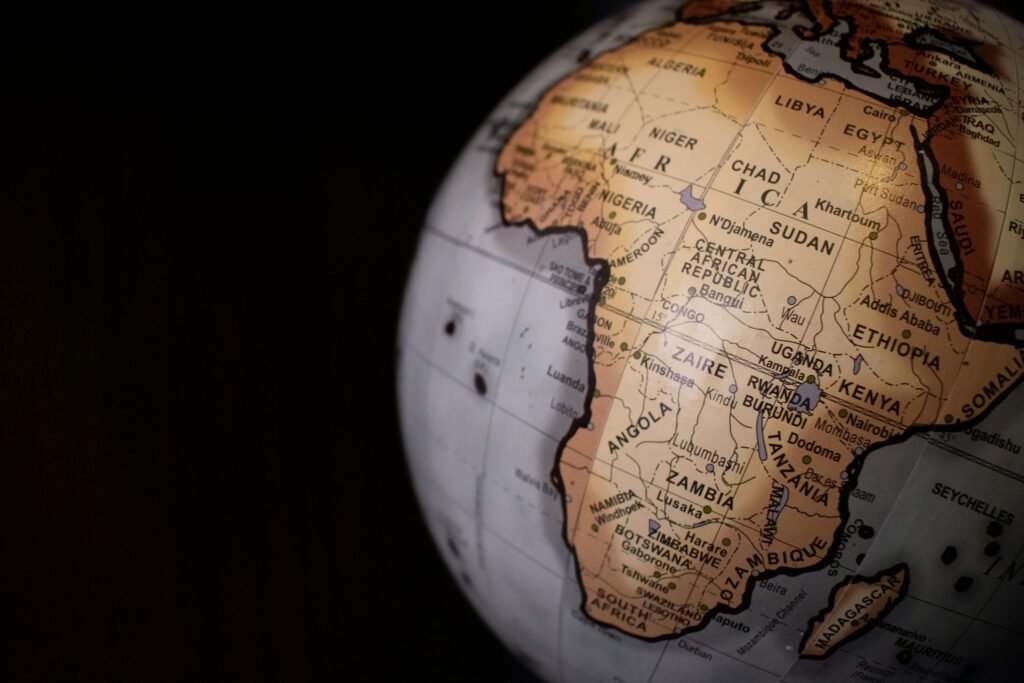
For four centuries cartographers have done Africa a disservice. On a Mercator map, the continent looks roughly the size of Greenland, while it is in fact 14 times larger. On September 5th the United Nations General Assembly voted 164 to one to encourage the world to retire that distortion in favour of the Equal Earth projection, which draws Africa at something closer to its true, enormous scale. Though the continent celebrates this feat, it’s difficult to see how this links to overall wellbeing for Africans.
That is worth dwelling on, because the map’s defenders have made a bigger claim than they perhaps intend: that Africa has been underestimated because it has been drawn too small, and that correcting the drawing corrects the underestimation. It is a tidy theory. It also happens to be testable, and the test fails. By any measure that matters to a person trying to earn a living, Africa is not merely perceived as poor. It is disproportionately, measurably so, and the reasons have nothing to do with the shape of a map.
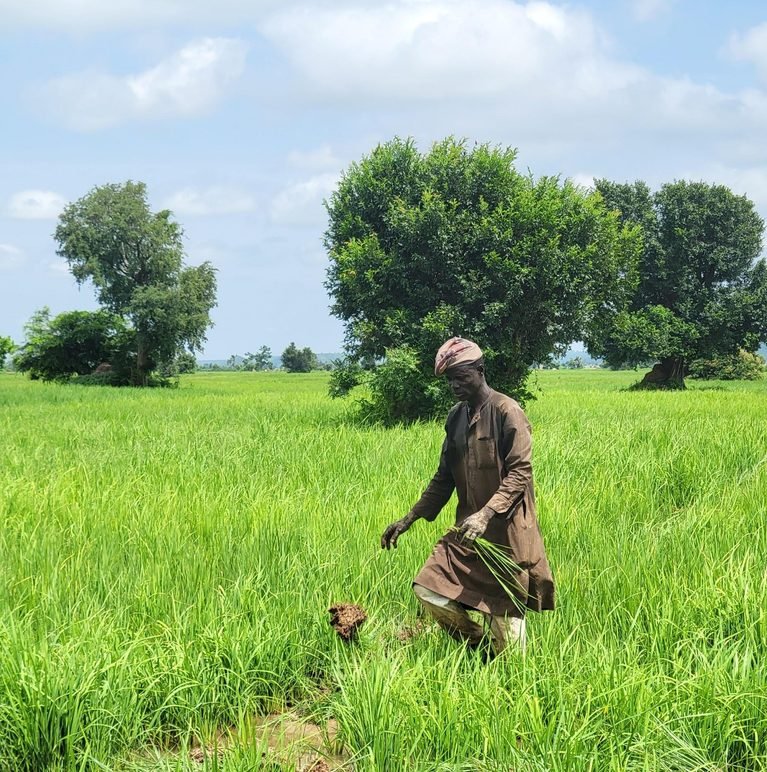
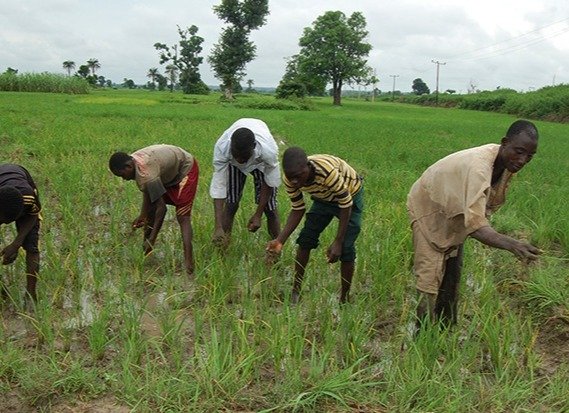
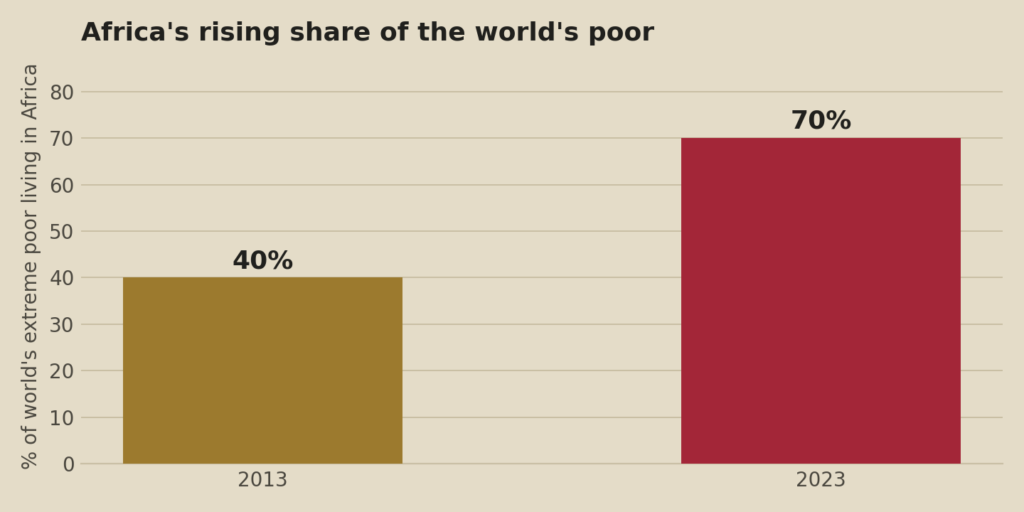
Start with the poverty. According to the World Bank’s estimates, roughly 830 million people were living in extreme poverty in 2025. The apex bank reported that in 2013, half of the world’s poor lived in South Asia and East Asia & the Pacific. By 2023, that number had dropped to just 15 percent. In contrast, a decade ago, four in ten of the world’s extremely poor lived in Africa; today the figure is seven in ten, even as poverty rates fell sharply in South Asia, East Asia, and Latin America. Rural sub-Saharan Africa holds a tenth of the world’s population and more than half its extreme poor, up from a third in 2013.
Now contrast the poverty data with the continent’s minerals. Africa sits on around 30 percent of the world’s proven reserves of the metals that power the energy transition, according to the Mo Ibrahim Foundation’s Africa Critical Minerals Report. Congo alone produces more than 70 percent of the world’s mined cobalt. Guinea holds a quarter of the world’s bauxite.
A continent with a fifth of humanity, sitting on nearly a third of its mineral wealth and most of its spare farmland, ought by nature to be rich. That it instead houses the bulk of the world’s poor is not an accident of geography so much as it is a flaw in the economics.
Part of the flaw is where the value goes once it leaves the ground. An OECD study of Africa’s critical-minerals trade found that roughly a quarter of the continent’s mineral exports leave as raw ore, and nearly three-quarters more leave only lightly processed. Almost none is refined at home. Congo digs the cobalt; China refines more than 60 percent of the world’s supply.
Why doesn’t Africa simply build the smelters and refineries itself and keep the margin? The uncomfortable answer is that it tries, and the attempt routinely runs into a problem that a bigger map cannot solve: the basic difficulty of operating an industrial business on the continent.
Doing Business Is Hard
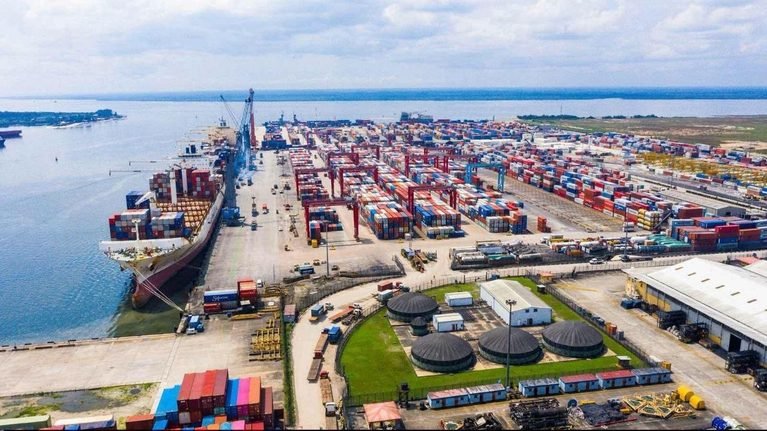
Take the most ambitious industrial project built in Africa in a generation. Aliko Dangote, Africa’s richest man, set out in the mid-2010s to build a Lagos oil refinery originally estimated at $12–14 billion. By the time it opened in 2024, the bill had reached roughly $19–20 billion, and Mr Dangote has since said that securing land title and the lengthy sand-filling it required, alone, stalled the project for nearly five years. To get the plant running at all, his company had to become its own infrastructure ministry. It built a private deep-water port and jetty, roughly 120km of subsea pipeline, its own roads, its own water-treatment plant, and a 435-megawatt power station big enough to electrify five Nigerian states. Mr Dangote is now applying to build a second seaport nearby, because the existing public ones cannot handle his cargo either.
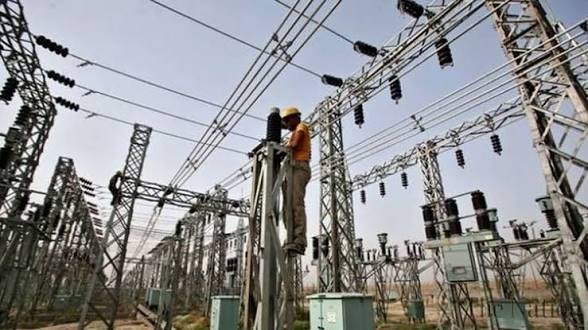
Power is the recurring villain in this story, and not only in Nigeria. Ghana’s only aluminium smelter, Volta Aluminium Company Limited (VALCO), has spent 2026 running at somewhere between a fifth and two-fifths of its capacity, hobbled by an unreliable grid, ageing equipment and thin working capital, despite Ghana having bauxite in the ground and a government strategy explicitly built around processing it at home rather than shipping it raw. In Zambia, Africa’s second-largest copper producer, the Chambishi smelter cut a fifth of its output in 2024 after prolonged drought lowered water levels feeding the hydropower dams that supply roughly 87 percent of the national grid; other copper processors in the country reported production falling well short of guidance for the same reason.
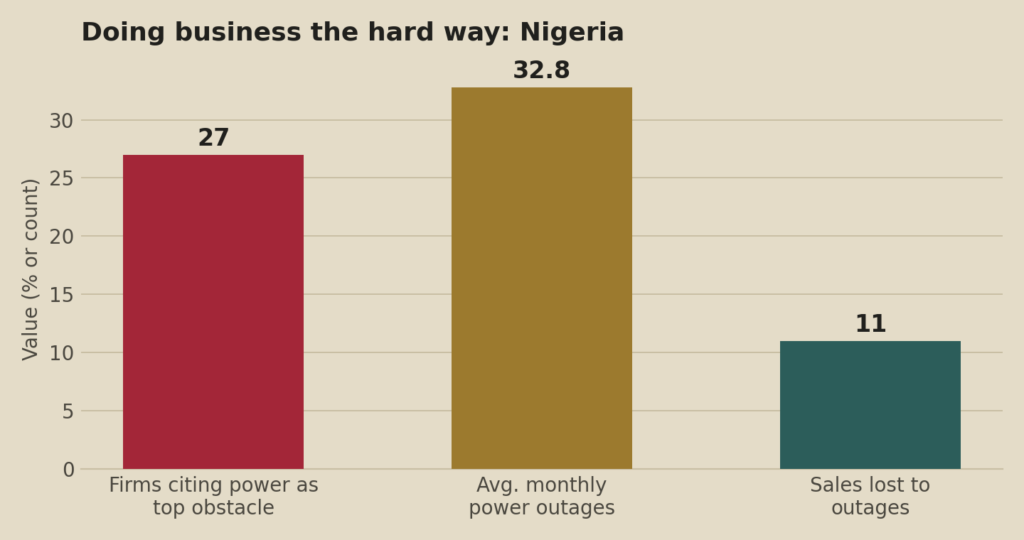
This is not a story confined to a handful of unlucky mega-projects. It shows up in the aggregate data too. A World Bank Enterprise Survey of firms across Nigeria found that 27 percent named electricity reliability as the single biggest obstacle to doing business, with the average firm reporting nearly 33 outages a month and losing about 11 percent of its sales value as a result. Across sub-Saharan Africa more broadly, a single additional unit of outage frequency and duration cut annual firm sales by hundreds of dollars on average, hitting small firms roughly four times harder than large ones, since small operators are the least able to afford a diesel generator as a backup and self-generated power typically costs close to four times as much as grid electricity when they can. One continent-wide estimate puts the resulting cost at 2.86 percent of GDP for every 1 percent increase in outage duration, worth roughly $28 billion in lost output a year.
The World Bank’s newest cross-country scorecard, Business Ready, found this gap to be smallest in high-income economies and greatest in sub-Saharan Africa and the Middle East. And a few exceptions prove the point. Rwanda registers a new company faster than the global average of 32 days for domestic firms and ranks among the best performers worldwide on several Business Ready measures, proof that the constraint is institutional, not geological or climatic. Nothing about Rwanda’s soil or rainfall differs fundamentally from its neighbours’. Its government simply decided to make starting and running a business easy.
Why Trade with Neighbours
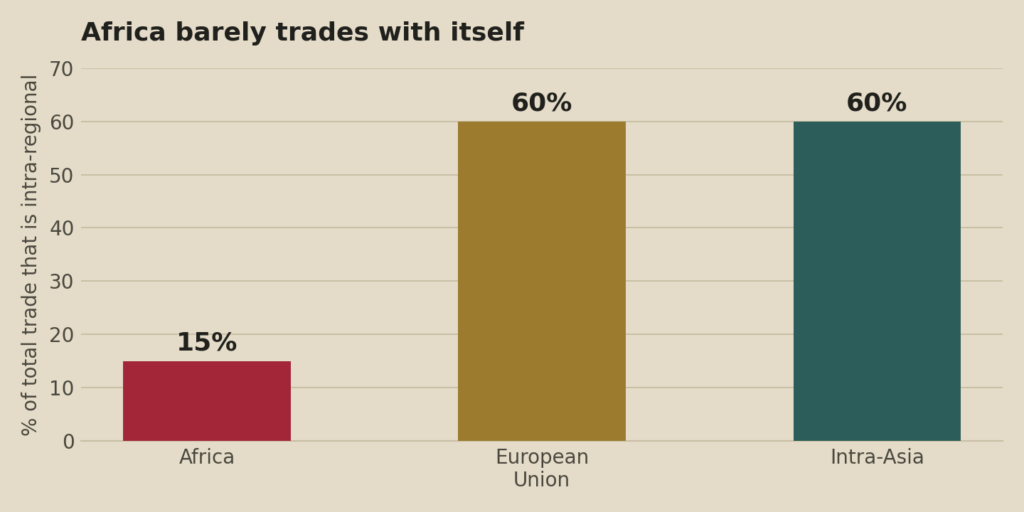
The part of this story that gets the least attention is the one closest to home: Africa barely trades with itself. Intra-African trade runs at around 14–15 percent of the continent’s total, according to the UN Economic Commission for Africa, against roughly 60 percent for both the European Union and intra-Asian trade. Fifty-four countries sit side by side and mostly sell past one another to Europe, to China, and to the Gulf.
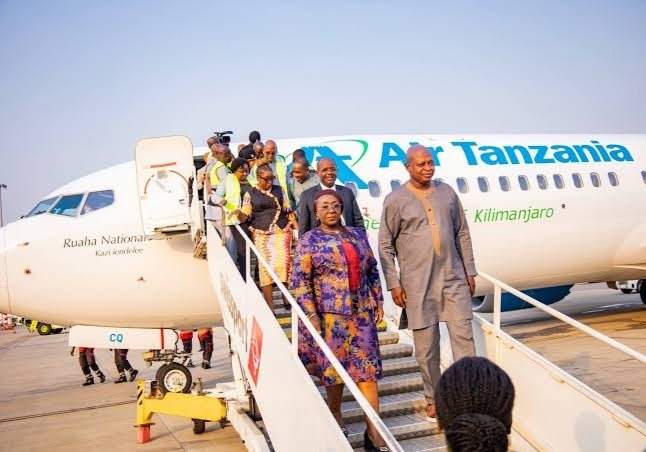
Borders are a large part of why. The African Union’s Protocol on the Free Movement of Persons, signed by 32 member states, was meant to do for African mobility roughly what the Schengen Agreement did for Europe’s. Seven years on, it has been ratified by four countries, namely Mali, Niger, Rwanda and São Tomé and Príncipe. But 15 ratifications are required for it to take legal effect.
Visas tell an even less flattering story, and one getting worse rather than better. The Africa Visa Openness Index, compiled jointly by the African Development Bank and the AU, found that of 54 countries assessed in 2025, only 11 improved their score, even as the share of intra-African travel requiring a visa in advance rose from 47 percent to 51 percent, the first such increase in years. Countries like Nigeria, Mauritania and Somalia have swapped visa-on-arrival for electronic visas that still require approval before departure.
Some governments are choosing otherwise, which is instructive. Kenya spent 2024 near the bottom of the visa-openness rankings after its electronic travel authorisation was reclassified as a visa. In 2025, it scrapped the visa requirement altogether for almost every African citizen and jumped to third place. Rwanda and The Gambia have topped the index for years with their visa-free policies. None of these countries needed a bigger map to make the decision. They needed a government willing to open a border and, in Rwanda’s case, willing to make starting a business quick as well.
The financial benefits of doing both are not conjecture. The World Bank estimates that full implementation of the African Continental Free Trade Area could lift African exports by almost 29 percent and lift 30 million people out of extreme poverty by 2035, mostly through trade between African countries themselves. None of that trade will move, however, if the trucks carrying it sit idle for want of a visa.
This is not to say the new map is worthless. Perception has real effects, and a continent habitually drawn smaller than it is will be habitually taken less seriously than it deserves. But perception was never Africa’s binding constraint; policy is. The world has agreed that Africa is bigger than it looks. Whether Africa acts like it is a matter of visas and tariffs, none of which show up on any map, however accurately drawn.