
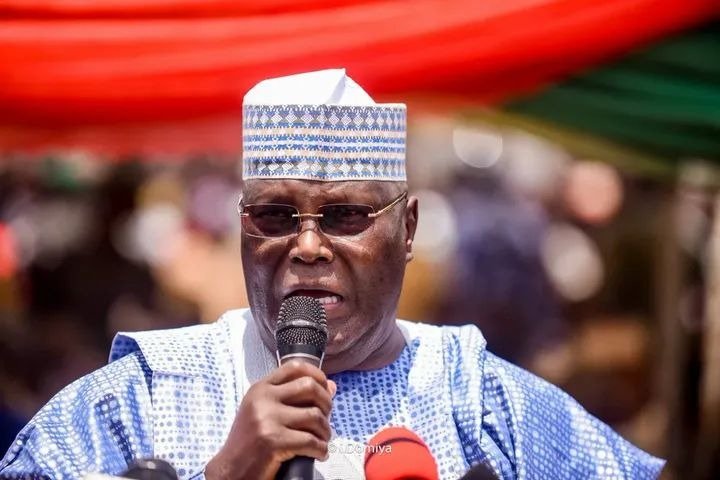
In late August, Atiku Abubakar, African Democratic Congress (ADC) presidential candidate, said he would reopen Nigeria’s land borders if elected president. This promise asserted that the country’s borders are closed, a claim The Liberalist found to be misleading.
The African Democratic Congress presidential candidate made the pledge while addressing supporters in a viral video, saying that “the Northern states is bordering Cameroon, Chad, Niger, Benin Republic. And you close all those borders. All our young men who are doing trading between these countries, they carry goods across, they do this and that, all what we call transborder trade is a legitimate business. So, I said I am going to reopen the borders and I will,” he added.
Nigeria’s Land Border Closure
A review of Nigeria’s recent border policy timeline exposes the error in Atiku’s rhetoric. The closures began in August 2019, when former President Muhammadu Buhari abruptly shut all land borders to curb smuggling and force agricultural self-sufficiency, a move that devastated the regional economy.
Subsequent directives steadily reversed that blanket blockade. On December 16, 2020, the Buhari administration reopened four major borders: Seme in Lagos, Illela in Sokoto, Maigatari in Jigawa, and Mfum in Cross River. In April 2022, the government unlocked additional four, including Idiroko in Ogun and Kamba in Kebbi states.
The only recent disruption stemmed from regional geopolitics rather than domestic trade policy. Following the July 2023 military coup in Niger Republic, the Economic Community of West African States (ECOWAS) enforced sanctions, prompting President Bola Ahmed Tinubu to seal the northern frontiers. Yet in March 2024, after ECOWAS lifted those sanctions, Tinubu ordered the immediate reopening of all land and air gateways to Niger.
Most recently, in February 2026, the Nigeria Customs Service restored full trade operations along the Tsamiya–Segbana–Kamba borders.
Atiku’s claim that Nigeria’s land borders remain closed conflicts directly with present reality. The physical gates legally stand open. The presidency, through Minister of Interior Olubunmi Tunji-Ojo, also clarified this factual blunder immediately, dismissing the pledge as a recycled campaign slogan and insisting the administration has already revived cross-border commerce.
But Atiku Is Not Entirely Wrong
A legally open border does not guarantee unhindered trade, and such restrictions undermine the very aims of an open-border policy. For instance, while the gates at Seme and Illela are open, the corridors feeding them remain distorted by predatory checkpoints and rent-seeking officials. Legitimate traders must navigate an extortionate bureaucracy and a security apparatus designed to extract revenue rather than facilitate commerce.
Onyekachi Ojinma, Chairman of the Association of Nigerian Licensed Customs Agents (ANLCA) Seme Chapter, quantified this operational barrier. He said traders run a gauntlet of over 50 checkpoints, including authorized and illegal ones between Badagry and the Seme border post.
“The government has officially opened up the border posts, but there is no business there for now because of bad roads, security agencies and multiple checkpoints. By the time cargoes are brought through the border, extortion must have killed the owner,” Ojinma lamented in 2022.
Trade experts note that militarised and hyper-taxed transit routes do not defend local industries. They fuel domestic inflation and siphon wealth from consumers into the pockets of corrupt state agents. Dr. Muda Yusuf, Chief Executive Officer of the Centre for the Promotion of Private Enterprise (CPPE), repeatedly stated that dual duty collections and duplicative inspections drive legitimate importers away from land routes entirely, dismantling the core purpose of regional economic integration.
Other regions prove that genuine open trade unlocks significant economic growth. For instance, within the East African Community (EAC), member states eliminated non-tariff hurdles and launched a Single Customs Territory, transforming cross-border trade across Kenya, Uganda, and Tanzania. Between 2020 and 2024, this unified customs framework drove a 180 percent surge in regional trade volumes, slashed operational business costs by 70 percent, and cut cargo transit times from 21 days to under four.
Analysts say when goods move without friction, businesses tend to scale, eliminating transaction costs and stabilising food supplies.
_________________
This article was produced as part of the Liberalist Centre’s Journalism for Liberty Fellowship, with funding from Liberty International.